Categories
Uncategorized

Difference Between Residential and Commercial Conveyancing

A house purchase can feel stressful enough. Add a shopfront, warehouse, medical suite or development site into the mix, and the legal work changes quickly. The difference between residential and commercial conveyancing is not just the type of property involved – it is the level of risk, the scope of due diligence, and the legal and commercial issues that need to be checked before contracts are signed.

For buyers, sellers, investors and business owners in New South Wales, that distinction matters. A residential purchase usually follows a more standard path. A commercial transaction often demands deeper investigation into leases, zoning, GST, land use, financing structures and the practical way the property generates income. If those issues are missed early, the cost can be significant.

What is the difference between residential and commercial conveyancing?

At a basic level, residential conveyancing deals with homes and other property used primarily for living. That includes houses, units, townhouses and vacant residential land. Commercial conveyancing deals with property used for business or investment purposes, such as retail premises, offices, industrial sites, mixed-use buildings and some development sites.

The legal process in both matters still involves reviewing the contract, carrying out searches, advising on risk, managing exchange and settlement, and making sure title transfers properly. The key difference is that commercial conveyancing usually requires broader legal analysis and stronger commercial judgement. There are often more moving parts, fewer standard protections, and greater pressure on the parties to investigate the deal for themselves.

In practice, residential transactions tend to be more regulated and more familiar to everyday buyers and sellers. Commercial transactions are often more heavily negotiated and can turn on the fine detail of the contract, the lease structure, planning controls, tax treatment or the buyer’s intended use of the site.

Why residential conveyancing is usually more straightforward

Most residential transactions in NSW follow a comparatively predictable structure. The contract is still important, and it still needs careful legal review, but many of the issues are common across matters. Buyers usually want to know whether the property has clear title, whether there are easements or restrictions, whether council approvals are in order, and whether there are strata concerns if the property is part of a scheme.

There are also consumer protections built into many residential transactions. Cooling-off rights may apply in private treaty sales, subject to the usual exceptions. Disclosure obligations are generally clearer. The due diligence process is still essential, but the transaction is often centred on occupation and lifestyle rather than income generation or business operations.

That does not mean residential conveyancing is simple in every case. Problems can still arise with unapproved works, encroachments, strata defects, sewer diagrams, caveats, family law issues, probate sales or delayed finance. But compared with commercial matters, the range of legal and financial variables is usually narrower.

Why commercial conveyancing is more complex

Commercial conveyancing often starts with a different question: not just “what am I buying?” but “how does this property function as an asset?” That changes the legal review.

A commercial buyer may need advice on existing leases, rental income, outgoings, fit-out obligations, rent review clauses, options to renew, make good obligations, development restrictions and whether the current use is lawful under local planning controls. Zoning becomes highly relevant. So does whether the property can be used in the way the buyer intends.

The contract itself is also less likely to be treated as a standard form exercise. Special conditions can significantly alter risk. The buyer may be purchasing subject to lease, relying on income figures, negotiating access rights, or working through due diligence periods and finance approval conditions. GST, going concern treatment and stamp duty implications may also need detailed advice.

This is where commercial conveyancing becomes less about processing a transfer and more about identifying legal and commercial exposure before the commitment becomes binding.

Contract terms are not treated the same way

One of the clearest points of difference between residential and commercial conveyancing is the role of contract negotiation.

In a typical residential matter, there may be some room to negotiate special conditions, settlement dates or inclusions, but many transactions still proceed on relatively familiar terms. In commercial matters, the contract can be much more heavily tailored. A poorly drafted clause about access, GST, lease assignment, default, deposit release or conditions precedent can materially change the deal.

For example, a buyer of a commercial premises may think they are acquiring vacant possession, only to find the contract preserves a tenancy or licence arrangement. A seller may assume a lease is secure, while the document reveals rights that reduce the certainty of future income. These are not minor drafting points. They affect value, finance and operational planning.

Due diligence goes much further in commercial matters

The difference between residential and commercial conveyancing becomes even clearer during due diligence.

For residential property, due diligence usually focuses on title, planning certificates, drainage, strata records where relevant, council matters and any visible or disclosed defects. For commercial property, due diligence can extend well beyond that. It may include reviewing lease documents, tenant payment history, outstanding disputes, planning restrictions, contamination risk, fire safety compliance, building classifications, service arrangements, development approvals and whether there are notices or orders affecting the site.

If the property is being bought as an investment, the quality of the lease is often as important as the building itself. If the property is being bought for business use, the legal question is whether the site can actually support the intended operation. A café, childcare centre, medical practice or warehouse each raises different planning and compliance issues.

This is where local NSW knowledge matters. Council processes, zoning controls and land use rules can vary significantly depending on the location and the type of premises involved.

Finance, tax and settlement risk are different

Residential buyers are usually focused on loan approval, settlement timing and practical issues like inspections and moving dates. Commercial transactions often involve more layered finance arrangements and more tax considerations.

Lenders may impose stricter conditions for commercial property. Valuation methodology can differ. Lease income may affect lending decisions. The structure of the purchasing entity, whether an individual, company, trust or SMSF, can also affect the advice required.

Tax is another area where commercial matters can become more technical. GST may apply, not apply, or be dealt with under a going concern arrangement depending on the transaction structure. That requires careful review. Errors in this area can affect the amount payable at settlement and create avoidable disputes afterwards.

Settlement itself may also carry more operational risk in a commercial matter. There can be rent adjustments, outgoings adjustments, bond transfers, lease handovers and post-settlement obligations that do not usually arise in a straightforward residential purchase.

The stakes are often higher, but not always in the same way

Residential buyers are often making an emotionally significant decision. For many people, it is the family home and the largest personal purchase they will make. The legal work needs to protect that position carefully.

Commercial buyers and sellers are usually dealing with different pressures. The stakes may involve business continuity, rental return, development feasibility or long-term investment performance. Even a small issue in the contract or lease can affect the asset’s value and income potential.

That said, one is not automatically more important than the other. A first home buyer can be just as exposed financially as a commercial investor if proper advice is not obtained early. The real point is that the nature of the risk is different, so the legal approach has to be different too.

Which type of conveyancing do you need?

That sounds obvious, but some transactions sit in the middle. A mixed-use property, a shop with an upstairs residence, vacant land with uncertain zoning, or a property intended for redevelopment may not fit neatly into a basic residential or commercial category.

That is why it helps to get advice before signing, not after. The label used by the agent or seller does not always reflect the legal issues that matter most. The intended use, the planning controls, the contract terms and the tax position all need to be looked at together.

For clients across Sydney and NSW, GKE Lawyers regularly sees matters where a transaction appeared straightforward at first glance but involved more complexity once the documents were properly reviewed. Early advice can clarify whether the deal is suitable, what risks need to be negotiated, and whether the timing and cost still make commercial sense.

A good conveyancing process is not just about getting to settlement. It is about making sure you understand what you are buying or selling, what could go wrong, and what needs to be dealt with before the deal becomes difficult to unwind. If a property matter involves more than a standard home purchase, the safest approach is to treat it that way from the start.

Categories
Uncategorized

Top 5 gslegal.sydney Alternatives 2026

Choosing a law firm for property conveyancing, estate planning, or business legal advice often means dealing with opaque fee structures or the need to coordinate separate providers for notarial and overseas document work. Many Sydney practices still lack fixed-fee transparency or force clients to manage international document notarisation through external specialists, making linked matters slower and more expensive. This comparison details service scope, fee clarity, and specialist offerings across five Sydney law firms so you can select one that handles your unique legal situation without fragmented billing or handovers.

Table of Contents

GKE Lawyers

https://gkelawyers.com.au

At a Glance

Fixed-fee quotes plus no-win, no-fee arrangements for certain personal injury claims are offered up front, which reduces billing uncertainty for clients in Sydney. The firm also handles international document notarisation and legalisation alongside local property work.

Core Features

GKE Lawyers is a full-service Sydney law firm covering property law and conveyancing, commercial law, family law, litigation and dispute resolution, wills and estates, motor accident claims, personal injury, and notarial services.

They provide fixed-fee quotes and transparent fee discussions, offer specialist services in international document notarisation, and work under the NSW Torrens system for property title registration matters.

The team handles both local NSW matters and international authentication through notary and apostille processes.

Key Differentiator

The practice combines broad legal expertise across core practice areas with specialist international notarisation and a visible pricing approach in Sydney. That mix makes the firm practical for matters that cross domestic conveyancing, estate work and overseas document requirements.

GKE’s local knowledge of Sydney and New South Wales procedures reduces handover friction for property and probate tasks that must meet state registration rules.

Pros

  • The firm advertises high client satisfaction and longstanding client relationships, which suggests repeat work and continuity of counsel rather than one-off matters.

  • Experienced multi-disciplinary team: Solicitors with strengths across property, family, litigation and personal injury mean fewer referrals and a single point of contact for linked matters.

  • Transparent fees: Upfront fixed-fee quotes and frank discussions about costs make budgeting for conveyancing or estate planning simpler than open-ended hourly arrangements.

  • Specialist international services reduce extra steps. If you need apostilles, notarisation or legalisation for documents headed overseas, the firm handles those processes directly.

  • Tailored advice for case-specific outcomes rather than templated forms; useful when a property transfer, will or dispute carries unusual facts.

Cons

  • Online detail on specific pricing brackets and independent client ratings is limited, so prospective clients should request a written fee estimate and ask for references before engaging.

Who It’s For

Sydney individuals and local businesses needing specialist legal advice across property transactions, family law, commercial matters, wills and estate planning, or international document notarisation. Ideal for clients who value a local team that discusses fees up front and manages linked legal steps.

Unique Value Proposition

Fixed-fee quotes combined with no-win, no-fee arrangements for qualifying personal injury matters make GKE Lawyers useful when you want fee predictability and contingency options together. That billing clarity, paired with in-house notarial capability, reduces the number of separate providers you must coordinate.

This means a Sydney household arranging a property transfer, a will and overseas document legalisation deals with one firm rather than juggling a solicitor and an external notary.

Real World Use Case

A Sydney family sells a property, updates wills, and needs several documents legalised for overseas residency applications. GKE Lawyers manages the conveyancing under NSW title procedures, prepares estate documents, and completes notarisation and apostille steps, providing fee estimates before any work starts.

Pricing

Specific fees are not listed publicly. The firm offers fixed-fee quotes for discrete matters and advertises no-win, no-fee arrangements for relevant personal injury claims. Ask for a written quote and scope breakdown during the initial engagement discussion.

Website: https://gkelawyers.com.au

https://sydlegal.com.au

At a Glance

The firm advertises over 40 years of combined legal experience and a 2008 founding date, trading on steady continuity rather than rapid expansion. Multiple office locations across NSW and a focus on plain spoken advice are emphasised in its materials.

Core Features

The practice groups cover commercial law, litigation, estate planning, family law, conveyancing and intellectual property under one roof. Each matter is handled by a team made up of principals, partners, special counsel and solicitors, with support staff assigned to client administration.

The firm promotes a client-centric approach that aims for close collaboration and tailored legal strategies. Offices around NSW provide in-person availability for hearings, signings and notarial acts.

Key Differentiator

What sets Sydney Legal Advisers apart is the emphasis on personalised, client-focused service delivered through a traditional law firm model. The pitch is straightforward communication and a willingness to tailor strategy to the client rather than forcing standard templates.

Pros

  • Experienced team. The structure and seniority of staff means you are likely to deal with seasoned lawyers rather than trainees for substantive matters. That experience claim above supports this positioning.

  • Broad scope of services. You can run property conveyancing, IP advice and dispute work through the same firm which reduces the need to coordinate multiple providers.

  • Client collaboration. The firm highlights regular contact, plain language explanations and named points of contact, which helps where you need frequent updates during a dispute or settlement negotiation.

  • Local accessibility. Multiple NSW offices mean you can attend meetings or have documents witnessed in person without travelling to the CBD for every appointment.

Cons

  • Jurisdictional limit. The firm is limited to NSW practice so interstate or international matters will need referral or separate counsel.

  • Not a substitute for free online advice. The firm provides legal information but will not offer enforceable legal advice without a formal consultation and retainer.

  • Implementation gaps for hybrid projects. For work requiring online dispute resolution platforms or large scale national rollouts, you will need external specialists.

When It May Not Fit

If you need an online dispute resolution service or representation outside NSW, this firm will not be the right match. Also, if you prefer automated, template-only document production without lawyer input, the personalised model will cost more and take longer.

Who It’s For

Individuals and small to medium sized businesses in NSW who want experienced lawyers and in person access. Good for clients who value clear communication, local offices and a single firm handling multiple related matters.

Real World Use Case

A small business owner uses the firm for contract review and dispute resolution. The team reviews contracts, prepares a settlement strategy and represents the owner in negotiations and court filings where needed, keeping the business informed at each step.

Pricing

Not applicable — informational only. Contact the firm for a quote or initial consultation rate and confirm whether a retainer will be required.

Website: https://sydlegal.com.au

Sky Solicitors

https://skysolicitors.com.au

At a Glance

The firm reports over 15 years’ experience and offers fixed fee services for conveyancing, wills and guardianship, which removes billing uncertainty for those matters. Sky Solicitors operates from Parramatta and emphasises practical, client-focused advice across criminal, family and commercial law.

Core Features

Sky Solicitors pairs senior solicitor oversight with a broad service mix so one firm can handle property, family, business and criminal matters.

  • Fixed fee services for Property, Wills and Guardianship, plus competitive quotes for Family and Criminal Law.
  • Senior solicitors lead advice and representation, with a multilingual team fluent in English, Punjabi, Hindi and Urdu.
  • Practical dispute resolution options including court representation and alternative dispute resolution.

Key Differentiator

Personalised legal solutions backed by senior solicitor involvement is the firm’s distinguishing angle. That hands-on approach aims to keep complex matters out of bureaucratic review loops and gives you a named solicitor rather than rotating juniors.

Pros

  • Experienced team. The senior-led model means you speak to a solicitor who has handled similar matters rather than an intern or paralegal.

  • Predictable billing for common matters. Fixed fees for conveyancing and estate documents reduce surprise costs for first home buyers and executors.

  • Multilingual capability. Access to Punjabi, Hindi and Urdu speakers helps clients in western Sydney who prefer to discuss sensitive matters in their first language.

  • Client-first approach. The firm advertises approachable, practical advice and active communication during matters.

Cons

  • No independent online reviews cited. There is no published third-party review record to verify the firm’s service claims.

  • Limited technology detail. The practice does not advertise an online client portal or case management tools, which may affect real-time updates.

  • Pricing transparency is partial. Fixed fees appear for some services but detailed price lists or online quotes are not published for every practice area.

Who It’s For

Individuals and families in Parramatta and greater Sydney who want senior solicitor attention for property purchases, wills, family disputes or criminal defence. Business owners needing local commercial or leasing advice will also find the firm appropriate.

Real World Use Case

A couple buying their first home engages the firm for conveyancing under a fixed fee. The nominated solicitor manages searches, liaises with the other side, and delivers settlement documents with clear communication through each step.

A small business owner receives practical advice on a commercial lease and a tailored deed drafted under senior oversight.

Pricing

Sky Solicitors uses fixed fees for Property Conveyancing, Business Law, Leasing, Wills, Power of Attorney and Guardianship. Family and Criminal Law are described as competitively priced while other matters are likely billed hourly or by custom quote.

Website: https://skysolicitors.com.au

GSM Law Group

https://gsmlawgroup.com.au

At a Glance

GSM Law Group publishes a fixed cost pricing approach and offers after-hours and in-home appointments from offices in Maroubra and Wollongong, making legal help accessible for clients who cannot attend daytime consultations.

Core Features

Property and conveyancing work covers buying, selling, contract review and property transfers with clear handover at settlement.

Estate planning includes wills, powers of attorney and estate administration, while family law support covers separation, divorce and child arrangements. The firm also reviews retirement village leases and prioritises plain-language communication.

Key Differentiator

The combination of published fixed fees with flexible scheduling is GSM’s practical edge. That mix suits individuals and families who value predictable costs and appointment times outside business hours rather than large commercial briefings or protracted litigation support.

Pros

  • Clear communication and attentive client service. Clients report punctual callbacks and plain-language explanations rather than legalese.
  • Fixed pricing reduces surprise bills and makes budgeting for a property purchase or will straightforward.
  • Flexible scheduling including in-home services helps people working irregular hours or caring responsibilities avoid weekday office visits.
  • Breadth across property, estate planning and family law means multiple matters can be kept under one firm, simplifying document flow and instruction.

Cons

  • No substantive third-party reviews are available, so independent user experience detail is limited.
  • The firm does not publish case outcomes or success rates publicly, which leaves a gap for clients wanting precedent-based assurance.
  • Buyer scenarios with high-stakes estate or family disputes may need a firm with specialist litigious capability or a profile in appellate work.

When It May Not Fit

GSM is geared to straightforward property transactions, standard estate planning and routine family law matters. Complex interstate estates, commercial property litigation, or high-conflict family disputes will likely outgrow the firm’s advertised remit and may require a specialised or high‑profile practice.

Who It’s For

Individuals and families in NSW who prefer predictable legal fees and appointment flexibility. Ideal for first‑time homebuyers, retirees reviewing retirement village leases, and people arranging wills who need clear steps and a single point of contact.

Real World Use Case

A first‑time buyer in Sydney asks GSM to review a contract, manage settlement and prepare a basic will. GSM schedules an evening meeting, quotes a fixed fee for conveyancing, and hands over final documents by email with plain instructions for signing and lodgement.

Pricing

GSM advertises a transparent fixed cost model and a clear fee structure but does not list standard fees on the information provided here. Contact the firm for a tailored quote based on the property value or the complexity of the estate or family matter.

Website: https://gsmlawgroup.com.au

Sprintlaw

https://sprintlaw.com.au

At a Glance

Fixed-fee legal packages plus membership plans that bundle unlimited consultations and template access, all delivered remotely across Australia and the UK via a digital platform. That model removes surprise billing and centralises common startup needs into predictable scopes.

Actionable next step: compare the fixed-fee package lists to your immediate company priorities before booking a consultation.

Core Features

Sprintlaw packages include fixed-fee company setup, shareholder and employment contracts, IP registration, and eCommerce compliance templates. Automated processes speed routine document creation and reduce back-and-forth for standard work.

Membership options add ongoing access to lawyers and a library of templates for repeat tasks. Remote consultations cover the entire engagement so you rarely need in-person meetings.

Actionable next step: list three recurring documents you need and check whether Sprintlaw’s templates cover them.

Key Differentiator

The service pairs automated document workflows with specialist lawyers for startups and small businesses, aiming to convert common legal tasks into predictable fixed fees. That combination makes legal work feel more like a product than a quoted service.

Actionable next step: pick one routine legal task and price it across alternatives to see potential savings from Sprintlaw’s fixed-fee approach.

Pros

  • Affordable fixed fees remove uncertainty about costs and make budgeting simpler for early-stage businesses.

  • Completely online delivery means you can complete company registration, contracts and IP filing without visiting an office.

  • Specialisation in startups and small business law produces packages targeted at typical needs: company structure, shareholder agreements, and eCommerce compliance.

  • The vendor advertises 300+ Google reviews and multiple industry awards, which suggests a track record of client engagement; treat that as a self-reported indicator rather than an audited metric.

  • Membership plans that include unlimited consultations and template access reduce incremental legal spend for frequent users.

Actionable next step: if you use legal services monthly, model membership costs against ad hoc fixed fees to find the breakeven month.

Cons

  • The offering excludes dispute work and litigation. If you expect contract disputes or court proceedings, Sprintlaw will not handle those matters.

  • Advice is limited to Australian, English and New Zealand law. Cross-border issues outside those jurisdictions require separate counsel.

  • The productised approach suits common transactions but is less flexible for bespoke commercial arrangements that demand bespoke drafting.

Actionable next step: flag any anticipated disputes or non-covered jurisdictions before engaging to avoid scope misalignment.

When It May Not Fit

If you require litigation, conveyancing, wills or family law, Sprintlaw’s scope is the wrong tool. The same applies when your matter involves legal systems outside Australia, England or New Zealand.

Actionable next step: compile a shortlist of excluded services and confirm an alternative provider for those needs before signing up.

Who It’s For

Small business owners, founders and startups in Australia seeking cost-predictable, remote legal support for incorporation, contracts and IP. Good for teams that prefer packaged scopes over hourly retainers.

Actionable next step: use your first consultation to map a six‑month legal plan and check which fixed-fee packages cover it.

Real World Use Case

A tech startup used Sprintlaw to register its company, draft customer terms and lodge trademark applications via remote consultations and fixed fees. The process reduced negotiation time for standard contracts and consolidated IP filings under one provider.

Actionable next step: gather your company details and three contract templates to speed a similar onboarding.

Pricing

Sprintlaw offers transparent fixed fees for discrete packages and optional membership tiers for ongoing support. Exact prices vary by service and are published upfront on their platform so you can compare before engaging.

Actionable next step: visit the pricing pages for the specific package you need and note any add‑ons that affect the total cost.

Website: https://sprintlaw.com.au

When selecting a legal service provider in Sydney, clients often prioritise factors such as pricing transparency, scope of legal expertise, and accessibility. Here we compare GKE Lawyers, Sydney Legal Advisers, Sky Solicitors, GSM Law Group, and Sprintlaw to understand their capabilities and unique characteristics.

Pricing Transparency and Predictability

GKE Lawyers and Sky Solicitors both emphasise fixed-fee services, which promote clarity in legal costs. GKE Lawyers extends predictability with upfront discussions about potential expenses, while Sky Solicitors highlights fixed fees specifically for its property and estate practice areas. On the other hand, GSM Law Group offers a fixed pricing model alongside flexible scheduling options. Clients should consider individual needs when deciding, as these pricing assurances serve distinct preferences.

While all compared providers cover common law areas such as property transactions and estate planning, GKE Lawyers stands out for its international document notarisation and legalisation services, a rare feature amongst local providers. However, Sprintlaw offers tailored fixed-fee packages for corporate and startup legal solutions, an area not strongly emphasised by the others. For SMEs and tech-oriented businesses, Sprintlaw’s specialisation may provide a better fit.

Best Fit Recommendations

  • GKE Lawyers: Suitable for clients who require legal assistance encompassing property law and unique services like document legalisation and international notarial acts.
  • Sky Solicitors: A wise choice for multilingual individuals in Western Sydney requiring fixed-fee options for property and family law matters.
  • Sprintlaw: Ideal for startups aiming to streamline corporate entity setup and IP registration through fixed-price offers.

Our Pick: GKE Lawyers

For family, property, and commercial legal protection under one roof, GKE Lawyers emerges as a preferred option. Their ability to facilitate NSW-based and international solutions adds value to mixed-scope matters. However, businesses focused primarily on startup-centric concerns should consider Sprintlaw for potentially better-suited packages.

Compare these legal firms to determine which offers the characteristics most aligned with your needs.

Firm Name Key Differentiator Best For Pricing Notable Limitation
GKE Lawyers Fixed-fee quotes and international notarisation Sydney individuals needing local and overseas document services Not disclosed Specific pricing brackets not detailed online
Sydney Legal Advisers Continuity with over 40 years of experience NSW residents seeking multi-office accessibility Not disclosed Limited to jurisdiction within NSW
Sky Solicitors Senior solicitor oversight and multilingual services Parramatta families needing personalised document handling Not disclosed No independent review verification
GSM Law Group Fixed-fee pricing and flexible scheduling NSW individuals preferring after-hours appointments Not disclosed Limited suitability for high-stakes disputes
Sprintlaw Fixed-fee packages for startups and small businesses Startups seeking cost-predictable remote consultations Published online Excludes dispute work or representation in court

Looking for reliable alternatives to gslegal.sydney that cover property, family, commercial law and international notarisation? As the article highlights, many users want transparent fixed-fee options and a local team well versed in NSW’s Torrens system to avoid uncertainty and costly handovers during legal matters.

At GKE Lawyers, we offer fixed-fee quotes and no-win, no-fee arrangements for personal injury claims alongside comprehensive legal support tailored to Sydney clients. Our multi-disciplinary expertise means you can manage property transfers, wills and overseas document legalisation under one roof with clear costs from the start.

https://gkelawyers.com.au

Explore trusted property and conveyancing services with Property & Conveyancing Archives – GKE Lawyers or visit our main site at GKE Lawyers to get detailed fee quotes and personalised advice. Book your consultation now to see how Com can help you take control of your legal needs seamlessly.

Frequently Asked Questions

What fixed-fee services does GKE Lawyers offer?

GKE Lawyers provides fixed-fee quotes for personal injury claims and various other legal services like property law and wills. Their transparent fee discussions reduce billing uncertainty, especially for clients looking for clear costs upfront. Consider reaching out for a specific quote tailored to your needs.

Sydney Legal Advisers has multiple office locations across New South Wales, allowing for convenient in-person meetings for clients. GKE Lawyers primarily operates out of Sydney but does offer assistance in legal matters that may be handled remotely. If you prefer frequent face-to-face interactions, Sydney Legal Advisers may be the better choice.

What services are included under the fixed-fee pricing at GKE Lawyers?

GKE Lawyers offers fixed fees specifically for personal injury claims, property transactions, and other discrete legal matters. This pricing strategy is designed to make budgeting simpler for clients who wish to avoid the unpredictability of hourly billing. Make sure to request a detailed fee estimate during your initial consultation.

Does GKE Lawyers provide notarisation services for international documents?

Yes, GKE Lawyers specializes in international notarisation and legalisation of documents, which is a significant feature for clients needing assistance with overseas document requirements. This capability streamlines the process by allowing clients to manage both legal and notarial services in one place, simplifying their experience significantly.

How does GKE Lawyers ensure client satisfaction?

GKE Lawyers emphasizes longstanding client relationships and high client satisfaction, suggesting a strong commitment to service quality. This approach highlights their focus on continuity of counsel rather than handling one-off matters, contributing positively to the client experience. Consider their fixed-fee approach as it may suit your preferences for straightforward legal service.

Categories
Uncategorized

What does commercial litigation mean for NSW businesses

Many business owners assume a commercial dispute will inevitably end in a courtroom showdown. In reality, understanding what does commercial litigation mean reveals a far broader process, one that begins well before any hearing and often resolves without a judge ever delivering a verdict. Commercial litigation covers everything from the moment formal legal action is considered through to enforcement of any judgment. For NSW business owners currently facing a dispute, grasping this full picture early is not just useful. It is the difference between making decisions with confidence and reacting under pressure.


Table of Contents

Key Takeaways

Point Details
Definition Commercial litigation occurs when one business takes legal action against another to resolve a dispute.
Dispute types Common issues include contract breaches, shareholder conflicts, intellectual property, and debt collection.
Litigation process It involves stages like pleadings, discovery, trial, or alternative dispute resolution.
Costs and complexity Litigation can be costly and complex due to legal fees, discovery, and expert consultations.
Preparation Early legal advice and understanding of the process help protect business interests and manage risks.

What is commercial litigation and why does it matter

“Commercial litigation” means a situation where one company or other commercial entity takes legal action against another, typically to resolve a business-related dispute such as suing for breach of contract. It is not limited to full courtroom trials. The commercial litigation definition also captures the pre-trial stages, evidence exchange, negotiations, and any settlement discussions that occur along the way.

Commercial litigation is the civil-court process for business disputes where claims and defences are developed, and sometimes a trial occurs, after a breakdown in business negotiations or contractual relationships. This distinction matters because many businesses only discover how involved the process is once they are already inside it.

For NSW business owners, understanding the commercial litigation overview helps you:

  • Assess whether your dispute is likely to escalate to formal legal proceedings
  • Identify the right time to engage specialist legal counsel
  • Understand your rights and obligations from the outset
  • Weigh up the cost and time implications before committing to a course of action
  • Approach commercial dispute resolution with realistic expectations about what the process involves

What is commercial litigation at its core? It is a civil law mechanism for resolving business conflicts where informal methods have failed or are unsuitable. Grasping this early gives you an immediate advantage in any dispute.


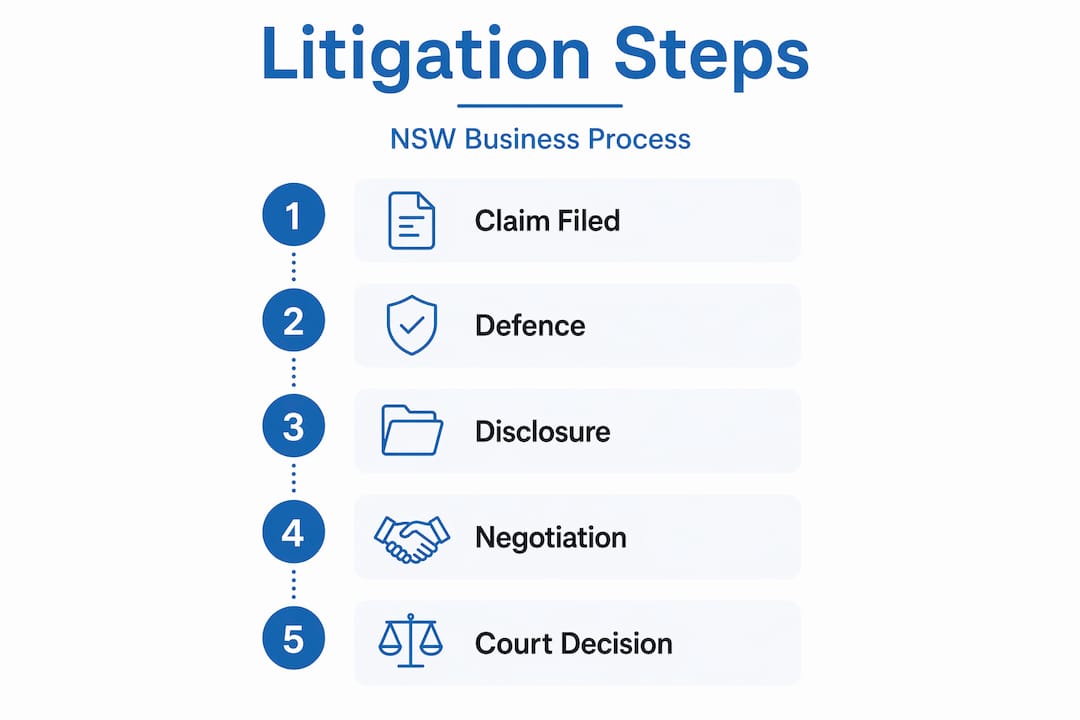
Infographic showing NSW litigation process steps

Common types of disputes that lead to commercial litigation

Commercial litigation covers a wide range of issues, including contract breaches, partner and shareholder disputes, intellectual property, debt collection, and employment matters. Knowing which category your situation falls into helps you assess how complex the process is likely to be and what specialist advice you need.

Common disputes that trigger commercial litigation in NSW include:

  • Breach of contract: A supplier fails to deliver goods on time, a client refuses to pay an invoice, or a service agreement is terminated without proper notice.
  • Shareholder and partnership disputes: Disagreements over profit distribution, management decisions, or alleged breaches of shareholders’ agreements.
  • Intellectual property disputes: Unauthorised use of trademarks, copyright infringement, or misappropriation of confidential business information.
  • Debt recovery: A creditor pursues a debtor through formal legal channels after informal demands fail. Business debt collection matters represent a significant proportion of commercial disputes in NSW courts.
  • Property disputes: Disagreements over commercial leases, development agreements, or ownership of business property. Property dispute litigation requires specific expertise given the interaction between property law and commercial obligations.
  • Employment disputes: Unfair dismissal claims, restraint of trade breaches, or disputes over employment contracts.

Recognising the category of your dispute early allows you to anticipate likely evidence requirements, potential counterclaims, and the likely forum in which the matter will be heard.

Pro Tip: If you are unsure whether your situation qualifies as a commercial dispute, document every relevant communication, contract, and transaction record immediately. Organised documentation strengthens your position at every stage, including pre-litigation negotiations.


Understanding the commercial litigation process in New South Wales

Now that you know the kinds of disputes involved, it helps to understand how the process actually unfolds for NSW businesses. Commercial litigation does not jump straight to a trial. It moves through defined stages, and your leverage as a business owner shifts at each one.

The key stages of commercial litigation in NSW:

  1. Pre-litigation: Parties attempt to resolve the matter through letters of demand, negotiations, or informal discussions. This is often the most cost-effective point at which to reach a resolution.
  2. Pleadings: If negotiations fail, formal documents are filed with the court. The plaintiff files a statement of claim; the defendant files a defence. Counterclaims may also be raised here.
  3. Discovery and disclosure: Both parties disclose relevant documents and information. This stage is critical because it can reveal evidence that changes the entire complexion of the dispute.
  4. Alternative dispute resolution (ADR): Many NSW courts require parties to attempt mediation or arbitration before proceeding to trial. ADR can resolve matters faster and at lower cost.
  5. Trial: If ADR fails, the matter proceeds to a hearing where evidence is presented and a judge delivers a judgment.
  6. Enforcement: Winning a judgment does not automatically mean the money arrives. Enforcement steps may be required if the losing party does not comply voluntarily.

Commercial litigation can involve significant cost and complexity due to legal fees, court fees, evidence disclosure, and expert reports. The complexity escalates considerably once formal claims and defences are filed.

Once a dispute turns into formal claims, defences, and evidence, the leverage and decision points for businesses change. What seemed like a straightforward recovery action can quickly involve counterclaims that put your own position under scrutiny.

Paralegal reviewing evidence documents workspace

Stage Typical duration Key cost drivers ADR available?
Pre-litigation Weeks to months Legal advice, demand letters Yes, informally
Pleadings 1 to 3 months Drafting, filing fees Yes
Discovery 2 to 6 months Document review, legal hours Yes
ADR 1 to 3 months Mediator fees, preparation Core stage
Trial 1 to 5+ days Barrister fees, expert witnesses No
Enforcement Variable Court orders, process fees No

Understanding NSW property dispute resolution timelines gives you a concrete reference point for how long commercial disputes can realistically run.

Pro Tip: Do not wait until pleadings are filed to think about ADR. Proposing mediation early signals commercial reasonableness, can reduce costs substantially, and is looked upon favourably by courts if the matter does proceed to trial.


Common challenges and costs in commercial litigation

Commercial litigation can be expensive and time-consuming due to legal fees, expert consultations, court fees, and discovery expenses. For NSW business owners, the financial exposure often surprises people who expected a straightforward process.

Major cost components to anticipate:

  • Solicitor and barrister fees: Charged at hourly rates or on agreed fee arrangements. Complex matters involving senior counsel attract significantly higher costs.
  • Court filing fees: NSW Supreme Court filing fees for commercial matters can run into thousands of dollars depending on the claim amount.
  • Expert witness reports: Disputes involving valuations, accounting, engineering, or technology often require paid expert opinions.
  • Discovery costs: Reviewing and producing large volumes of documents, particularly electronically stored information, can add tens of thousands of dollars to a matter.
  • Enforcement costs: Even after judgment, collecting the money can require additional court orders and legal steps.
Cost component Typical range (NSW) Variable factors
Solicitor fees $300 to $700+ per hour Seniority, firm size, complexity
Barrister fees $500 to $5,000+ per day Experience, matter complexity
Expert reports $5,000 to $50,000+ Discipline, report length
Court filing fees $1,000 to $10,000+ Claim amount, court level
Discovery review $5,000 to $100,000+ Volume of documents involved

“Disclosure and evidence gathering often reveal hidden issues that broaden claims and defences, increasing costs and settlement leverage.”

Understanding civil litigation costs and challenges in detail before you commit to a course of action allows you to make genuinely informed decisions rather than being caught off guard mid-process.


How to prepare for commercial litigation and protect your business

Understanding conflicts early and seeking legal advice helps businesses manage leverage and outcomes realistically. Preparation is not just about gathering paperwork. It is about entering the process with a clear strategy.

Steps to prepare effectively:

  1. Identify and assess the dispute early. As soon as you recognise that a business relationship is breaking down, take stock of what obligations exist, what has gone wrong, and what your exposure might be on both sides.
  2. Seek specialist legal advice promptly. Commercial litigation is not an area for general legal advice. You need a lawyer who regularly works in this space and understands the NSW courts and procedural requirements.
  3. Organise your documentation. Contracts, emails, invoices, meeting notes, and financial records are all potentially relevant. Do not delete or alter anything. Preserve everything.
  4. Assess ADR options seriously. Mediation and arbitration are not signs of weakness. They are often faster, cheaper, and more predictable than a full trial. Consider them as genuine alternatives, not as a last resort.
  5. Build a realistic budget and timeline. Work with your legal team to model out likely costs and durations at each stage. This informs whether settling early makes commercial sense compared to pursuing full judgment.
  6. Review your contracts for dispute resolution clauses. Many commercial agreements include mandatory mediation or arbitration provisions. These clauses affect your options before you even file a claim.

Commercial litigation preparation that starts early gives you better options at every stage, including the ability to negotiate from a position of greater knowledge and organisation.

Pro Tip: Ask your lawyer to prepare a litigation risk assessment before you commit to formal proceedings. A clear-eyed view of your chances, costs, and likely recovery helps you weigh litigation against settlement with actual numbers rather than assumptions.


Why understanding commercial litigation early changes your business outcomes

Most business owners who come to us mid-dispute say the same thing: they wish they had understood the process earlier. Not because early understanding would have prevented the dispute, but because it would have changed the decisions they made in the weeks before legal action began.

Here is what we see consistently: businesses that wait until proceedings are served before seeking proper advice have already made concessions, sent damaging emails, or discarded documents that would have been useful. The negotiation positions they took in the weeks before formal action often reflect a fundamental misunderstanding of what commercial litigation explained actually looks like in practice.

Disputes initially thought narrow often widen after pleadings and disclosure, affecting costs and settlement leverage. A straightforward breach of contract claim can attract a counterclaim for lost profits, reputational damage, or unconscionable conduct. When you understand this risk early, you approach pre-litigation negotiations differently.

There is also a perception element that most commentary ignores. Courts and opposing parties both read how a business enters the litigation process. A party that arrives organised, legally advised, and genuinely open to ADR is treated differently from one that appears reactive and unprepared. That perception affects settlement offers, the willingness of the other side to negotiate, and even how a judge interprets your conduct if costs are being assessed.

Our view is that commercial litigation insights are most valuable before the dispute becomes entrenched. Once both sides have filed, positions harden and costs accumulate quickly. Early understanding of what commercial litigation means for your specific situation is not a luxury. It is the most cost-effective legal investment you can make.


How GKE Lawyers support NSW business owners with commercial litigation

Understanding commercial litigation explained in theory is one thing. Navigating it for your actual business is another matter entirely. GKE Lawyers is a full-service Sydney law firm with direct experience in commercial dispute resolution across the NSW courts, from straightforward debt recovery through to complex multi-party commercial proceedings.

https://gkelawyers.com.au

Our team provides tailored advice for commercial litigation lawyers in Sydney matters, with a focus on realistic cost management and practical outcomes. We assist with everything from pre-litigation strategy and contract review through to ADR facilitation and trial representation. We also handle property dispute lawyers Sydney matters and business debt recovery services for NSW clients who need to recover what they are owed. If you are facing a commercial dispute and want to understand your options before things escalate, contact GKE Lawyers for a consultation with our litigation team.


Frequently asked questions

What types of disputes are usually handled by commercial litigation?

Commercial litigation covers contract breaches, partner and shareholder disputes, intellectual property, debt collection, and employment matters between businesses. Most disputes involve a breakdown in a contractual or commercial relationship between two or more parties.

Is commercial litigation always resolved through a court trial?

No. Many commercial disputes are resolved through mediation, arbitration, or negotiated settlement well before any trial takes place. Litigation in commercial matters can also encompass negotiations and settlements to avoid the time and cost associated with trials.

How costly can commercial litigation be for NSW businesses?

Commercial litigation can be expensive due to legal fees, court fees, expert reports, and discovery costs, which is why early legal advice and realistic budget planning are essential for any NSW business considering formal proceedings.

What is evidence disclosure in commercial litigation?

Evidence disclosure, known as discovery, is the process where both parties share relevant documents and information before trial. Disclosure often reveals hidden issues that broaden claims and defences, which can significantly affect both the cost and the settlement leverage of each party.

How can NSW business owners prepare to deal with commercial litigation?

Understanding conflicts early and seeking specialist legal advice helps businesses manage leverage and outcomes realistically. Gathering documentation, assessing ADR options, and building a clear budget and timeline are the most important first steps.

Categories
Uncategorized

Top 6 keanelawyers.com.au Alternatives 2026

Most people seeking legal help with property, estates or business matters in New South Wales are frustrated by firms that either lack transparent pricing or cannot provide both local expertise and practical fee certainty. Many traditional law firms require lengthy consultations just to obtain a basic cost estimate and few offer upfront fixed fees or the flexibility of combined in-person and online service options. After reading this comparison you will be able to choose a legal service provider that suits your needs for conveyancing, estate planning, or disputes with a clear understanding of price transparency, specialist expertise and accessibility.

Table of Contents

GKE Lawyers
Product Screenshot

At a Glance

Fixed-price quotes and no-win, no-fee options for motor accident and personal injury work give Sydney clients clear cost expectations before engagement. The firm focuses on property law, conveyancing, family law, wills and estates, notarial services and commercial matters across NSW.

Core Features

  • Transparent fixed fees and upfront quotes that aim to remove billing surprises for commonly requested services.
  • Sydney-based solicitors with local knowledge of NSW property and Torrens title procedures and practical conveyancing workflows.
  • A broad service mix covering property law, commercial contracts, family law reforms, estate planning, motor accident claims and notarial certification.
  • No-win, no-fee arrangements available for eligible personal injury and motor accident claims, combined with direct solicitor engagement rather than a DIY portal.

Key Differentiator

Fixed-price, transparent legal advice with a local Sydney focus is the firm’s standout trait. That combination means you can expect clear cost discussions up front and advice grounded in NSW practice, especially for property transactions under the Torrens system.

Pros

  • Experienced local team. The firm’s Sydney base means solicitors work with NSW courts, Land Registry practice and conveyancing conventions every day, which speeds practical decision making.
  • Upfront pricing reduces billing uncertainty. For buyers and sellers that matters when budgets are tight and timelines are fixed.
  • Responsive, client-focused service. According to the firm, clients report positive reviews and many repeat instructions, which suggests consistent client handling.
  • Specialist property and conveyancing knowledge. If you are buying or selling in NSW you get people who know title registration and local settlement practices.
  • Direct access to solicitors for estate planning and notarial services, including document witnessing and international certification, so you avoid middlemen.

Cons

  • The firm’s broad practice means it may lack ultra-specific niche expertise for highly specialised areas; some clients prefer boutique specialists for rare technical matters.

Notable Integrations

GKE Lawyers uses NAATI translation services for notarisation and foreign document authentication, which helps when clients need certified translations or documents for overseas authorities. This connection simplifies cross-border certification for expatriate or international transaction work.

Who It’s For

Sydney residents and small to medium businesses that want practical legal advice with predictable fees. Particularly suitable for people buying or selling property in NSW, families needing separation or estate planning advice, and clients pursuing motor accident claims.

Unique Value Proposition

Fixed-price quotes and clear fee discussions are the firm’s concrete promise. That fee model, paired with Sydney-based solicitors experienced in NSW conveyancing and probate, means clients know likely costs and get advice aligned with state title registration and local court practice.

Real World Use Case

A Sydney couple buying a home engages GKE Lawyers for conveyancing on a fixed-price quote. The solicitors manage searches, coordinate settlement under the Torrens system and provide timely updates, removing common settlement delays and unexpected legal invoices.

Pricing

The firm advertises transparent fixed fees and fixed-price quotes for many services. Exact price ranges are not listed publicly; fees are provided after initial matter assessment so you see a clear quote before work begins.

Website: https://gkelawyers.com.au

Chamberlains Law Firm

Product Screenshot

At a Glance

Online e-Services for wills and subscription plans operate alongside physical offices in Sydney, Canberra, Newcastle, Brisbane and Perth, giving clients the choice of digital convenience or face-to-face meetings across major Australian cities.

Core Features

Offers a wide range of practice areas covering family law, injury and compensation, building and construction law, corporate and commercial matters, and estate planning. The firm pairs traditional advisory and representation with online e-Services for wills and subscription legal plans.

Specialised lawyers handle sector-specific matters and the firm maintains a client-focused approach aimed at simplifying complex legal processes.

Key Differentiator

A hybrid model that pairs city-based offices with online legal products is Chamberlains’ defining angle. That combination targets clients who want access to local lawyers without losing the speed and price transparency of digital services.

Pros

  • Offers both in-person and online legal services, so you can meet a lawyer in an office or complete simple matters such as wills online.

  • Specialised teams for family, construction, injury and commercial law mean advice comes from lawyers experienced in each field rather than generalists.

  • Physical presence in multiple cities reduces travel time for depositions, signed documents and urgent court attendance compared with purely online providers.

  • Subscription plan options make routine work such as ongoing commercial advice or small-business employment queries easier to budget for.

Cons

  • Publicly available material shows few independent client reviews, so assessing typical client experience requires direct enquiries or a consultation.

  • Legal fees are not published; some matters may become costly depending on complexity and court involvement.

  • The breadth of services can feel overwhelming for a new client who only needs a single, simple document or quick advice.

When It May Not Fit

If your matter is very small and cost sensitive a boutique online document service will likely be cheaper and faster. Equally, very large corporate transactions that require a dedicated large-firm team or international coordination may need a different firm with global reach.

Notable Integrations

  • Online booking and consultation scheduling for quick appointments across offices.

  • Payment gateways for online services that let you pay for wills or subscription plans without visiting an office.

  • Legal documentation and form services to generate standard documents and streamline simple matters.

Who It’s For

Individuals in New South Wales and around Australia seeking a mix of face-to-face counsel and online convenience. Small to medium businesses that want access to specialised legal advice on employment, commercial contracts or construction disputes will find the firm relevant.

Unique Value Proposition

Provides accessible legal help by pairing city-based lawyers with online product options such as wills and subscription plans. That practical mix suits clients who value local legal representation but also want predictable, digitally delivered services for routine matters.

Real World Use Case

A small Australian business engages Chamberlains to draft an enterprise agreement. The company uses an initial online booking, then meets a specialised employment lawyer in Sydney to finalise terms and complete consultation notes for Fair Work compliance.

Pricing

Pricing is not published on public pages and will vary by matter complexity and service type. Contact the firm for a written fee estimate or ask about subscription plan rates for routine work.

Website: https://chamberlains.com.au

Thomson Geer

Product Screenshot

At a Glance

According to the firm, Thomson Geer was ranked first for M&A volume in 2025 in Australia, a concrete signal of deal activity and resourcing depth. The firm reports broad national coverage with offices in Sydney, Melbourne, Brisbane, Adelaide, Perth and Canberra.

Core Features

Thomson Geer supplies full spectrum corporate legal services across major practice areas and sectors. The firm handles large transactions and regulatory matters from local counsel to multi jurisdictional projects.

  • Domestic and cross border advice for corporate transactions and compliance.
  • Industry specific legal teams covering health, resources, financial services and government work.
  • Mergers and acquisitions capability backed by a high market share in deal volume, as reported by the firm.

Key Differentiator

The firm reports being Australia’s top ranked independent corporate law firm by M&A volume in 2025, which is a specific indicator of transactional focus and capacity. That market position pairs with awards and industry recognition, according to the company’s announcements.

Pros

  • Large, independent firm with scale. That scale lets Thomson Geer staff complex, simultaneous transactions across jurisdictions without outsourcing tightly scoped work.

  • Deep industry teams mean advice is practical and sector aware. Expect precedents and commercial framing tailored to regulated sectors such as health and financial services.

  • High reported M&A throughput translates into seasoned partners and execution teams used to tight timetables and simultaneous regulatory clearances.

  • Public recognition and award shortlistings are cited by the firm, which helps when you need a firm with visible market standing for due diligence or vendor confidence.

Cons

  • Pricing is not published on the website, so initial cost visibility is limited and a fee estimate requires a direct engagement conversation.

  • The firm’s scale and corporate focus can mean matter teams are structured for larger clients; smaller matters risk receiving standardised resourcing rather than a boutique partner lead.

  • Materials available are firm forward facing; independent third party client satisfaction data is not included in the provided content and should be requested by buyers.

When It May Not Fit

If you are a small business or an individual seeking low cost, limited scope work, Thomson Geer’s model and typical client base may be an awkward fit. Niche or fixed fee consumer matters are more likely to be better served by smaller local boutiques or sole practitioners.

Who It’s For

Large corporations, government bodies and institutions that need multi jurisdictional transaction teams, regulatory advice and sector specific legal capability across Australia. Organisations that value a high deal count and visible market recognition will find the firm aligned to those needs.

Unique Value Proposition

The firm reports a high M&A volume in 2025 and combines that transaction load with offices across every major Australian jurisdiction. For multinational or interstate clients requiring coordinated domestic counsel, that resourcing density is a tangible advantage.

Real World Use Case

A multinational engages Thomson Geer to manage a complex acquisition that spans Australian regulatory approvals, vendor warranties and local employment transitions. The firm staffs partner led teams in Sydney and Melbourne and co ordinates external foreign counsel.

Pricing

Fees are not specified on the website. Prospective clients should request an engagement estimate and scope of work during an initial briefing to obtain fixed fee or hourly rate proposals.

Website: https://tglaw.com.au

Gilbert + Tobin

Product Screenshot

At a Glance

Gilbert + Tobin describes itself as Australia’s most advanced law firm, emphasising complex, high-stakes work across energy, technology, finance and real estate. The firm advertises a strong focus on innovation, pro bono engagement and strategic regulation advice — vendor self-reported positioning.

Core Features

  • Extensive sector expertise across energy, technology, finance and real estate, with teams for corporate, regulatory and disputes work.
  • Deep specialisation in mergers and acquisitions, regulatory reform and cross-border transactions.
  • Focus on technology law, including Artificial Intelligence, Tech and Digital law services, plus active corporate citizenship and pro bono programmes.

Key Differentiator

According to the firm, its edge is handling highly complex matters that require integrated legal, regulatory and policy insight. That orientation makes the practice attractive to clients facing regulatory change or large transactions rather than routine conveyancing or simple estate matters.

Pros

  • Strong expertise in complex, high-stakes legal issues. Teams are structured to manage regulatory and transactional risk across multiple jurisdictions.

  • Focused on innovation and tech law. For clients with digital products or AI projects the firm advertises specialised capability and sector know-how.

  • Proactive strategic advisory. Gilbert + Tobin positions itself to advise on policy and regulatory strategy as well as litigation and transactional mechanics.

  • Commitment to diversity and pro bono work. The firm highlights corporate citizenship initiatives that some clients value when assessing cultural fit.

Cons

  • No public pricing or fixed service packages. Prospective clients must contact the firm for fee structures and engagement terms.

  • Limited visibility on client onboarding or client portal features. The website does not detail how matters are managed day to day.

  • Not optimised for very small matters or low-cost needs. The firm’s specialisation suggests higher fee bands and a focus on institutional clients.

When It May Not Fit

If you are an individual in New South Wales seeking cost-conscious wills, small estate work, or basic conveyancing, Gilbert + Tobin is likely a poor match. The firm’s model targets large corporate and institutional engagements and does not publish flexible low-cost tiers.

Who It’s For

Large corporations, financial institutions and institutional clients requiring high-end sectoral advice on M&A, regulatory reform, technology law or major disputes. Not the go-to for sole traders or homeowners needing straightforward wills or inexpensive conveyancing.

Unique Value Proposition

Deep sector specialisation in regulatory, transactional and technology matters for institutional clients. Gilbert + Tobin advertises integrated teams that combine corporate, regulatory and policy advice for cross-border deals and major regulatory challenges.

Real World Use Case

A multinational energy company engages Gilbert + Tobin for cross-border transaction compliance and environmental regulatory strategy when acquiring assets in multiple jurisdictions, leveraging the firm’s regulatory and transactional teams.

Pricing

Pricing is not specified on the website; the firm requests direct engagement to discuss fees and retainer arrangements. Expect bespoke proposals and fee structures aligned to the scale and complexity of the matter.

Website: https://gtlaw.com.au

Product Screenshot

At a Glance

Lane Legal’s specialist focus on contested estates and estate dispute resolution, coupled with offices in Sydney CBD and Hornsby, makes it a practical choice for NSW families facing will challenges. The firm also publishes educational articles that clarify estate planning steps for clients.

Core Features

  • Expertise in wills, probate and estate administration, including contested estates and family provision claims.
  • Legal support for property sales and acquisitions tied to estates and probate matters.
  • Commercial services for business sales, shareholder agreements, joint ventures, franchising and leasing.
  • Estate planning advice covering testamentary trusts, powers of attorney and advanced care directives.
  • Assistance with charitable estate planning and will challenges when disputes arise.

Key Differentiator

The firm emphasizes practical dispute resolution for contested estates while also producing client-facing educational material. That combination means you get litigation-ready advice and plain-language guidance on trusts, powers of attorney and how claims under the Succession Act work in NSW.

Pros

  • Specialised estate work. The team concentrates on estate planning and contentious estate issues, so lawyers tend to have deeper case experience than generalist firms.

  • Local accessibility. Offices in Sydney CBD and Hornsby offer face-to-face options whether you live near the city or north of the harbour.

  • Clear client resources. Educational articles help clients prepare for meetings and understand steps such as lodging applications for family provision claims.

  • Dual private and commercial capability. Lane Legal supports both individual estate matters and business transactions, which helps where property, trusts and business interests intersect.

Cons

  • Fee transparency is limited. The firm does not publish standard pricing; prospective clients must request estimates directly.

  • Not appropriate for cross-border estates. The practice is not positioned for complex international succession or large multinational corporate transactions.

  • Turnaround expectations are unclear. Public materials do not list typical timelines for probate or contested-matter resolution, so you will need to confirm during intake.

When It May Not Fit

If your estate involves foreign jurisdictions, overseas assets or multinational corporate structures, Lane Legal’s practice focus is narrower. Similarly, firms that require published fixed-fee packages for simple wills may find the bespoke engagement model here less immediate.

Who It’s For

Residents of NSW who need hands-on estate planning, will drafting and family provision advice. Also suitable for small to medium enterprises seeking legal help with business sales, shareholder arrangements and property matters linked to estates.

Unique Value Proposition

Specialised contentious-estate work paired with client education defines Lane Legal’s offering. The firm combines litigation experience for will challenges with plain-language articles so clients arrive informed and procedural steps are clearer during emotionally charged matters.

Real World Use Case

A family in NSW engages Lane Legal to update wills, establish testamentary trusts for minors and pursue a family provision claim after a deceased estate distribution causes dispute. The firm manages both the trust drafting and the contested claim through to resolution.

Pricing

Contact the firm directly for fee estimates and consultation charges. Because standard rates and typical timelines are not published, obtain a written fee estimate and scope before instruction.

Website: https://www.lanelegal.com.au

Teece Hodgson & Ward

Product Screenshot

At a Glance

Teece Hodgson & Ward highlights a team of accredited specialists in Wills & Estates Law and Property Law, with a stated strength in international estate issues and long-term client relationships across New South Wales.

The firm advertises recognition in Doyle’s Guide for estate law and litigation, a vendor-reported accolade that signals peer acknowledgement within the sector.

Core Features

Specialist estate planning support for trusts, testamentary trusts and succession planning paired with contested estate and estate litigation capability.

The team lists accredited specialists in both Wills & Estates Law and Property Law, plus resources such as checklists, client questionnaires and legal updates to guide executors and trustees.

Comprehensive commercial and property law services for businesses, including start-ups and educational institutions, round out the firm’s offering.

Key Differentiator

The firm emphasises international estate law expertise alongside local practice, a combination the partners state is useful for clients with multi-jurisdictional assets or cross-border succession issues.

This international angle and the presence of accredited specialists position the firm as a resource for complex estate structures that interact with foreign jurisdictional rules.

Pros

  • Experienced specialists. The team lists accredited practitioners, which helps when you require technically precise wills, trust deeds or complex property transfers.

  • Practical client resources. Checklists and tailored questionnaires reduce back-and-forth and speed up document collection for busy professionals.

  • Recognised in peer listings. The firm advertises inclusion in Doyle’s Guide, which supports its reputation among other legal practitioners in NSW.

  • Range of services for businesses. From structuring to property transactions the firm covers the legal work many small to medium enterprises need as they grow.

  • Relationship focus. The firm emphasises long-term service and accessibility, useful if you want a single adviser for estate and property matters over decades.

Cons

  • No public pricing. Fees are not published, so budgeting requires an initial call or meeting and may deter clients seeking fixed-fee clarity.

  • Limited third-party reviews. There are no widely available client reviews to independently verify satisfaction or typical outcomes.

  • Specialisation scope. The firm concentrates on estate, litigation and property matters and is not geared to criminal or family law work.

When It May Not Fit

If you need low-cost, document-only wills at scale, this firm’s specialist focus and likely bespoke pricing may be more than you require.

If your primary legal need is outside estate, property or commercial law, for example family law or criminal defence, this practice’s core expertise will not match those needs.

Who It’s For

Private clients with substantial or multi-jurisdictional estates, executors and trustees needing litigation support, and business owners seeking property or commercial structuring advice in NSW.

Unique Value Proposition

Teece Hodgson & Ward highlights a specialist, accredited team with declared international estate law capability and peer-recognised standing in estate litigation and planning. For clients with cross-border assets or complex trust arrangements the firm’s mix of technical expertise and client resources is a clear selling point.

Real World Use Case

A Sydney professional with assets in Australia and overseas engages the firm to draft a will and associated trust arrangements that minimise conflicts between jurisdictions and provide a clear roadmap for executors.

The firm’s questionnaires and checklists accelerate the information-gathering phase and reduce legal billable hours.

Pricing

Pricing is not publicly stated and appears custom based on matter complexity and client needs; prospective clients should request a fee estimate during an initial consultation.

Website: https://teece.com.au

Selecting the most appropriate legal service provider for your needs involves evaluating cost structures, local expertise, and overall service offerings. Among the reviewed firms, GKE Lawyers stands out with its transparent pricing model and Sydney-focused expertise, effectively addressing specific client concerns in NSW property and personal injury matters.

Distinguishing Cost Frameworks

GKE Lawyers prominently highlights its fixed-fee cost structure and transparent fee quotes. This ensures clients have a clear understanding of charges associated with property transactions or estate planning before engagement, reducing financial unpredictabilities. Conversely, Chamberlains Law Firm, while offering innovative subscription-based models catering to businesses, still lacks the upfront fee certainty, marking a divergence in approach.

Geographic and Sector Expertise

For Sydney-based clientele requiring personal legal representation, GKE Lawyers demonstrates exceptional local proficiency in NSW-specific laws such as the Torrens title system and local settlement practices. In contrast, firms like Thomson Geer excel in multi-jurisdictional corporate law, ideal for multinational transactions, but may not align seamlessly with narrowly defined individual legal needs confined to NSW.

Best Fit Scenarios

  • GKE Lawyers: Perfect for Sydney residents focusing on property conveyancing, wills, and no-win, no-fee personal injury matters, benefiting from cost transparency and local expertise.
  • Chamberlains Law Firm: Suitable for small businesses seeking ongoing legal counsel through flexible subscription plans and those valuing a hybrid service model.
  • Thomson Geer: Aligned best with institutional clients requiring large-scale transactional support and regulatory guidance.

Our Pick: GKE Lawyers

Among the compared firms, GKE Lawyers uniquely combines fixed-price assurances with a localized client focus in Sydney, targeting property, estate, and family law sectors. For individuals or small businesses within Sydney desiring affordable, predictable legal support directly tied to regional legislative frameworks, GKE Lawyers proves to be the optimal choice. However, clients seeking specialized corporate law or national-scale representation might find alternate options better aligned.

When selecting legal services, understanding each firm’s specializations and pricing models is key to making an informed decision.

Firm Key Feature Best For Pricing Limitation
GKE Lawyers Upfront fixed-price quotes in NSW law matters Sydney individuals and SMBs requiring property or estate support Not disclosed May lack niche expertise for highly specialized legal matters
Chamberlains Law Firm Online e-Services alongside city-based offices Clients wanting hybrid online and face-to-face legal services Not disclosed Publicly available material shows few independent client reviews
Thomson Geer High M&A volume ranking for 2025 Large corporations needing comprehensive corporate law services Not disclosed Structured for larger clients; smaller matters may not get boutique focus
Gilbert + Tobin Expertise in technology and regulatory law Corporations seeking advanced strategic or transaction advice Not disclosed Not optimized for small or low-cost matters
Lane Legal Focused on contested estates and estate planning NSW families requiring estate dispute handling or will creation Not disclosed Limited capacity for international or cross-border estate matters
Teece Hodgson & Ward Accredited specialists in wills and property law Clients with multi-jurisdictional estates needing expert guidance Not disclosed Core expertise limited to estate and property law matters

Finding the right law firm can feel challenging, especially when dealing with complex property transactions or personal injury claims under NSW’s Torrens system. GKE Lawyers offers clear, fixed-price quotes and experienced solicitors based in Sydney who understand local property law, conveyancing, family law, and more. This transparency helps remove surprises so you can focus on what matters.

Take control of your legal needs with trusted support from experts who provide notarial services and handle motor accident claims with no-win, no-fee options. Explore solutions tailored to your situation by visiting our Property & Conveyancing Archives or browse broader service information in our Uncategorized Archives.

https://gkelawyers.com.au

Act today and get a fixed-price quote that lets you approach your property or personal injury matter with confidence. Visit https://gkelawyers.com.au and speak directly with a Sydney solicitor who can guide you through each step smoothly.

Frequently Asked Questions

GKE Lawyers offers transparent fixed-price quotes for their commonly requested services, which helps clients avoid billing surprises. This clarity is especially beneficial for clients needing conveyancing or estate planning, ensuring that you know the costs upfront before any work begins.

Can GKE Lawyers assist with motor accident claims on a no-win, no-fee basis?

Yes, GKE Lawyers provides no-win, no-fee options for eligible personal injury and motor accident claims. This commitment allows clients to pursue their claims without the financial risk of upfront legal fees, while also ensuring direct solicitor engagement for personalised support throughout the process.

What is the difference between GKE Lawyers and Chamberlains Law Firm when it comes to client engagement?

Chamberlains Law Firm offers online e-Services alongside physical offices, which can be appealing for clients seeking digital convenience. However, GKE Lawyers excels in providing direct access to local solicitors who are deeply familiar with New South Wales property law, making them a better fit for those directly dealing with property transactions.

Lane Legal focuses on contested estates and provides educational resources, which is beneficial for families facing complex will challenges. In contrast, GKE Lawyers provides clear upfront pricing and a broader range of legal services without the focus on disputes, making it ideal for clients needing straightforward estate planning.

Can I expect GKE Lawyers to manage my property transactions in NSW effectively?

GKE Lawyers specialises in property law with local knowledge of New South Wales’ Torrens title procedures. This expertise ensures that your property transactions are handled smoothly, reducing common delays and uncertainties associated with settlements.

Categories
Uncategorized

Drafting a shareholder agreement in Sydney: step-by-step

When two or three business partners launch a company together in New South Wales, the early days are often marked by enthusiasm and mutual trust. Disputes feel distant. But without a properly drafted shareholder agreement, even the closest partners can find themselves in costly litigation over decision-making authority, share transfers, or profit distributions. A poorly structured agreement, or none at all, can expose your business to serious legal and financial risk. This guide walks you through every stage of drafting a shareholder agreement that is enforceable, compliant with NSW law, and tailored to your specific business circumstances.

Table of Contents

Key Takeaways

Point Details
Agreement is essential Every Sydney business should have a tailored shareholder agreement to protect interests and prevent disputes.
Include key clauses Critical elements cover share capital, transfers, decision-making, and dispute resolution.
Prioritise compliance Ensure your agreement is consistent with your constitution and complies with NSW law.
Avoid common mistakes Custom drafting and clear terms help prevent conflicts and costly litigation.
Get expert legal help For complex issues, professional legal advice ensures enforceability and peace of mind.

What is a shareholder agreement and why is it crucial for Sydney businesses?

A shareholder agreement is a private contract between the shareholders of a company that governs how the business is managed, how decisions are made, and what happens when shareholders disagree or wish to exit. Unlike a company constitution, which is a public document lodged with ASIC, a shareholder agreement is confidential and binding only on the parties who sign it.

For Sydney businesses, this distinction matters enormously. The commercial environment in New South Wales is competitive and fast-moving. Whether you operate a technology startup in Surry Hills, a construction firm in Parramatta, or a family-owned retail business on the Northern Beaches, your shareholder agreement functions as the foundational rulebook for your business relationships.

Key parties involved in a shareholder agreement typically include:

  • Founding shareholders and co-owners
  • Investors and venture capital participants
  • Silent partners or minority shareholders
  • The company itself as a contracting party

Each party has distinct rights and obligations, and the agreement must reflect these clearly to be enforceable. Vague language or missing clauses create ambiguity, and ambiguity in commercial contracts is where disputes are born.

The scope of what a well-drafted agreement should cover is substantial. Essential shareholder agreement clauses for Australian businesses typically address share capital and classes, new share issuing mechanics, decision-making and reserved matters, share transfers including pre-emption and exit protections, founder vesting and leaver provisions, drag-along and tag-along rights, dividend and financial policy, and deadlock and dispute resolution processes.

Clause Purpose
Share capital and classes Defines types of shares and shareholder rights
Pre-emption rights Gives existing shareholders first right to buy shares
Drag-along rights Allows majority to compel minority to sell in an acquisition
Tag-along rights Protects minority shareholders if majority sells
Founder vesting Ensures founders earn equity over time
Dispute resolution Sets out mediation or arbitration steps before litigation
Reserved matters Lists decisions requiring unanimous or special shareholder approval
Dividend policy Governs how profits are distributed among shareholders

It is also worth noting that shareholder agreements have relevance beyond the corporate world. If a shareholder passes away, the agreement directly interacts with wills and estate administration processes, particularly in how shares are treated as assets in an estate. Forward-thinking business owners often integrate their shareholder agreement planning with estate planning in Sydney to ensure business continuity when a shareholder dies or becomes incapacitated.

Pro Tip: If your company is at an early stage with only two or three founders, now is the ideal time to draft your shareholder agreement. It is far easier to negotiate terms when relationships are healthy than during a dispute or when one party is seeking an exit.

Creating your shareholder agreement: step-by-step guide for NSW

Understanding what should be included, the next step is working through the actual drafting process. This requires careful preparation, open communication between shareholders, and professional legal review before signing.

Infographic showing shareholder agreement drafting steps

Step 1: Identify all shareholders and their roles

Begin by listing every person or entity that holds or will hold shares. Clarify whether each shareholder is also a director, employee, or passive investor. This determines which governance rights apply to each party.

Step 2: Define share classes and ownership percentages

Decide whether your company will have ordinary shares only, or whether you need preference shares, employee shares, or founder shares with special voting rights. Document the exact percentage each shareholder holds and how dilution will be managed if new shares are issued.

Step 3: Establish decision-making rules

Not every decision should require unanimous shareholder approval. Define which matters require a simple majority, a special majority, or unanimity. Reserved matters, those decisions too significant to leave to the board alone, must be explicitly listed.

Step 4: Draft share transfer and exit provisions

This is often the most contested area. Your agreement should specify pre-emption rights so that shareholders must first offer shares to existing owners before selling externally. Include drag-along and tag-along clauses to manage acquisition scenarios. Also address what happens when a shareholder dies, becomes bankrupt, or is no longer employed by the business.

Lawyer reviewing share transfer agreement details

Step 5: Include founder vesting and leaver provisions

Vesting schedules protect the business when a founder leaves early. A good leaver clause may allow departing shareholders to retain vested shares, while a bad leaver clause (such as for misconduct) may require shares to be sold back at a discounted price. These provisions need precise drafting to be enforceable.

Step 6: Set out dispute resolution mechanisms

The essential dispute resolution clauses in an Australian shareholders agreement address both deadlock situations and interpersonal conflicts. The table below compares common approaches:

Approach How it works Best suited for
Mediation Neutral third party facilitates dialogue Early-stage or relationship-focused disputes
Expert determination Specialist makes binding decision on technical issues Financial or valuation disputes
Arbitration Private binding decision outside court Complex commercial disputes
Russian roulette clause One party sets a price; the other buys or sells at that price Deadlocked 50/50 partnerships
Shoot-out clause Both parties submit sealed bids; highest bidder buys Competitive exit scenarios

Step 7: Review against the company constitution

Your shareholder agreement must be read together with your company constitution to avoid inconsistency. Where the two conflict, the outcome depends on whether the agreement is expressed to override the constitution, which requires careful legal drafting.

Step 8: Obtain legal review and execution

Before signing, have a qualified commercial lawyer review the complete document. This is not a step to skip. You should also conduct legal checks for commercial property if your business owns or intends to lease commercial premises, as those obligations may also need to be reflected in your governance framework.

Pro Tip: Always have each shareholder sign the agreement in the presence of an independent witness. For documents that will be used internationally or in cross-border transactions, consider having them certified by a notary for added legal weight.

Ensuring compliance and enforceability in Sydney

With your draft prepared, you need to ensure it is legally compliant and will stand up to scrutiny if a dispute arises. A shareholder agreement that looks comprehensive on paper can still fail in court if it contains provisions that breach statutory obligations or contradict other governance documents.

The critical standard for compliance is clear. For enforceability, ensure any commercial provisions you draft do not require breaches of statutory duties and that the governance architecture, meaning the constitution, shareholders agreement, and board processes, is internally consistent.

A shareholder agreement that conflicts with the company constitution or requires directors to breach their statutory duties under the Corporations Act 2001 (Cth) will not be enforced by Australian courts. Internal consistency across all governance documents is not optional. It is essential.

Compliance checklist for NSW shareholder agreements:

  • The agreement must not require directors to act in breach of their duties under the Corporations Act 2001 (Cth), including the duty to act in good faith and in the best interests of the company
  • Provisions dealing with share transfers must align with any restrictions in the constitution and comply with ASIC notification requirements
  • Confidentiality clauses must not prevent disclosure required by law
  • Any restraint of trade provisions must be reasonable in scope and duration to be enforceable under NSW law
  • Financial assistance provisions must comply with Part 2J.3 of the Corporations Act 2001 (Cth) if the company is assisting someone to acquire its own shares
  • The agreement should specify governing law as New South Wales to avoid jurisdictional uncertainty

It is also worth considering what happens when shareholders disagree about property co-owned by the business. Understanding co-ownership disputes can help you draft stronger provisions for business assets held jointly, particularly for companies that own commercial real estate alongside their operating business.

Regularly review and update your shareholder agreement as the business grows. A document drafted for a two-person startup will not be adequate for a seven-shareholder company operating across multiple states.

Common mistakes and how to avoid disputes

Ensuring enforceability is critical, but avoiding costly mistakes and disputes from the outset is equally important. Many shareholder disputes in Sydney are not caused by deliberate bad faith but by agreements that were vague, incomplete, or simply not understood by all parties when signed.

Common drafting mistakes to avoid:

  • Failing to define “deadlock” clearly, leaving the business unable to make decisions when shareholders are evenly split
  • Omitting leaver provisions, which means departing shareholders may retain full equity regardless of the circumstances of their departure
  • Using generic online templates without adapting them to the company’s specific structure, industry, or risk profile
  • Neglecting to address intellectual property ownership, particularly important for technology companies or businesses built on proprietary processes
  • Ignoring minority shareholder protections, which can expose the company to oppression claims under the Corporations Act 2001 (Cth)
  • Not reviewing the agreement after major changes, such as new investment rounds, shareholder exits, or significant shifts in business direction
  • Omitting a proper dispute escalation process, which forces shareholders straight into litigation without any intermediate steps

The deadlock and dispute resolution processes that well-drafted Australian shareholder agreements include are not there by accident. They reflect hard lessons learned from real disputes. Without these provisions, even a minor disagreement can escalate into a costly court proceeding.

If a dispute does escalate, knowing your options matters. Civil dispute resolution services can assist when shareholder conflicts reach an impasse and formal legal intervention is required.

Pro Tip: Consider including an annual review clause in your agreement, requiring all shareholders to sit down each year and confirm the agreement still reflects the business’s current circumstances. This simple step can prevent minor misunderstandings from becoming significant disputes.

Lessons from real Sydney businesses: why a generic template rarely works

We have worked with many Sydney business owners who began their commercial journey with a downloaded template, confident it covered everything they needed. In our experience, those templates almost always fall short when the business is tested by real-world pressure.

Generic agreements do not account for the specific dynamics of your industry, the size and nature of your shareholder group, or the personal and financial circumstances of individual shareholders. A standard template designed for a technology startup, for example, will likely be poorly suited to a professional services firm or a construction company operating under fixed-price contracts.

One of the most instructive patterns we observe is the 50/50 shareholder arrangement with no deadlock mechanism. Two equal partners, both directors, both with veto power, and no agreed process for resolving gridlock. When the relationship sours, the company is effectively paralysed. Neither party can force the other to act, and the business suffers while legal costs mount. A properly drafted agreement would have included a mechanism such as mediation, an independent chairman’s casting vote, or a structured buyout process to break that deadlock.

We also see frequent problems with leaver provisions that were either absent or so broadly written that they were unenforceable. A clause that simply states “a departing shareholder must sell their shares at fair market value” sounds reasonable, but who determines fair market value, using what methodology, and within what timeframe? Without precise drafting, that single question can take months and thousands of dollars to resolve.

The lesson is straightforward. Your shareholder agreement should be drafted by a lawyer who understands your business and the specific legal environment in New South Wales. It should reflect your actual ownership structure, your industry’s particular risks, and the realistic scenarios your company might face over the next five to ten years. Reviewing co-ownership dispute case studies can give you a clearer picture of how quickly unresolved tensions can escalate when governance documents are inadequate.

Bespoke drafting is not a luxury. For most businesses, it is the most cost-effective legal investment you will ever make.

Need expert help drafting your shareholder agreement?

If you are ready to protect your business with a properly drafted shareholder agreement, or if you need an existing agreement reviewed and updated, GKE Lawyers can help. Our commercial law team works with business owners across Sydney and throughout New South Wales to draft clear, enforceable agreements that reflect your specific needs and comply with all relevant legislation.

https://gkelawyers.com.au

We also assist with related legal matters, including property disputes involving business assets, conveyancing through our property lawyers in Sydney, and a full range of commercial and litigation services. Whether you are starting a new business or restructuring an existing one, our team provides Sydney legal guidance that is practical, personal, and focused on protecting your interests. Contact us today to book a consultation.

Frequently asked questions

What clauses should my Sydney shareholder agreement include?

Your agreement should cover share capital and decision-making, share transfer rules including pre-emption and drag-along rights, dispute resolution processes, founder vesting, and financial and dividend policies tailored to NSW regulations.

Is a shareholder agreement mandatory for private companies in NSW?

No, it is not legally required, but it is strongly recommended to clearly define shareholder rights and prevent costly disputes from arising as the business grows and circumstances change.

How do I ensure my shareholder agreement is enforceable in NSW?

For enforceability, ensure the agreement aligns with your company constitution, is internally consistent across all governance documents, and does not require directors to breach their statutory duties under Australian law.

Can business owners in Sydney resolve shareholder disputes without litigation?

Yes, many agreements include mediation, expert determination, or other deadlock resolution processes that allow disputes to be resolved privately, which is typically faster, less expensive, and less damaging to business relationships than going to court.

Categories
Uncategorized

Breach of contract in NSW: Know your rights and options

A broken promise does not automatically become a breach of contract in New South Wales. That assumption catches many individuals and businesses off guard when they discover that what felt like a clear violation may not entitle them to any meaningful legal remedy. Under NSW law, a breach occurs when a party fails to perform a contractual obligation, whether through non-performance, late performance, or substandard performance, but the consequences of that breach depend heavily on contract wording and whether you can demonstrate real, quantifiable harm. This guide unpacks exactly how breach of contract works in NSW, what courts look for, and what your practical options are.

Table of Contents

Key Takeaways

Point Details
Clear breach criteria NSW law requires clear evidence of non-performance, late delivery, or substandard fulfilment to prove breach.
Essential vs technical terms Serious breaches of essential terms trigger more remedies than minor technical issues.
Proving loss Courts will only award substantial damages if you can demonstrate real financial loss.
Strict timeframes Most breach claims must be filed within 6 years, or 12 years for claims under deeds.
Action steps Practical options include negotiation, dispute resolution, and professional legal advice in Sydney.

What counts as a breach of contract in NSW?

With the legal foundation set, let’s break down exactly what constitutes a breach under NSW contract law.

A contract is a legally binding agreement between two or more parties. For a breach to occur, there must first be a valid, enforceable contract in place. Once that threshold is met, a breach happens when a party fails to perform an obligation under that agreement, including by failing to perform entirely, performing late, or performing in a way that does not meet the required standard. Not every shortfall will carry the same legal weight.

Types of breach you need to know

NSW law distinguishes between several categories of breach:

  • Non-performance: One party simply does not do what they agreed to do. A builder who walks off a job halfway through is a clear example.
  • Late performance: The work or payment is delivered, but not within the agreed timeframe. Whether this constitutes a serious breach depends on whether time was expressed as “of the essence” in the contract.
  • Defective performance: The party performs their obligation, but not to the contractual standard. Poor workmanship on a renovation or a goods supplier delivering incorrect specifications both fall into this category.
  • Anticipatory breach: This is where one party clearly communicates, before the performance date, that they will not be meeting their obligations. A tenant announcing they will not pay rent next month gives rise to an anticipatory breach, and the other party can act immediately rather than waiting.

Essential vs non-essential terms

The distinction between essential and non-essential contract terms is fundamental to how courts assess breach claims in NSW. An essential term, sometimes called a condition, goes to the heart of the agreement. Breaching it entitles the innocent party to terminate the contract and claim damages. A non-essential term, sometimes called a warranty, is less central. Breaching it may entitle the innocent party to damages, but not to terminate the contract outright.

Term type Also known as Breach consequence
Essential term Condition Right to terminate and claim damages
Non-essential term Warranty Right to damages only
Intermediate term Innominate term Depends on severity of the breach

“A breach of contract occurs when a party fails to perform an obligation under a legally binding agreement, including by failing to perform, performing late, or performing in a way that does not meet the contractual standard.” NSW Law Handbook

How courts assess the seriousness of breach

Now that you know what constitutes a breach, it’s crucial to understand how NSW courts treat different types of breaches.

Courts do not treat all breaches equally. Even where something has clearly gone wrong, the remedy available to you will depend on how serious the breach is and what the contract itself says about consequences. This is where many people are surprised by the outcome of their dispute.

Lawyer explaining contract details to client

What courts focus on

NSW courts look carefully at three primary considerations:

  • The precise wording of the contract, particularly whether a term was expressed as essential or time-sensitive
  • Whether the breach went to the root of the agreement, or was merely a technical shortfall
  • Whether the innocent party suffered an actual, measurable loss as a direct result

The practical implication is significant. As highlighted in how breach of contract law works in Australia, courts focus on contractual wording, seriousness, and whether you can prove actual loss. Technical breaches with no real harm may not produce substantial damages. This means that even if you are technically correct that a breach occurred, you could receive nominal damages or nothing at all if you cannot prove financial loss.

Comparison: Technical breach vs serious breach

Infographic comparing technical and serious breach

Factor Technical breach Serious breach
Impact on contract Minor, does not undermine purpose Substantial, undermines core purpose
Typical remedy Nominal damages or none Damages, possible termination
Time is of the essence Usually not relevant Often relevant
Courts’ typical approach May decline significant award More likely to grant full relief

Pro Tip: Before you assume you can walk away from a contract because the other party missed a deadline, check whether your contract expressly states that time is of the essence. If it does not, late performance may only entitle you to damages, not termination.

Our litigation lawyers Sydney frequently see clients who believe they have a strong case, only to discover their contract wording weakens their position significantly. Getting advice early is far more cost-effective than discovering this mid-dispute.

Property transactions require particular care here. When buying a property in Sydney, the contract for sale will contain both essential and non-essential terms, and understanding which is which can mean the difference between terminating the deal and being locked in.

Establishing harm and proving loss in breach cases

Understanding breach severity flows directly into proving whether you’re entitled to compensation.

Proving that a breach occurred is only half the battle. To receive substantial compensation, you must demonstrate that you suffered an actual, quantifiable loss as a result of that breach. This is the step where many claims either succeed or fail.

The process for proving loss

  1. Identify your loss clearly. What exactly did you lose because of the breach? Lost profit, additional costs you incurred, or the difference between the contract price and what you paid a replacement supplier are all valid heads of loss.
  2. Calculate the financial impact. NSW courts award damages aimed at putting you in the position you would have been in had the contract been performed. This is known as expectation damages. You may also be entitled to reliance damages if you incurred expenses in anticipation of the contract being fulfilled.
  3. Gather supporting documents. Invoices, bank statements, correspondence, quotes from replacement suppliers, and expert reports all help substantiate your loss claim. Undocumented loss is difficult to establish convincingly in court.
  4. Address consequential losses. Where your loss flows beyond the immediate breach, such as lost business opportunities or downstream contract failures, you must show these losses were reasonably foreseeable at the time the contract was made.
  5. Mitigate your loss. You have a legal obligation to take reasonable steps to reduce your loss. If you could have found a replacement supplier at a similar price but chose not to, the court may reduce your damages accordingly.

What courts will and will not award

  • Courts will award compensation that directly flows from the breach and was foreseeable
  • Courts will award costs you incurred in attempting to mitigate your loss
  • Courts will generally not award damages for emotional distress in commercial contracts
  • Courts will not award speculative losses without evidence to support them

As reinforced by the breach of contract guidance on Australian contract law, proving actual loss is essential. This is true whether you are pursuing a commercial dispute or a claim arising from a personal agreement.

Pro Tip: Start collecting and organising your evidence from the moment you suspect a breach. The longer you wait, the harder it becomes to reconstruct the paper trail you need.

Our litigation lawyers Sydney work closely with clients to prepare detailed loss assessments before filing any claim, which strengthens your position from the outset. For disputes involving estate-related contracts, our estate lawyers Sydney can assist where the breach intersects with deceased estate matters. For personal harm resulting from a breach, compensation claims may also be relevant depending on the facts.

Limitation periods and timelines for breach claims in NSW

Knowing when you must act is essential. Let’s clarify the time limits for breach claims.

Time limits are a critical and often overlooked dimension of breach of contract claims. Waiting too long to act can extinguish your right to bring a claim entirely, regardless of how strong it might otherwise be.

Under NSW law, breach of contract proceedings are generally subject to limitation periods, with a common rule of 6 years for most ordinary (simple) contract claims and 12 years for claims under deeds. These periods typically begin from the date of the breach, not when you discovered it.

Key limitation periods at a glance

Contract type Limitation period Period starts from
Simple contract (oral or written) 6 years Date of breach
Deed 12 years Date of breach
Contracts involving minors May vary Seek legal advice
Fraud or concealment May be extended Discovery of the fraud

Important points about limitation periods in NSW

  • The clock starts ticking from the date the breach occurred, which may be earlier than you realise
  • If the breach is ongoing, different rules may apply to determine when time started running
  • Limitation periods can be extended in limited circumstances, such as where the breach was actively concealed
  • Filing your claim one day after the limitation period expires can result in your claim being permanently barred
  • Limitation periods apply even if negotiations are ongoing, so do not assume that talking to the other party stops the clock

Where contracts relate to succession disputes, contesting a will in Sydney also carries strict time limits under NSW law, reinforcing just how important it is to act within defined timeframes across all legal matters.

Practical next steps after a breach of contract

Armed with timelines and a clear understanding of breach, here’s what you can do next.

Knowing your rights is useful. Acting on them effectively is what actually matters. If you believe a contract has been breached, follow these steps methodically.

  1. Review the contract in detail. Read every clause carefully, paying attention to how terms are defined, whether any notice requirements exist, and what remedies the contract itself specifies for breach.
  2. Gather and preserve all relevant evidence. This includes written communications, emails, text messages, invoices, photographs, and any other records related to the contract and the alleged breach.
  3. Send a formal letter of demand. Put the other party on notice in writing. Specify the breach, the loss you have suffered, and what you require to resolve the matter. This step also demonstrates that you attempted to resolve the dispute before escalating.
  4. Consider negotiation or mediation. Many contract disputes in NSW are resolved without going to court. Mediation is cost-effective, faster, and gives both parties more control over the outcome.
  5. Seek legal advice before committing to litigation. Dispute resolution in Sydney is a specialist area, and your lawyer will help you assess the realistic value of your claim against the cost and time of court proceedings.
  6. Escalate to litigation when necessary. Where negotiation has failed and the stakes are high, court proceedings may be the only way to protect your interests.

Under general NSW contract law principles, the innocent party has both a right to act and an obligation to act reasonably. Sitting on your rights without taking steps to mitigate your loss can reduce or even eliminate your entitlement to damages.

Why breach of contract is misunderstood in NSW

In our experience, the biggest mistakes people make in contract disputes have very little to do with the facts of what happened. They almost always come down to two things: misunderstanding what the contract actually says, and overestimating how easy it is to prove loss.

Many clients come to us certain they have a strong case. A supplier did not deliver. A contractor did a poor job. A business partner failed to pay. In isolation, each of these sounds like a clear breach. But once we read the contract carefully, a different picture often emerges. The payment term was ambiguous. The delivery clause had no express time requirement. The workmanship standard was not properly defined. Suddenly, what felt like an open-and-shut case becomes considerably more complex.

The other issue we see repeatedly is the assumption that suffering a breach automatically entitles someone to significant compensation. Courts in NSW are rigorous about requiring evidence of actual financial loss. We have seen technically valid breach claims produce very modest results because the claimant could not substantiate their losses with adequate documentation. As underscored by Australian breach of contract law, technical breaches with no real harm may not produce substantial damages.

The uncomfortable truth is that contract disputes are won or lost on preparation. The party that has clear documentation, well-evidenced loss, and a thorough understanding of the contract terms almost always achieves a better outcome, whether in court or in settlement negotiations. This is not something you can retrofit at the end of a dispute. It starts the moment a contract is signed, or at the very latest, the moment you suspect something has gone wrong.

Our advice to anyone entering a commercial relationship is straightforward: treat your contract as a living document. Understand it before you sign it, keep records throughout the relationship, and get legal advice at the first sign of trouble. Making a prior commitment to commercial property legal checks and contract review before any dispute arises is always a more cost-effective approach than litigating afterwards.

Need expert help with contract disputes in Sydney?

If your contract situation feels complex or urgent, here’s where professionals can step in.

Facing a breach of contract situation in NSW is stressful, but you do not have to navigate it alone. At GKE Lawyers, our team brings focused experience across property, commercial, and dispute resolution matters to help you understand your position and make informed decisions quickly.

https://gkelawyers.com.au

Whether you need property dispute lawyers Sydney to assist with a real estate contract issue, litigation lawyers for contracts to prepare or defend a claim, or conveyancing experts Sydney to ensure your next property transaction is properly documented from day one, our team is ready to help. We serve clients across Sydney and throughout New South Wales. Contact GKE Lawyers today to book a consultation and get clear, practical advice on your options.

Frequently asked questions

What is considered a breach of contract under NSW law?

A breach happens when one party fails to meet their obligations as agreed, including non-performance, late delivery, or performing to a substandard level. Under NSW law, a breach is established when the failure relates to a legally binding obligation within a valid contract.

How long do I have to make a breach of contract claim in NSW?

Most simple contract claims must be brought within 6 years, while breaches under deeds carry a 12-year time limit. The limitation period for NSW claims typically begins from the date the breach occurred.

Can I claim damages if there is no actual loss from the breach?

Generally, you must prove actual financial loss to receive substantial damages in NSW. Courts recognise that technical breaches without real harm may result in only nominal damages or none at all.

What are typical remedies for breach of contract in Sydney?

Remedies can include damages, contract termination, or specific performance, depending on the contract terms and the nature of the breach. NSW breach of contract remedies are shaped by whether the breached term was essential and whether actual loss can be demonstrated.

What should I do first if my contract has been breached?

Review your contract thoroughly, gather all relevant evidence and correspondence, and consider seeking legal advice before taking any formal steps. Acting early protects your rights and preserves your option to negotiate a resolution without the time and cost of court proceedings.

Categories
Uncategorized

How to protect your rights in NSW property settlement

Separating from a partner is one of the most stressful experiences you can face, and the legal process of dividing property and assets adds a significant layer of complexity and uncertainty. Many people in New South Wales make costly mistakes during this period, simply because they do not understand the rules, the deadlines, or the difference between a handshake agreement and a legally binding arrangement. This guide walks you through every critical stage of property settlement after separation in NSW, from identifying your relationship type and compiling your financial picture, to choosing the right legal pathway and avoiding the pitfalls that derail even the most amicable splits.


Table of Contents

Key Takeaways

Point Details
Know your time limits Missing the property settlement deadline could forfeit your rights, so check which rules apply to your situation.
Documentation is vital Start by organising all your financial information to make negotiation and resolution smoother.
Formalise your agreement Use a binding financial agreement or consent orders if you want your property settlement to be legally enforceable.
Explore all settlement methods Agreement and mediation can avoid lengthy court processes when you act early and cooperatively.

What to do first: understanding property settlement basics in NSW

Property settlement is the legal process of dividing assets, debts, and financial resources between two people after the end of a relationship. In NSW, this process is governed by both federal legislation for married couples and state legislation for de facto couples, which means the rules, timelines, and available remedies can differ depending on your circumstances.

Understanding family law basics before you begin negotiating is essential. Married couples are governed by the Family Law Act 1975 (Cth), while de facto couples in NSW are governed by the Property (Relationships) Act 1984 (NSW) for state-based matters, though federal de facto provisions also apply in many situations. Knowing which legislation applies to you determines which court has jurisdiction, what deadlines you face, and what evidence matters most.

One of the first and most important things you need to establish is your separation date. This is the date on which the relationship effectively ended, and it has direct legal consequences for calculating application deadlines. Courts look at factors such as living arrangements, communication, financial separation, and social conduct when determining this date. Disputes about the separation date are common and can affect your rights significantly, so it is worth getting clarity on this early.

Before any negotiations begin, compile a thorough inventory of all assets and debts. This includes:

  • Real property (family home, investment properties, land)
  • Bank accounts, savings, and term deposits
  • Superannuation balances for both parties
  • Vehicles, boats, and other personal property
  • Shares, managed funds, and business interests
  • Joint and individual debts, including mortgages, personal loans, and credit cards
  • Inheritances or gifts received during the relationship

In NSW, you must start property settlement proceedings within strict time limits that depend on whether you were married or in a de facto relationship. Missing these windows can be extremely costly, and the courts are not always sympathetic to late applicants.

Relationship type Governing legislation Key deadline
Married couple Family Law Act 1975 (Cth) 12 months after divorce is finalised
De facto couple (NSW) Property (Relationships) Act 1984 (NSW) 2 years after separation

Pro Tip: Start gathering financial documents, bank statements, mortgage paperwork, and superannuation records as soon as possible after separation. The earlier you have a complete picture, the less stressful the negotiation process will be, and the less likely you are to overlook an asset or undervalue your entitlements.

Understanding family law in Sydney and how it applies to your specific situation is a foundational step that can protect you from making decisions you will regret later.

Infographic of NSW property settlement process steps


Key requirements and timelines: what you must know

Time limits in property settlement law are not soft guidelines. They are strict legal requirements, and missing them can mean you lose the right to make a claim altogether. Here is a clear breakdown of the major timelines you need to be aware of.

For married couples:

  1. You must be separated for 12 months before you can apply for divorce.
  2. Once the divorce order is made, you have exactly 12 months to commence property settlement proceedings.
  3. If you miss this window, you must apply to the court for “leave” to proceed out of time.

For de facto couples:

  1. The relationship must have broken down before the clock starts.
  2. NSW de facto law provides a 2-year application window after the relationship ceases, with limited ability to get leave after that time passes.
  3. Establishing the exact date of separation becomes critically important.
Factor Married couples De facto couples
Deadline to apply 12 months after divorce 2 years after separation
Governing court Federal Circuit and Family Court NSW courts (or federal, depending on the matter)
Out-of-time applications Leave required under Family Law Act Leave required, hardship test applies
Super splitting available Yes Yes, under federal provisions
Key documents needed Marriage certificate, financial disclosure Evidence of de facto relationship, separation date

Critical warning: If you allow either deadline to pass without formalising your settlement or commencing proceedings, you may permanently lose the ability to make a claim. Even if both parties are on good terms, the absence of a formal legal order means either party could later dispute what was agreed. Do not rely on goodwill alone.

The concept of “leave” to apply out of time is important to understand. If you have missed the deadline, you can ask the court for permission to proceed, but this is not automatic. Late de facto applications may be allowed only where hardship considerations favour the late applicant. The court will examine factors such as whether a child would suffer hardship, whether the applicant would be left without adequate support, and whether the other party would be prejudiced by a late claim.

Getting property dispute advice from a qualified lawyer well before any deadline approaches is strongly recommended. Acting early gives you options. Waiting until the deadline passes removes them.

Pro Tip: Set a calendar reminder for your relevant deadline the moment you separate. Write it down, tell your lawyer, and treat it as a hard stop. The difference between lodging one day inside and one day outside the window can determine whether you have any legal recourse at all.


Reaching an agreement with your former partner is genuinely a positive outcome, but it only protects you if that agreement is formalised correctly. Many people in NSW make the mistake of assuming that a verbal agreement, a written email exchange, or even a signed document prepared without legal input will be enough to protect them. This is rarely the case.

The main legal pathways to settle property after separation are:

  1. Informal agreement — A verbal or written understanding between parties. Not legally binding and unenforceable in most circumstances.
  2. Mediation — A structured negotiation facilitated by a neutral third party. Can lead to a binding outcome if documented properly, but the mediation itself does not create a legally enforceable order.
  3. Binding financial agreement (BFA) — A private contract between the parties that sets out how assets and debts will be divided. Must meet strict legal requirements, including independent legal advice for both parties, to be valid.
  4. Consent orders — An agreement lodged with the court and approved by a registrar or judge. Once approved, it has the same force as a court order.
  5. Court order — Issued by a judge following a contested hearing. Used when parties cannot agree. The most expensive and time-consuming option.

If you want asset transfers or super splitting to be legally effective, you generally need consent orders or a binding financial agreement, not just an informal arrangement. Banks will not transfer a mortgage or update title records based on a handshake. The Titles Registry requires formal legal documentation. Superannuation funds have their own compliance requirements before they will action a split.

Informal agreements can leave you exposed in ways that only become apparent years later, such as when one party seeks to revisit the division, when a bank requires proof of legal entitlement, or when a new partner or creditor enters the picture.

Solicitor reviewing property agreement paperwork

When considering property transfers after separation, it is critical to understand that only a formal legal order or BFA will give you the certainty and protection you need.

Pro Tip: Never sign any document, whether labelled as a “settlement deed,” “agreement,” or “arrangement,” without having a qualified lawyer review it first. What seems straightforward in plain language can have significant legal implications, particularly around stamp duty exemptions, future financial claims, and superannuation entitlements.


Settlement methods: agreement, mediation, or court?

Choosing the right method to resolve your property settlement is one of the most consequential decisions you will make throughout this process. The approach that suits you depends on the level of conflict between parties, the complexity of your asset pool, and how quickly you need a resolution.

Here is a clear breakdown of the three main approaches:

  • Negotiated agreement: Best suited when both parties are cooperative, have a clear understanding of their assets, and are willing to compromise. This approach is the fastest and least expensive. It works best when formalised through consent orders to ensure enforceability.
  • Mediation: Well suited when there is one or more disputed items but both parties are broadly willing to resolve matters without a judge’s intervention. A skilled mediator can help parties find common ground efficiently. You can negotiate property settlement directly, but if agreement is not reached, mediation or court may be necessary.
  • Court proceedings: Reserved for situations where there is an irretrievable breakdown in communication, allegations of asset concealment, significant power imbalances, or complex financial structures that require judicial determination. Court is the most expensive, time-consuming, and emotionally draining option.

Understanding mediation options in NSW can help you determine whether this step is right for your situation before committing to litigation.

When preparing for mediation, you should gather all financial documents, prepare a list of your priorities and non-negotiables, and attend with a clear understanding of your legal entitlements. When preparing for court, you need to engage a solicitor, comply with disclosure requirements, and be ready for a process that can take months or years.

Before escalating any dispute, consider using dispute resolution methods that can achieve a fair outcome without the financial and emotional cost of litigation. If you are unsure which path suits your circumstances, speaking with a lawyer who handles property disputes in Sydney is the most reliable first step.


A lawyer’s perspective: common pitfalls in NSW property settlements

After working through a wide range of property settlements in NSW, we have seen certain mistakes appear repeatedly. Understanding these pitfalls is often what separates a clean, protected outcome from one that causes problems for years after the relationship ends.

The separation date dispute is more common than people expect. Many clients come to us believing their separation date is obvious, only to find that the other party disputes it. This matters because the separation date determines which assets are included in the pool and when the legal clock starts ticking on deadlines. Documenting your separation clearly and early is not optional.

Informal agreements create a false sense of security. We have seen clients accept a split of the family home, hand over keys, and genuinely believe the matter is resolved, only to face a claim from their former partner years later. Without consent orders or a BFA, no division of property is final. Banks, superannuation funds, and the courts do not recognise informal arrangements as binding.

Delaying paperwork is one of the most preventable risks. People frequently put off gathering financial records, assuming they can do it later. By the time a deadline approaches, bank records are harder to access, valuations become contentious, and stress levels are high. Starting the paperwork process immediately after separation is always the right move.

Rushing to court can backfire. Some clients arrive convinced that court is the only option. In practice, many of these matters are resolved through out-of-court solutions that cost a fraction of litigation and produce equally binding results. Court should be a last resort, not a first response.

Even amicable separations need professional documentation. A friendly split today can become a disputed one tomorrow if circumstances change, such as one party remarrying, experiencing financial difficulty, or simply having a change of heart. The only way to truly protect yourself is through a legally formalised agreement.


Get expert help with your property settlement in NSW

Property settlement in NSW is one of the most legally complex processes a person can face outside of a courtroom, and the stakes are high. Whether you are trying to protect your share of the family home, secure a fair division of superannuation, or simply understand your rights and obligations, having the right legal support makes a measurable difference to outcomes.

https://gkelawyers.com.au

At GKE Lawyers, our property lawyers in Sydney work closely with clients navigating separation and asset division across NSW. We help you understand your entitlements, meet critical deadlines, and formalise agreements that are legally binding and enforceable. Our property dispute lawyers are experienced in both negotiated settlements and contested proceedings, giving you confident representation at every stage. If you are ready to take the next step, contact us to book a consultation and get clarity on your situation today.


Frequently asked questions

Can you make a legally binding property settlement without going to court in NSW?

Yes, you can formalise your settlement through consent orders or a binding financial agreement, both of which are legally enforceable without requiring a contested court hearing.

What happens if property settlement is not done within the time limit?

You may lose the automatic right to apply, but courts can sometimes allow late applications if you can demonstrate hardship. Late de facto applications may be permitted only where hardship considerations favour the applicant.

Is mediation compulsory before applying to court for property settlement in NSW?

Mediation is strongly encouraged and widely used before court, but it is not strictly compulsory in all circumstances, particularly if urgent or complex issues exist. Negotiation and mediation are generally recommended as first steps.

Consent orders are submitted to the court and approved by a judicial officer, making them enforceable as a court order. Binding financial agreements are private contracts that do not require court approval but must meet strict legal requirements, including independent legal advice for both parties, to be valid.

Categories
Uncategorized

Estate planning in NSW: Protect your family’s future

Estate planning is far more than writing a Will. According to the NSW Government, estate planning involves putting legal documents in place to direct what happens to your estate when you die and to manage important decisions if you lose capacity. For NSW residents, this means considering everything from asset distribution and guardianship appointments to powers of attorney and trust structures. Getting these elements right requires local legal knowledge, because NSW laws and requirements shape every document in your plan.

Table of Contents

Key Takeaways

Point Details
Estate planning is multi-faceted It covers asset distribution, trust management, incapacity planning, and key legal roles.
A valid Will is essential Having a properly executed Will guides asset distribution and avoids complex court processes.
Choose your representatives wisely Executors and trustees should be reliable and capable of carrying out your intentions.
Incapacity planning matters Assigning an Enduring Power of Attorney and guardian protects you and your family if you lose capacity.
Professional help makes a difference Legal advice and secure document storage strengthen compliance and peace of mind.

Understanding estate planning in New South Wales

Estate planning is a structured legal process that covers a wider range of decisions than most people realise. Estate planning in NSW involves putting legal documents in place to direct what happens to your estate when you die and to manage important decisions if you lose capacity. That single sentence carries enormous weight, because it confirms that your plan must work in two distinct scenarios: after your death, and while you are still alive but unable to make decisions for yourself.

The core documents in a NSW estate plan typically include:

  • Will: Directs the distribution of your estate after death and appoints an executor
  • Enduring Power of Attorney: Authorises someone to make legal and financial decisions on your behalf
  • Appointment of Enduring Guardian: Authorises someone to make health, lifestyle, and accommodation decisions if you lose capacity
  • Testamentary trust: A structure created within your Will that activates after death to manage assets for beneficiaries

Critically, estate planning is broader than just a Will because incapacity planning and the correct choice of roles affect family protection and implementation in ways that asset distribution alone cannot address. Many NSW families discover this the hard way, when an unforeseen illness or accident occurs and no incapacity documents are in place. Estate planning advice from a qualified solicitor can help you avoid these gaps before they become crises.

Key estate planning documents and their function:

Document When it applies Primary function
Will After death Asset distribution and executor appointment
Enduring Power of Attorney During incapacity Legal and financial decisions
Enduring Guardian During incapacity Health and lifestyle decisions
Testamentary trust After death (via Will) Asset management for beneficiaries

Pro Tip: Do not treat estate planning as a one-time event. Review your plan every three to five years or whenever a major life event occurs, such as marriage, divorce, the birth of a child, or acquiring significant assets.

The role of a Will in estate planning

A Will sits at the centre of any sound estate plan. A Will states your instructions for distributing your estate after death and appoints an executor to administer the estate. That executor has the legal responsibility to locate your assets, pay any outstanding debts, and distribute what remains to your nominated beneficiaries according to your stated wishes.

A valid Will in NSW typically covers:

  • Beneficiaries: The people or organisations who receive your assets
  • Executor: The person responsible for carrying out your instructions
  • Guardianship: Who cares for minor children if both parents pass away
  • Specific bequests: Particular items, sums of money, or property you wish to leave to named individuals
  • Residuary estate: What happens to everything not specifically mentioned

“Without a valid Will, your estate may not be distributed the way you intended, and the administration process becomes significantly more complex and stressful for your family.”

When a person dies with a valid Will, the executor typically applies for a grant of probate from the Supreme Court of NSW. Probate is the court’s formal recognition that the Will is valid and that the executor has authority to act. When a person dies without a valid Will (known as dying intestate), administration of the estate changes and the family must apply for letters of administration, a separate court process where the court appoints an administrator.

Situation Court process Who applies Outcome
Valid Will exists Grant of probate Named executor Estate distributed per Will
No valid Will Letters of administration Next of kin Estate distributed per intestacy laws

The intestacy rules in NSW follow a set statutory formula, which may not reflect your personal wishes or family circumstances. For example, a long-term de facto partner might not receive what you intended, or assets could be divided in ways that create financial hardship. Getting Will preparation in Sydney right from the start avoids these complications entirely.

Understanding the probate process in NSW is also important for executors, as the timeframes, required documents, and court fees all need to be managed correctly after a loved one passes.

Trusts and testamentary trusts explained

While a Will answers many questions about what happens to your estate, trusts provide additional flexibility and protection, particularly for families with young children, blended family arrangements, or significant assets.

Trusts in NSW involve one person holding property on behalf of, and for the benefit of, another, with a trustee managing trust assets according to the trust deed or Will. The key benefit is control: assets are not handed over outright but managed according to specific terms you set.

Here are the main reasons NSW families use trusts in estate planning:

  1. Protecting minor beneficiaries: Children cannot legally manage significant assets. A trust ensures their inheritance is managed responsibly until they reach a suitable age, often 18, 21, or 25 depending on your instructions.
  2. Providing for vulnerable beneficiaries: Adults with disabilities or mental health conditions benefit from managed distributions rather than lump sums that could be misused or affect their eligibility for government support payments.
  3. Tax efficiency: Testamentary trusts can offer income-splitting benefits for adult beneficiaries, which may reduce the overall tax burden on the estate’s earnings over time.
  4. Protecting assets from relationship breakdown: If a beneficiary goes through a divorce, assets held in trust may be better protected than those transferred outright.
  5. Managing complex family structures: Blended families with children from multiple relationships often use trusts to ensure fair distribution across all family members.

Testamentary trusts are created within a Will and come into effect only after the person dies. This is an important distinction: they have no legal effect during your lifetime and do not require any separate ongoing management before your death. Once the Will is executed and the estate is administered, the trustee steps in to manage the assets according to your instructions.

Trust type When it activates Managed by Primary use
Testamentary trust After death (via Will) Appointed trustee Protecting beneficiaries long-term
Inter vivos trust During lifetime Appointed trustee Asset management now and after death
Superannuation trust After death (via binding nomination) Fund trustee Directing super death benefits

Pro Tip: If you have children under 18 or a beneficiary with a disability, discuss a testamentary trust with your solicitor. It can make a significant difference to how well their inheritance is managed and preserved over time.

If you are concerned about disputes or the validity of your estate arrangements, understanding the options around contesting a Will in NSW is also worth exploring with your legal adviser.

Hierarchy infographic of NSW estate planning essentials

Incapacity planning: Powers of attorney and guardianship

Many NSW residents focus heavily on what happens after they die, but preparing for incapacity during your lifetime is equally important. Incapacity can result from a sudden accident, a progressive illness, or age-related cognitive decline. Without the right documents in place, your family may face an urgent and costly legal process to gain authority to manage your affairs.

Woman signs power of attorney document at home

An Enduring Power of Attorney authorises someone to make legal and financial decisions when you are unable to. Your chosen attorney can manage your bank accounts, pay bills, manage investments, and deal with property transactions on your behalf. The word “enduring” is critical here: it means the power continues even if you lose mental capacity, unlike a general power of attorney, which automatically ends at that point.

An enduring guardian is appointed to make accommodation, healthcare, lifestyle, and medical decisions if you become unable to make your own decisions. This is the person who can decide where you live, what medical treatment you receive, and what support services you access. These are deeply personal decisions, and you want someone who genuinely understands your values and wishes.

Key considerations when appointing these roles:

  • Choose someone you trust completely. They will have real authority over significant aspects of your life.
  • Consider practical capacity. A person who is unorganised, lives overseas, or has competing personal interests may not be suitable, regardless of your relationship with them.
  • Appoint a substitute. If your primary attorney or guardian is unable or unwilling to act, a named substitute ensures there is no gap in authority.
  • Review your appointments regularly. Life circumstances change, and the person you appoint today may not be the right person in ten years.

Pro Tip: Your attorney and guardian do not need to be the same person. In fact, separating financial and personal decisions between two trusted individuals can create a useful system of checks and provide greater family confidence in the process.

Working with estate administration support professionals ensures your incapacity documents are drafted correctly and legally valid in NSW.

Choosing executors, trustees, and storage solutions

Selecting the right executor and trustee is one of the most consequential decisions in your entire estate plan. It is not simply a matter of choosing the most senior family member or your closest friend. These roles carry real legal responsibilities, and the person you choose must be able to manage them effectively.

What a good executor or trustee looks like:

  • Organised and reliable, capable of managing paperwork and meeting legal deadlines
  • Financially literate enough to understand account management and distributions
  • Emotionally resilient, as they may need to make difficult decisions during a period of grief
  • Free from conflicts of interest with beneficiaries
  • Willing and available to act, which takes more time than most people realise

Trustee honesty and capacity are essential qualities in asset management. An executor who lacks organisational skills or becomes overwhelmed can delay the administration of your estate by months or even years.

Common document storage and management options in NSW:

Storage option Benefits Considerations
With your solicitor Secure, professional, easily retrieved Ongoing storage fee may apply
NSW Trustee and Guardian Government-backed, integrated with service Fees apply for preparation and storage
Home safe Accessible Risk of loss, damage, or being overlooked
Safety deposit box Secure Access may be difficult for executor after death

NSW Trustee and Guardian provides estate planning services including preparing Wills, Powers of Attorney, and Appointment of Enduring Guardian, and can also store these documents securely. This is a practical option for many NSW residents, particularly those who want a government-backed service with integrated document management.

Seeking probate application advice early also helps your executor understand what will be required of them when the time comes, reducing stress and uncertainty for your family.

What most people in NSW miss about estate planning

After working with NSW families on estate planning matters, we have observed a consistent pattern: most people believe that signing a Will is enough. They draft it, file it away, and consider the task complete. This approach leaves significant gaps that can have serious consequences for the people they care most about.

Estate planning is broader than just a Will because incapacity planning and the correct choice of roles affect family protection and implementation just as profoundly as the distribution of assets. A perfectly drafted Will becomes far less effective if the executor lacks the skills to carry it out, or if no enduring guardian has been appointed and a family member must urgently apply to the NSW Civil and Administrative Tribunal for decision-making authority during a health crisis.

The choice of executor and trustee deserves the same careful thought as asset distribution. We have seen estates where the named executor was well-intentioned but completely unprepared for the administrative and emotional demands of the role. Delays, errors, and family tension followed. Choosing the right person, and having an honest conversation with them beforehand, changes real outcomes.

Incapacity planning is also frequently postponed because people associate it with old age. In reality, incapacity can occur at any life stage. Reviewing your estate planning detail regularly and ensuring all documents are current is one of the most practical things any NSW resident can do for their family’s protection.

Get help with estate planning in NSW

Understanding estate planning is the first step. Acting on it is what protects your family.

https://gkelawyers.com.au

At GKE Lawyers, our estate planning solicitors help NSW residents prepare Wills, testamentary trusts, Powers of Attorney, and Appointment of Enduring Guardian documents that are legally sound and tailored to your specific circumstances. We take the time to understand your family structure, your assets, and your wishes so that every document works together as a coherent plan. Whether you are starting your estate plan for the first time or reviewing documents that have not been updated in years, our team is ready to assist. Contact GKE Lawyers today to book a consultation and take the next practical step towards protecting the people who matter most to you.

Frequently asked questions

What if I die without a Will in NSW?

If you die without a valid Will, your estate will be administered through a court process called letters of administration, and assets are distributed according to the NSW intestacy rules, which may not reflect your personal wishes. Administration changes significantly without a valid Will, and the process is more burdensome for your family.

What is an Enduring Power of Attorney?

An Enduring Power of Attorney authorises a person you choose to make legal and financial decisions on your behalf when you are no longer able to do so yourself. Unlike a general power of attorney, it continues to operate even after you lose mental capacity.

How do trusts fit into estate planning?

Trusts allow assets to be held and managed by a trustee for the benefit of your chosen beneficiaries, providing protection and control over how wealth is distributed. Testamentary trusts are created within a Will and only come into effect after the person dies.

Who should I choose as executor or trustee?

Choose someone who is honest, organised, and capable of managing legal and financial responsibilities, as trustee honesty and capacity are essential to effective asset management. Speak with your chosen person beforehand to confirm they are willing and prepared to take on the role.

Can professionals help with estate planning in NSW?

Yes. Legal solicitors and NSW Trustee and Guardian both offer estate planning services including Will preparation, Powers of Attorney, Enduring Guardian appointments, and secure document storage across New South Wales.

Categories
Uncategorized

Family law in NSW: Key rights, rules and processes

Many people assume family law is simply about divorce. In reality, family law in NSW is primarily governed by the federal Family Law Act 1975 (Cth), which applies uniformly across Australia and covers a much broader range of issues, including parenting arrangements, property settlements, de facto relationships, financial disclosure obligations, and even what happens to the family pet. Whether you are considering separation, dealing with a custody dispute, or trying to understand your rights after a long-term relationship ends, this guide explains the key elements of family law in NSW, recent major reforms, and the practical steps you can take to protect yourself and your family.

Table of Contents

Key Takeaways

Point Details
Broad coverage Family law in NSW covers divorce, children, property, and relationships beyond just marriage.
Major 2025 changes Recent reforms affect how courts handle family violence, economic abuse, and pets in settlements.
Focus on children Parenting decisions always prioritise the child’s best interests and safety after 2024 amendments.
Dispute resolution first Most family law issues require mediation before court is considered.
Expert advice matters Unique situations need professional legal guidance to get the right result under NSW law.

How family law works in NSW

Family law in NSW operates under a federal framework, meaning the same laws apply whether you live in Sydney, regional NSW, or any other state. This is an important distinction: NSW does not have its own separate family law system. Instead, the Family Law Act 1975 (Cth) sets out the rules for divorce, parenting arrangements, property division, and more, with matters heard in the Federal Circuit and Family Court of Australia (FCFCOA).

As a starting point for anyone seeking an introduction to family law, it helps to understand exactly which situations the Act covers:

  • Divorce and separation for married couples
  • Parenting arrangements (previously called “custody”) for children of both married and de facto couples
  • Property settlement and superannuation splitting for married and de facto couples
  • De facto relationships (including same-sex couples) that have broken down
  • Binding Financial Agreements as an alternative to court-ordered settlements
  • Family violence, including economic abuse and dowry abuse, and their effect on outcomes

Recent legislative changes have made the framework even broader. From June 2025, the Family Law Amendment Act 2024 introduced significant updates: courts must now consider the impact of family violence, including economic abuse and dowry abuse, when determining property settlements; immediate full financial disclosure between parties is mandatory from the outset; and there are new provisions around pet ownership following separation. These changes apply to both new and existing cases, unless a final hearing has already started.

Who is covered and common scenarios

Situation Who is covered Key issue
Married couple separating Both spouses Divorce, property, parenting
De facto couple separating Both partners (2+ years or child involved) Property, parenting (no divorce needed)
Dispute over children Either parent or carer Parenting arrangements, safety
Financial disagreement Married or de facto Property settlement, disclosure
Family violence situation Victim and dependants Protective orders, adjusted settlements

Understanding which category your situation falls into is the first practical step. Each category involves different processes, timelines, and legal requirements.

Divorce and separation: Key processes in NSW

Man reviewing divorce documents at kitchen table

Once you understand what family law covers, the next concern for many people is how divorce and separation actually work. In NSW, divorce is a no-fault process, which means neither party needs to prove wrongdoing. The only ground for divorce is irretrievable breakdown of the marriage, evidenced by 12 months of separation. At least one party must have an Australian connection, either by being an Australian citizen, ordinarily resident in Australia, or present in Australia on the application date.

Here is a step-by-step overview of the divorce process:

  1. Confirm 12 months of separation. This period can include time spent separated while living under the same roof, but additional evidence will be required.
  2. Lodge an application. Applications are filed with the FCFCOA, either as a sole application or jointly with your former spouse.
  3. Serve the application. If filing alone, the other party must be formally served with the divorce application.
  4. Attend a hearing (if required). Hearings are typically brief; you may only need to attend if children under 18 are involved.
  5. Receive the divorce order. If granted, the divorce becomes final one month and one day after the order is made.

It is important to understand that divorce and property settlement are two separate legal processes. A divorce order does not resolve financial matters. Property settlement must be initiated within 12 months of the divorce becoming final, or you may lose the right to apply.

Separation under one roof

Many couples in NSW continue to live in the same home for financial or practical reasons even after the relationship ends. This is known as “separation under one roof” and it is legally recognised, but it does require additional evidence. Courts will look for proof that you and your former partner genuinely led separate lives within the shared home.

“Separation under one roof” requires affidavits from the separating parties and, ideally, a supporting statement from a third party such as a friend, family member, or counsellor who can confirm the living arrangement and the nature of the separation.

Pro Tip: If you are in this situation, start documenting the separation clearly and early. Keep records of separate finances, separate social activities, and any communications that clearly reflect the relationship has ended. A well-prepared affidavit can make the difference between a straightforward application and a contested hearing.

Parenting arrangements and child-focused decisions

After separation, decisions about children are often the most emotionally charged part of the process. The term “custody” is no longer used in Australian family law. Instead, the focus is on parenting arrangements that serve the child’s best interests.

The best interests of the child remain the paramount consideration in all parenting decisions. Following the 2024 amendments, there is no longer a presumption of equal shared parental responsibility or equal time. This is a significant shift. Courts now start from a neutral position and assess each case individually, prioritising safety above all else.

What courts consider when making parenting decisions

Factor Why it matters
Safety from family violence or abuse Highest priority; overrides time arrangements
The child’s own views Considered in proportion to the child’s age and maturity
The child’s relationship with each parent Supports continuity and emotional wellbeing
Each parent’s capacity to meet the child’s needs Practical ability to provide care, stability, schooling
Impact of change on the child Courts minimise disruption where possible
Cultural and Aboriginal or Torres Strait Islander identity Recognised and preserved where relevant

Before applying to the court for parenting orders, parties are generally required to attempt Family Dispute Resolution (FDR), a structured mediation process designed to help parents reach agreement without litigation. There are important exemptions, however. If there is a history of family violence, child abuse, or urgent safety concerns, you are not required to attend FDR before going to court.

  • FDR is conducted by accredited practitioners, often through services such as Relationships Australia or Legal Aid NSW.
  • If agreement is reached in FDR, the parties can formalise this through consent orders, which are legally binding.
  • If FDR fails, the practitioner issues a certificate allowing you to apply to court.

Pro Tip: One of the most common mistakes parents make during negotiations is confusing their own needs with the child’s. Courts are not interested in what is fair to you as a parent; they are focused entirely on what is best for your child. Keeping this distinction clear in all communications and documentation will strengthen your position.

Property settlement, family violence and pets: Recent changes explained

Property matters after separation are more complex than most people expect. The process involves identifying the total asset pool (including superannuation), assessing each party’s financial and non-financial contributions, and then considering future needs before arriving at a fair division.

Key elements of property settlement in NSW include:

  • Identifying the property pool: All assets, liabilities, and superannuation interests of both parties are included, regardless of whose name they are in.
  • Assessing contributions: Both financial contributions (income, property brought into the relationship) and non-financial contributions (homemaking, parenting) are recognised.
  • Future needs adjustment: The court considers factors such as age, health, earning capacity, and primary care of children.
  • Superannuation splitting: Super is treated as property and can be split between parties by agreement or court order.
  • Binding Financial Agreements (BFAs): Couples can opt for a private agreement rather than a court-determined settlement, but these must be drafted carefully to be enforceable.

The Family Law Amendment Act 2024 brought three major changes to property matters that every NSW resident should understand.

Family violence and economic abuse. Courts must now actively consider the effect of family violence, including economic abuse (such as controlling finances, restricting employment, forcing debt) and dowry abuse, when assessing property settlements. This means that if you experienced financial control during the relationship, it can directly affect the outcome of your settlement. This is a genuinely transformative change for many victims.

Infographic summarizing major NSW family law changes

Mandatory immediate financial disclosure. From the outset of any property dispute, both parties are required to fully and immediately disclose all financial information. Non-disclosure is treated seriously by courts and can result in adverse findings. This obligation begins before formal proceedings, not only after they commence.

Pet ownership. Previously, pets were treated as chattels (personal property assessed by monetary value). Under the new laws, courts must consider pet ownership more thoughtfully, looking at who purchased the pet, who has primarily cared for it, and what living arrangements exist. This reflects the reality that pets are members of the family, not simply possessions.

Pro Tip: If you believe economic abuse has affected your financial position during the relationship, document every instance you can recall and gather any available evidence, including bank records, communications, or witness accounts. These details can substantially shift the outcome of a property settlement under the 2024 reforms.

Resolving disputes and next steps

No matter the issue, resolving disputes in family law usually follows a structured path. Dispute resolution is encouraged, and in many cases required, before a matter proceeds to court. This is because litigation is expensive, time-consuming, and emotionally taxing for everyone involved, especially children.

The main resolution pathways available in NSW include:

  • Mediation: A neutral third party helps both parties negotiate an agreement outside of court.
  • Family Dispute Resolution (FDR): Specifically for parenting matters; required before court in most cases.
  • Collaborative law: Both parties and their lawyers commit to resolving matters without court proceedings.
  • Consent orders: Once an agreement is reached, it can be formalised as a court order without a contested hearing.

If agreement cannot be reached, here is what to do:

  1. Obtain a certificate from your FDR practitioner confirming that resolution was attempted but failed.
  2. File an application in the FCFCOA for parenting or property orders.
  3. Participate in any court-ordered mediation or case management steps.
  4. Attend the final hearing, where a judge will make binding orders.

Family violence situations are treated as exemptions to the requirement to attempt FDR. If there is risk to your safety or the safety of your children, you can go directly to court and also apply for protection orders through the NSW Local Court.

A fresh perspective on family law in NSW

Having worked with many families navigating these issues, we have noticed something consistent: the legal framework matters, but the practical realities of each person’s situation often shape outcomes just as much as the law itself.

Many people underestimate how much preparation and organisation can affect the result. The introduction of mandatory financial disclosure and the recognition of economic abuse are not just technical legal reforms. They are a reflection of what practitioners have long observed: that financial control and manipulation are frequently central to family breakdown, yet they were historically hard to address within the legal system.

The same is true for some of the edge-case issues that have moved into mainstream family law. Separation under one roof, binding financial agreements, and now pet ownership are all areas where getting the details right early matters enormously. A poorly drafted agreement or an undocumented separation can unravel a case that seemed straightforward.

Our honest advice is this: do not wait until things become adversarial before seeking legal guidance. The earlier you get clear, tailored advice about your specific situation, the better placed you are to protect your rights and reach an outcome that actually works for your family. The system is rules-based, but it is also deeply nuanced, and no two situations are the same.

How expert family lawyers can help

Navigating family law in NSW, especially after the significant 2024 reforms, requires more than a general understanding of the rules. It requires advice that is specific to your circumstances.

https://gkelawyers.com.au

At GKE Lawyers, our family law solicitors work with clients across Sydney and NSW to provide clear, practical guidance on divorce, parenting arrangements, property settlements, and financial agreements. Whether you are dealing with economic abuse, complex asset structures, or a parenting dispute, we are here to help you understand your options and move forward with confidence. Contact our team today for a confidential consultation and find out how we can support you through every step of the process.

Frequently asked questions

Do I have to go to court for all family law issues in NSW?

No, many family law matters are resolved through mediation or consent orders without court involvement; court proceedings are considered a last resort after other resolution pathways have been exhausted.

What is considered economic abuse in family law?

Economic abuse includes restricting access to finances, controlling spending, or dowry abuse, and under 2024 reforms courts must now consider its impact directly when determining property settlements.

Is there a difference between custody and parenting arrangements?

Yes, Australian courts now use “parenting arrangements” rather than “custody,” with the child’s best interests as the paramount and only focus, rather than any presumption about parental rights.

How are pets treated in family law disputes?

Since the 2024 amendments took effect in June 2025, pets are treated as owned property with courts considering who purchased and primarily cared for the animal, rather than simply assigning them a monetary value as chattels.

Do I need an affidavit if we separated under one roof?

Yes, if you and your former partner were still living together during the 12 months of separation, you will need supporting affidavits and ideally a third-party statement to confirm the genuine end of the relationship.

Categories
Uncategorized

Choose the right property dispute resolution in NSW

Property disputes in NSW can shift from a minor disagreement to a serious legal matter faster than most homeowners expect. Whether you are dealing with a difficult neighbour, a strata committee conflict, or a landlord who refuses to return a bond, the confusion about where to turn and what steps to take can feel overwhelming. NSW law offers several distinct pathways, each with its own rules, timeframes, and consequences. This guide walks you through each option clearly, so you can make a confident, informed decision and avoid costly mistakes along the way.

Table of Contents

Key Takeaways

Point Details
Direct talk first Informal discussion and clear communication can often resolve issues before escalation.
Mediation is key NSW offers free, structured mediation that resolves many disputes quickly and at minimal cost.
Know formal deadlines Time frames for Tribunal applications (often 28 days) are strict and must be followed.
Choose the right forum Matching your dispute to the correct service or legal process saves time and money.
Expert help adds value Legal advice and preparation boost your odds of settlement without lengthy court battles.

How to assess your property dispute

Now that you know what’s at stake, the first step is to assess the nature and urgency of your dispute before taking any action. Not every property conflict follows the same path, and choosing the wrong forum early can limit your options later or cause unnecessary delays.

Most property disputes in NSW fall into one of these broad categories:

  • Neighbour disputes: Noise, boundary encroachments, overhanging trees, or access issues
  • Strata and community scheme disputes: Disagreements with owners corporations, by-law breaches, or common property maintenance
  • Tenancy disputes: Bond refunds, rent increases, repairs, or unlawful eviction
  • Residential property disputes: Contract issues, easements, or encumbrances affecting title

Identifying which category your dispute belongs to is critical because it determines which service or forum applies. For example, NCAT’s case types confirm that if your dispute falls within the ‘housing and property’ category, covering renting, strata, and other residential property matters, NCAT processes and associated mediation pathways are likely directly relevant. If your dispute sits outside these categories, the availability of NSW Fair Trading mediation may vary depending on the governing legislation and scheme type.

Timing also matters. Some disputes have strict statutory deadlines, and acting too slowly can mean losing your right to apply to a Tribunal altogether. Ask yourself these questions before proceeding:

  • Is this a renting or strata-related issue?
  • Am I part of a community, neighbourhood, or strata scheme?
  • Is there a time-sensitive element, such as an imminent eviction or settlement date?
  • Have I already attempted any informal resolution?

Understanding the resolution pathways in NSW available to you is far easier once you have clearly defined what type of dispute you are dealing with.

Pro Tip: Gather all relevant documentation now, regardless of which pathway you choose. This includes lease agreements, strata by-laws, correspondence, photographs, receipts, and any written notices. Strong documentation is your most valuable asset at every stage of the process.

Direct negotiation: why ‘talk first’ often works

After clarifying your dispute, the next logical step is a direct approach. It sounds simple, but many people skip this step out of frustration or anxiety, and that can be a costly mistake.

NSW’s strata guidance outlines a step process that begins with direct communication before escalating to mediation or formal proceedings. This approach is consistent across most property dispute types in NSW. Speaking directly with the other party gives both sides a chance to resolve the matter quickly, without the time and expense of formal proceedings.

Here is a structured way to approach a direct negotiation:

  1. Identify the issue clearly. Write down exactly what the problem is, what outcome you want, and what evidence supports your position.
  2. Prepare your evidence. Gather documents, photographs, written communications, and any relevant lease or by-law provisions before the conversation.
  3. Schedule a neutral meeting. Choose a time and place where both parties can speak calmly and without distraction. Avoid confrontational settings.
  4. Discuss and keep detailed notes. During the meeting, stay factual and focused. After the meeting, write up a summary of what was discussed and any agreements reached.
  5. Follow up in writing. Send a brief email or letter summarising the outcome. This creates a record that may be useful if the dispute escalates.

“The simplest approach often saves weeks of legal costs and delays.”

Direct negotiation works particularly well when both parties have an ongoing relationship, such as neighbours or landlords and tenants, and when the issue is relatively straightforward. It preserves the relationship, costs nothing, and can be completed in days rather than weeks.

Pro Tip: Document every attempt at direct resolution, including dates, what was said, and who was present. If the matter later goes to mediation or Tribunal, this record demonstrates good faith and can strengthen your position. Reviewing initial dispute resolution steps with a legal professional before approaching the other party can also help you frame your position effectively.

Mediation: fast, free, and often effective

When talking isn’t enough, NSW’s structured mediation is often the crucial next step. Mediation sits between informal negotiation and formal Tribunal proceedings, and for many disputes, it is the most efficient path to resolution.

NSW’s guidance describes mediation as an informal negotiation process facilitated by a neutral mediator. The mediator does not make a decision or impose an outcome. Instead, they help both parties clarify their concerns, explore options, and work toward a mutually acceptable agreement. For community and neighbourhood schemes, mediation through NSW Fair Trading is identified as a key mechanism to avoid the cost and formality of Tribunal proceedings. If mediation does not resolve the dispute, the matter can then proceed to NCAT.

NCAT mediation guidance confirms that NCAT also uses mediation as a confidential, structured process. The mediator facilitates settlement discussions, but does not determine the outcome. If mediation at NCAT fails, the case proceeds to a Tribunal Member for a formal decision.

Key benefits of mediation include:

  • Cost: NSW Fair Trading mediation is free for eligible disputes
  • Speed: Sessions are typically arranged within weeks, not months
  • Confidentiality: What is discussed in mediation cannot generally be used in later proceedings
  • Control: Both parties retain control over the outcome, unlike a Tribunal decision
  • Flexibility: Agreements can be creative and tailored to the specific situation

When considering property mediation in NSW, preparation is everything. Here is a practical overview of what to expect:

Element Detail
What to bring Evidence, relevant documents, a clear summary of your position and desired outcome
Typical timeframe A few weeks from application to session; session itself usually lasts 2 to 4 hours
Who attends Both parties; legal representatives may attend in some cases
Possible outcomes Written agreement, partial agreement, or no agreement (matter proceeds to Tribunal)
Cost Free via NSW Fair Trading for eligible disputes; NCAT mediation fees may apply

Mediation is particularly effective for strata and tenancy disputes where both parties have ongoing obligations to each other. It is less suited to situations involving urgent orders, such as an imminent unlawful eviction, where a Tribunal application may be more appropriate.

Property mediation session in glass-walled room

NCAT tribunal and court: formal pathways explained

If mediation fails or is unavailable, the next stop is a formal forum. NCAT’s case types page explicitly states that ‘Housing and property’ includes applications about renting, strata, and other residential property disputes, making NCAT the central forum for most NSW property matters that require a binding decision.

Understanding how these formal pathways compare is essential for planning your next move.

Feature Mediation NCAT Court
Cost Free or low cost Moderate filing fees Significant legal costs
Timeframe Weeks Weeks to months Months to years
Outcome Agreement (not binding unless formalised) Binding orders Binding judgment
User-friendliness High Moderate Low
Legal representation Optional Limited in some divisions Common and often necessary
Best for Straightforward disputes Most property disputes Complex or high-value matters

A Law Foundation of NSW analysis of 39,707 NCAT tenancy applications in 2024 found that a substantial share of matters were finalised quickly, with over 66% of tenancy disputes resolved within four weeks. This makes NCAT a genuinely efficient option for most residential tenancy matters.

However, there are important risks and limitations to understand before lodging a formal application:

  • Strict time limits apply. As noted in NCAT’s tenancy and social housing fact sheet, if no specific time limit is stated in the relevant legislation, applications must generally be lodged within 28 days. Missing this window can mean losing your right to apply entirely.
  • Costs orders are possible. While NCAT is generally less expensive than court, a Tribunal Member can order one party to pay the other’s costs in certain circumstances.
  • Preparation is essential. Consent orders and early settlements are common at NCAT, but only when both parties arrive well prepared with clear evidence and realistic expectations.
  • Court is sometimes necessary. For complex property disputes involving significant sums, title issues, or matters requiring injunctive relief, the Supreme Court or District Court may be the appropriate forum.

When assessing formal property dispute resolution, it is worth speaking with a property lawyer before lodging any application to ensure you are using the right forum and meeting all procedural requirements.

What most guides miss about choosing the right pathway

Most articles about property dispute resolution focus on the mechanics: what each pathway is, how to apply, and what to expect. That information is useful, but it misses a crucial strategic layer that we see play out regularly for homeowners and investors in NSW.

The most common mistake is not choosing the wrong pathway. It is making the first move without understanding how that move affects every step that follows. For example, if you skip compulsory mediation in a strata dispute and go straight to NCAT, your application may be dismissed on procedural grounds. You then have to start again, having lost time and potentially missed a statutory deadline.

Documentation is the other area where people consistently underestimate the stakes. At GKE Lawyers, we see clients arrive at formal proceedings with strong cases that are weakened by incomplete records. A text message thread that was not saved, a phone call that was not followed up in writing, or a repair request that was verbal rather than documented. These gaps matter enormously when a Tribunal Member is weighing competing accounts of events.

There is also a persistent myth that court is always the worst outcome. In reality, for complex disputes involving significant property values, unclear title issues, or matters where a precedent-setting decision is needed, court may be the most appropriate and ultimately most efficient choice. A Tribunal cannot make certain orders that a court can, and attempting to resolve a genuinely complex matter through mediation or NCAT can sometimes delay an inevitable court application by months.

Pro Tip: Before taking any formal step, check whether mediation is compulsory for your type of dispute. NSW has different requirements for strata, community scheme, and tenancy disputes. Skipping a compulsory step is not just inefficient, it can invalidate your application entirely. Reviewing NSW legal dispute insights with an experienced property lawyer before you act is one of the most cost-effective decisions you can make.

The final point worth making is about consent-based outcomes. When both parties arrive at mediation or NCAT well prepared, with realistic expectations and a genuine willingness to resolve the matter, consent orders are faster than any contested hearing. The preparation you invest before the process begins directly determines how quickly and favourably it ends.

Expert help can make all the difference

Navigating property disputes in NSW involves strict deadlines, procedural rules, and strategic decisions that can significantly affect your outcome. Getting the process right from the start matters.

https://gkelawyers.com.au

At GKE Lawyers, our property dispute team helps homeowners and investors across Sydney and NSW understand their rights, meet critical deadlines, and choose the most effective resolution pathway for their specific situation. Whether you need support preparing for mediation, representation at NCAT, or advice on whether a court application is appropriate, we provide clear, practical guidance tailored to your circumstances. Do not wait until a deadline has passed or a procedural error has limited your options. Speak to property dispute lawyers at GKE Lawyers today and get the clarity you need to move forward with confidence.

Frequently asked questions

What is the first step if I have a property dispute in NSW?

Start by trying to resolve the dispute directly with the other party. As NSW’s strata guidance outlines, direct communication is the recommended first step before formal pathways like mediation or Tribunal are considered.

How long does NCAT typically take to resolve property disputes?

Most tenancy matters are finalised within four weeks, and a significant proportion within six weeks. The Law Foundation of NSW analysis of 39,707 NCAT tenancy applications in 2024 confirmed that a substantial share of matters were resolved quickly, often by consent.

Is mediation always required before going to NCAT?

For many strata disputes, mediation is compulsory before lodging with NCAT, but some dispute types can proceed directly to Tribunal. NSW’s strata disputes page notes that while mediation is compulsory for most strata matters, certain disputes bypass this requirement.

Are there time limits for filing with NCAT?

Yes. NCAT’s tenancy and social housing fact sheet confirms that if no specific time limit is stated in the relevant legislation, applications must generally be lodged within 28 days of the relevant event.

What if mediation does not resolve my property dispute?

If mediation fails, you can apply to NCAT or the courts for a formal determination. NSW’s guidance confirms that unresolved mediation matters can proceed to NCAT for a binding decision.