
Categories
Uncategorized

Personal injury claim types NSW: a clear guide

If you have been injured in New South Wales and are wondering whether you have a claim, the first challenge is often figuring out which type of claim applies to you. The personal injury claim types NSW residents can access vary significantly depending on how and where the injury occurred. Getting this right from the start affects your eligibility, the benefits available to you, and the time you have to act. This guide walks through the main claim categories, what you need to qualify, and the key differences between them.

Table of Contents

Key takeaways

Point Details
Claim type determines eligibility Your compensation rights depend entirely on which personal injury claim category applies to your situation.
Accident date matters immediately Your entitlements and available pathways are tied directly to when the accident or injury occurred.
Time limits are strict Missing a deadline can extinguish your right to claim, so early action is critical across all claim types.
Two main pathways exist NSW personal injury claims split into statutory benefits and common law damages, each with different conditions.
Professional advice changes outcomes Getting legal guidance early reduces the risk of errors that can affect the value or validity of your claim.

1. Understanding eligibility for personal injury claims in NSW

Before examining individual claim types, it helps to understand the criteria that appear across most NSW personal injury compensation pathways.

The single most important piece of information you need to confirm early is the date your injury or accident occurred. As the NSW Government notes, your rights and entitlements vary depending on when the accident happened. Different legislative schemes apply to different periods, so this date can change which rules govern your claim entirely.

Across most personal injury claim types in NSW, eligibility generally turns on:

  • Whether the injury arose from a specific accident or incident with an identifiable cause
  • The severity of the injury, particularly for common law damages claims
  • Whether there is an identifiable liable party, such as an employer, driver, or property owner
  • Whether you have met notification requirements within the required timeframes
  • The accident or injury date, which determines which legislative scheme applies

NSW personal injury claims divide into two broad legal categories. Statutory benefits are no-fault payments covering medical costs and lost income, available without proving fault. Common law damages require proving another party’s negligence and typically cover pain and suffering, future economic loss, and other heads of damage.

Pro Tip: Write down the exact date of your accident or injury as soon as possible and keep any documentation that confirms it. This single detail shapes your entire claim pathway.

2. Motor vehicle accident claims

Motor vehicle accident claims fall under NSW’s Compulsory Third Party (CTP) insurance scheme, which is one of the most commonly used personal injury claim types in NSW.

Driver fills out CTP insurance claim form

Every registered vehicle in NSW carries CTP insurance, meaning there is always a policy to claim against after a motor accident. Under this scheme, statutory benefits and common law damages are separate pathways with different conditions and time limits.

Statutory benefits are available regardless of fault and cover:

  • Weekly income support payments while you are unable to work
  • Treatment, rehabilitation, and medical expenses
  • Attendant care if required

Common law damages require you to prove that another driver or party was at fault for your injuries. These claims are available for more serious injuries and can include compensation for pain and suffering and future economic loss. Critically, common law claims must be made within three years of the motor accident date.

If you are unsure which pathway suits your situation, speaking with a car accident lawyer early gives you a clearer picture before any deadlines pass.

Workers compensation is the claim type that applies when you are injured at work or develop an illness or condition caused by your employment. It operates under a separate statutory scheme from the motor accident or public liability pathways.

To be eligible, your injury must arise out of or in the course of your employment. This includes physical injuries from accidents, psychological conditions caused by workplace stress, and diseases or conditions that develop from long-term occupational exposure.

Workers compensation benefits in NSW cover a broad range of losses, including:

  • Weekly payments for lost wages while you are unable to work
  • Medical and rehabilitation costs, including treatment fees and return-to-work assistance
  • Lump sum compensation for permanent impairment, available once your condition has stabilised

The workers compensation claim NSW process requires you to notify your employer as soon as reasonably practicable after the injury, then lodge a claim with their insurer. The Independent Review Office (IRO) provides assistance if a dispute arises about your claim or if the insurer’s decision needs to be challenged.

Pro Tip: Notify your employer in writing, even if you also tell them verbally. A written record protects you if the notification is later disputed.

NSW workers compensation may also include a separate common law damages claim for negligence in certain circumstances, but this pathway is more restricted than it once was and requires independent legal advice.

4. Public liability and general negligence claims

Public liability claims cover personal injuries that occur in public or on private property due to someone else’s failure to maintain a safe environment. These are among the most common injury claims in NSW outside of workplaces and roads.

Typical scenarios include slipping on a wet floor in a shopping centre, tripping on a cracked footpath managed by a local council, being injured at a sporting venue, or suffering harm on someone else’s private property.

To succeed in a public liability claim, you need to establish that:

  • The property owner or occupier owed you a duty of care
  • They breached that duty by failing to take reasonable precautions
  • That breach directly caused your injury
  • You suffered a measurable loss as a result

The three-year limitation period runs from the date you discovered the injury, not necessarily from the date of the incident itself. This distinction matters for conditions that develop gradually. Damages available under these claims include medical expenses, lost income, pain and suffering, and future care costs. Evidence such as incident reports, photographs, and witness statements is particularly important in public liability matters.

5. Medical negligence claims

Medical negligence claims arise when a health professional fails to provide care that meets the accepted standard of medical practice, and that failure causes harm to the patient. These claims are less common than motor or workplace injury claims but can involve significant compensation amounts.

To establish a medical negligence claim, you generally need to show that the treating professional departed from the standard of care a reasonable practitioner in their position would have provided. This typically requires expert medical evidence, which makes these claims more complex and resource-intensive to run.

Common examples include misdiagnosis, surgical errors, failures to warn patients about material risks, and medication mistakes. The limitation period is generally three years from the date you became aware, or ought reasonably to have become aware, of the injury and its connection to the treatment.

6. Product liability claims

Product liability claims apply when a defective product causes personal injury. In Australia, these claims operate under the Australian Consumer Law, which imposes consumer guarantees on manufacturers and suppliers.

You do not need to prove negligence in the traditional sense. Instead, you need to show that the product had a safety defect and that this defect caused your injury. Examples include faulty machinery, dangerous children’s products, or medical devices that malfunction.

Proof requirements differ from motor or workers claims in a meaningful way. While those schemes often centre on fault or employment nexus, product liability focuses on the product’s characteristics at the time it was supplied. Time limits and procedural steps remain broadly similar to other civil claims in NSW.

7. Comparing claim types: eligibility, timeframes, and benefits

Understanding how these claim categories sit alongside each other helps you assess which path applies to your situation.

Claim type Time limit Key eligibility factor Main benefits available
Motor vehicle (CTP) statutory 28 days to notify, claim within months Injury from a motor accident in NSW Weekly income, medical costs
Motor vehicle (CTP) common law 3 years from accident date Fault proven, injury severity threshold Pain and suffering, economic loss
Workers compensation Notify employer promptly Injury arising from employment Wages, medical, rehabilitation, lump sum
Public liability 3 years from injury discovery Negligence of property owner established Medical, lost income, pain and suffering
Medical negligence 3 years from awareness of injury Breach of standard of care proven Medical costs, lost earnings, general damages
Product liability 3 years from injury discovery Defective product caused the injury Compensation for loss and injury

As shown above, the distinction between statutory benefits and common law damages is relevant across more than one claim type. Statutory schemes tend to move faster and require less proof of fault, while common law pathways offer greater compensation potential but carry heavier evidentiary requirements.

Pro Tip: If you are unsure whether your claim is a workers compensation matter or a public liability matter (for example, if you were injured while working at a client’s premises), seek legal advice before lodging any claim. Filing under the wrong scheme can delay your access to benefits.

Organisations like LawAccess NSW and the Personal Injury Commission provide free guidance and dispute resolution for injured people across NSW.

My perspective on navigating personal injury claims in NSW

I have worked with many clients who came to us weeks or months after an injury, often unsure which claim applied to them and already worried they had missed a critical step. In my experience, the most common and costly mistake is delay.

The accident date is not just an administrative detail. It is the anchor point for your entire claim. I have seen situations where clients were assessed under an outdated legislative scheme because no one confirmed the relevant date early enough. That single oversight changed their entitlements substantially.

My strong view is that the statutory versus common law distinction is where most confusion sits, and it is where getting advice early pays off most clearly. Statutory benefits can start providing support relatively quickly, but they do not preclude a common law damages claim in many cases. Pursuing both pathways where available requires deliberate strategy, not a reactive approach.

Keep thorough records from day one. Medical reports, incident records, and any communications with employers or insurers are worth preserving carefully. And if a claim is disputed, the IRO’s dispute resolution services exist precisely to help. Do not feel you need to accept an insurer’s initial decision without question.

— Gaurav

How GKE Lawyers can support your personal injury claim

If you are ready to take the next step after an injury, having experienced legal support makes a genuine difference to your outcome.

https://gkelawyers.com.au

GKE Lawyers is a full-service Sydney law firm with dedicated expertise in personal injury compensation across NSW. We assist clients across the full range of claim types, from motor vehicle accidents and workers compensation to public liability and medical negligence. Our team understands the specific procedural requirements and time limits that apply in NSW, and we provide clear, practical guidance from the initial assessment through to resolution. Whether your matter is straightforward or complex, we are here to help you pursue the compensation you are entitled to. Contact GKE Lawyers today to book a consultation.

FAQ

What are the main personal injury claim types in NSW?

The main personal injury claim types NSW residents can access include motor vehicle (CTP) claims, workers compensation claims, public liability claims, medical negligence claims, and product liability claims. Each type has different eligibility criteria, time limits, and benefits.

How long do I have to file a personal injury claim in NSW?

Time limits vary by claim type. Motor vehicle common law claims must be lodged within three years of the accident, while public liability and medical negligence claims generally allow three years from when you discovered the injury.

What is the difference between statutory benefits and common law damages?

Statutory benefits are no-fault payments for medical costs and lost income, available without proving fault. Common law damages require proving another party’s negligence and can cover pain and suffering, future economic loss, and other losses.

Can I make both a workers compensation and a common law claim in NSW?

In some circumstances, yes. Workers compensation provides initial statutory benefits, and a separate common law damages claim may be available where negligence can be established. Legal advice is needed to determine whether both pathways apply to your situation.

Where can I get free advice about a personal injury claim in NSW?

LawAccess NSW and the Personal Injury Commission offer free guidance and dispute resolution services for injured people in NSW. The Independent Review Office also assists with CTP and workers compensation disputes.


Categories
Uncategorized

Cooling Off Period NSW Property Explained

You have found the property, signed the contract, and then the nerves hit. That is exactly where the cooling off period NSW property law provides can matter most. For many buyers, it is a short but valuable window to slow down, review the deal properly, and avoid being locked into a purchase before key checks are done.

In New South Wales, the cooling off period is not a general right to change your mind whenever you like. It is a specific legal protection that applies in certain residential sales, with strict limits, clear exceptions, and financial consequences if you walk away. If you are buying or selling, understanding how it works can save time, stress, and expensive mistakes.

What is the cooling off period in NSW property?

For most residential property purchases in NSW, a buyer gets a five business day cooling off period after contracts are exchanged. During that time, the buyer can rescind the contract, but there is usually a cost for doing so.

The rule is designed to give buyers a brief opportunity to confirm finance, obtain legal advice, arrange inspections, and check whether anything in the contract or the property itself raises concerns. It is not a substitute for proper due diligence before exchange, but it does provide a narrow safety net.

The cooling off period generally starts as soon as the buyer and seller exchange contracts. It ends at 5.00 pm on the fifth business day unless the parties agree in writing to change that period. The period can be shortened, extended, or waived altogether in some circumstances.

When the cooling off period NSW property rules usually apply

In practical terms, the cooling off period commonly applies to the sale of residential property by private treaty. That includes houses, units, townhouses and vacant residential land.

If you are a buyer, this can be the period where your solicitor or conveyancer reviews the contract in detail, checks special conditions, and identifies risks that may not have been obvious during the inspection or negotiation stage. If you are a seller, it is the period where the deal is not yet fully secure, because the buyer still has a limited right to pull out.

That said, whether the cooling off period applies depends on the type of sale and the documents exchanged. You should never assume you have those five business days unless the contract position has been checked carefully.

When there is no cooling off period

This is where many buyers are caught out. NSW law includes several important exceptions.

There is generally no cooling off period if the property is bought at auction. The same usually applies if you buy on the same day as the auction after the property is passed in, or if you buy within a prescribed period after an auction. The reasoning is straightforward – auction buyers are expected to do their due diligence before bidding.

There is also no cooling off period where the buyer gives the seller a section 66W certificate. This certificate is signed by the buyer’s solicitor or conveyancer and confirms that the buyer has received legal advice about the contract and is waiving the cooling off period. Sellers often ask for a 66W certificate in a competitive market because it gives them immediate certainty.

Some other transactions may also fall outside the usual cooling off rules, including certain commercial property sales or property bought by corporate entities in specific situations. The detail matters. A quick legal review before exchange is far cheaper than discovering too late that no cooling off rights existed.

What happens if the buyer rescinds during the cooling off period?

A buyer can rescind the contract during the cooling off period by serving written notice on the seller or the seller’s solicitor or agent. It must be done properly and within time.

If the buyer rescinds, the seller is usually entitled to keep 0.25 per cent of the purchase price. That amount comes out of the deposit paid. On a $1 million purchase, that is $2,500. The rest of the deposit is generally refunded.

This is an important point for buyers who think cooling off means cost-free cancellation. It does not. The right exists, but exercising it still carries a financial penalty. Depending on the purchase price, that penalty may be manageable or significant.

Can the cooling off period be extended or shortened?

Yes. The parties can agree in writing to change the cooling off period.

For buyers, an extension may be useful if finance approval is delayed, inspection reports are still pending, or further contract amendments are being negotiated. For sellers, agreeing to an extension can help keep a serious buyer in the deal, but it also means waiting longer for certainty.

A shortening of the cooling off period sometimes happens where both parties want to move quickly. In other cases, the buyer may waive the period entirely by providing a 66W certificate. That can strengthen a buyer’s offer, especially in a competitive Sydney market, but it also increases risk. Once the cooling off period is gone, the buyer is generally committed unless some other contractual right allows termination.

Why buyers should not rely on cooling off alone

The cooling off period is helpful, but it is not enough on its own. Five business days can pass quickly, especially if you are waiting on finance, strata records, building and pest reports, or advice about easements, zoning, council issues, or unapproved works.

A smart buyer starts due diligence before exchange wherever possible. That may include reviewing the contract, checking the title search, understanding inclusions and exclusions, and asking whether there are special conditions that shift risk unfairly. If the property is strata, a close review of the records can reveal levies, defects, disputes, or upcoming capital works.

The practical reality is that some problems cannot be fixed by rescinding after exchange. You may lose time, money, and bargaining power. In a fast-moving market, you might also lose the next property while sorting out problems with the first one.

What sellers need to know about the cooling off period

For sellers, the cooling off period creates uncertainty. Until it expires, the buyer may still walk away. That can disrupt plans to buy another property, coordinate settlement dates, or finalise finance arrangements.

This is why many sellers prefer offers with a 66W certificate attached. It means the contract becomes unconditional on exchange, at least in relation to cooling off rights. Sellers also need to be careful about how the contract is prepared and how negotiations are handled, because a poorly drafted contract can create disputes even where the cooling off period has ended.

If you are selling, practical legal advice before the property goes to market can make a real difference. A properly prepared contract and clear negotiation strategy help reduce delays and improve the chances of a clean transaction.

Cooling off period NSW property transactions and common misconceptions

One common misconception is that every buyer automatically gets five business days. That is not correct. Auctions, 66W certificates, and certain other transactions can remove that right entirely.

Another misconception is that the cooling off period solves finance risk. It may help, but only if the timing works. If your lender is slow, five business days may not be enough. Buyers should not exchange contracts on the assumption that approval will simply turn up in time.

There is also a tendency to treat the 0.25 per cent penalty as minor. Sometimes it is. Sometimes it is not. On higher-value Sydney property, it can be a substantial amount to forfeit for a rushed decision.

The legal and practical value of early advice

Property contracts in NSW are legally binding documents, not placeholders. By the time the cooling off period starts, the buyer is already in a contract and the seller is already working within that framework.

That is why early legal advice matters. A solicitor can explain whether cooling off applies, whether the contract should be amended before exchange, whether a 66W certificate is appropriate, and whether the property raises any red flags that deserve closer attention. Fast, clear advice is especially important when agents are pressing for exchange and buyers feel under pressure to act quickly.

For first-home buyers, investors, and families making a major financial commitment, this is not about overcomplicating the process. It is about knowing exactly where you stand before you commit.

At GKE Lawyers, this is the kind of practical guidance clients value most – direct advice, explained in plain English, with the legal detail handled properly behind the scenes.

The cooling off period can be useful breathing space, but the best position is to exchange contracts with your eyes open, not cross your fingers and hope the five days will sort everything out.

Categories
Uncategorized

Motor accident compensation claim NSW: 2026 guide

A motor accident compensation claim NSW residents need to understand can feel overwhelming, especially in the immediate aftermath of a crash. You may be dealing with injuries, lost income, and mounting medical bills, all while trying to figure out what you are entitled to and who to contact. The NSW CTP scheme provides real, practical support, but only if you act promptly and follow the right steps. This guide walks you through everything: who can claim, what is covered, how to lodge your claim, and what to do if things go wrong.

Table of Contents

Key takeaways

Point Details
CTP covers injuries, not property The scheme pays for treatment, income support, and pain and suffering, not vehicle repairs.
Fault does not bar your claim You can still claim even if you were partly at fault for the accident.
Lodge within 28 days Lodging promptly protects your entitlement to weekly income payments and other benefits.
Liability decisions take about 4 weeks Treatment costs are often covered during the assessment period to avoid delays in your care.
Disputes have a clear pathway You can request an internal review within 28 days of a declined claim before escalating further.

What a motor accident compensation claim in NSW covers

Before you lodge anything, you need to understand exactly what the NSW Compulsory Third Party scheme pays for, and who qualifies. Getting this wrong is one of the most common reasons people either delay their claim or abandon it altogether.

The CTP scheme is funded by the green slip insurance every registered vehicle owner pays. When an accident happens, the scheme provides financial support to people injured in that accident. Critically, CTP does not cover vehicle damage or property losses. That is handled separately through comprehensive vehicle insurance. The CTP focus is entirely on injured people and their recovery.

Who can make a claim

A wide cross-section of road users can access the NSW CTP scheme. This includes:

  • Drivers injured in a collision with another vehicle
  • Passengers in any vehicle involved in the accident
  • Pedestrians struck by a vehicle
  • Cyclists hit by a motor vehicle
  • Motorcycle riders injured in accidents

One of the most important things to understand is that contributory negligence may reduce your compensation, but it does not eliminate your entitlement. You can still access treatment and income support even if you were partially responsible for what happened. This is a significant departure from the “all or nothing” thinking many people incorrectly assume applies.

What benefits you can receive

The CTP scheme covers a range of supports designed to help you recover and manage the financial impact of your injuries. These include treatment and rehabilitation expenses, weekly payments to replace lost income, attendant care costs, and lump sum compensation for pain and suffering (available to those with more serious injuries).

Pro Tip: If you are unsure whether your injury is serious enough to qualify for a lump sum payment, speak with a personal injury lawyer before making any assumptions. Many people are entitled to more than they realise.

Preparing to lodge: documents, deadlines and finding the insurer

Good preparation separates a smooth claim from a stressful one. Most delays and complications come down to missing information or late lodgement, both of which are entirely preventable.

Woman organizing claim documents on sofa

What you need to gather

Before you lodge your claim, collect the following:

  • Full details of the accident including date, time, and location
  • The registration number of the at-fault vehicle
  • Contact details of witnesses where possible
  • Medical records and certificates confirming your injuries
  • Proof of your pre-accident income (pay slips, tax returns, or business records)
  • Photographs of the accident scene, vehicles, and your injuries

The more evidence you have from the outset, the stronger your claim will be. Do not wait for everything to be perfect before you start. You can continue gathering evidence after you lodge.

Time limits you must know

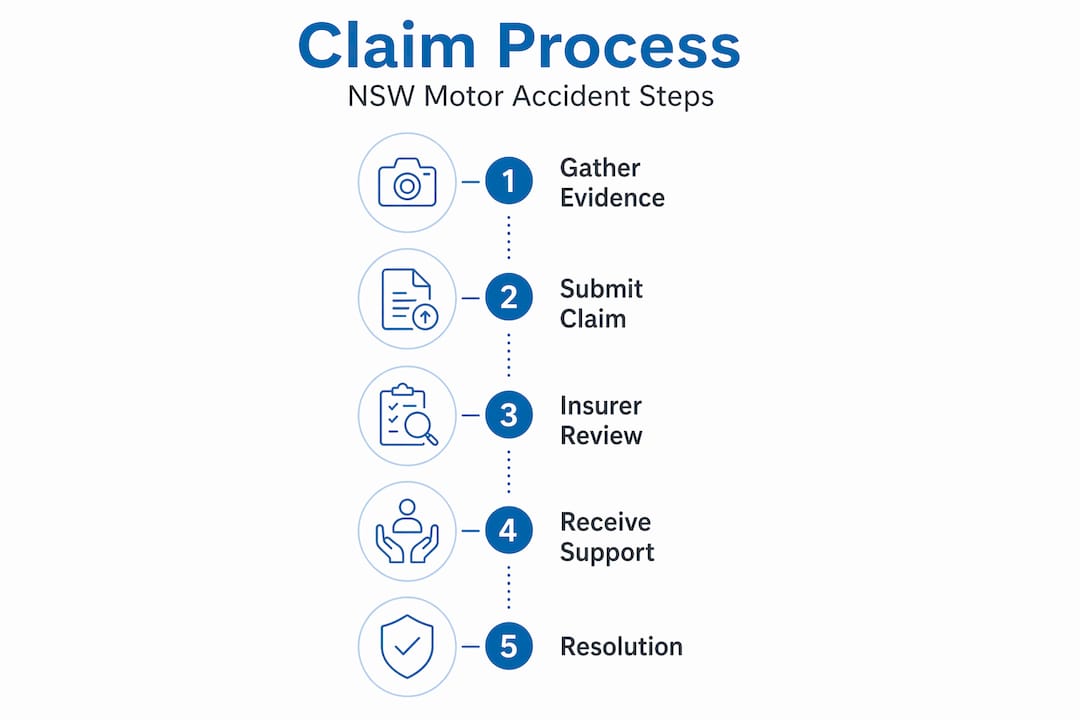
Infographic outlining motor accident claim steps

Stage Time limit Consequence of missing it
Lodge initial claim Within 28 days recommended Delay limits weekly payments and available supports
Request internal review Within 28 days of decline Lose right to easy internal reassessment
Commence court proceedings Generally 3 years from accident Claim may be statute-barred

Acting within 28 days is not just good practice. It is the threshold that protects your entitlement to ongoing income support from the moment your claim is lodged.

Finding the right CTP insurer

You need to lodge your claim with the CTP insurer of the at-fault vehicle, not your own insurer. In NSW, you can identify the insurer using the vehicle registration number through the SIRA website or by calling SIRA directly on 1300 137 131. Do not guess or assume. Lodging with the wrong insurer wastes time and may affect your entitlements.

Pro Tip: Take a photo of the at-fault vehicle’s number plate immediately after the accident. This single step removes the most common obstacle people face when trying to start their claim.

How to lodge your motor accident claim in NSW

Once you have your documents and have identified the insurer, you are ready to lodge. The motor accident claim process NSW claimants follow has two main pathways.

Your lodgement options

  1. Online via MyServiceNSW — The NSW government portal allows you to complete and submit the Personal Injury Claim form digitally. This is the fastest option.
  2. Directly with the CTP insurer — You can contact the insurer directly and lodge by phone, email, or post using the Personal Injury Claim form.

Both methods require you to complete the same form. The online pathway is generally more efficient because it creates a digital trail and confirms receipt in real time.

What happens after you lodge

The process following lodgement follows a clear sequence:

  1. The insurer acknowledges receipt within 3 business days of receiving your claim.
  2. A liability decision is made. This is the insurer’s formal acceptance or denial of your claim.
  3. A liability decision takes approximately 4 weeks after lodgement, though treatment costs related to your accident are typically covered during this period.
  4. Once liability is accepted, you begin receiving approved benefits.
  5. If the insurer requests additional information, respond promptly to avoid delays.

Comparing lodgement options

Method Speed Paper trail Best for
MyServiceNSW online portal Fast Automatic digital record Most claimants
Direct to insurer (phone/email/post) Variable Requires your own record-keeping Those needing guidance through the process

Pro Tip: Keep copies of every document you submit and every communication you receive. Date and label each item. If a dispute arises later, your records will matter enormously.

Avoiding common mistakes and handling denials

Even well-prepared claimants sometimes run into problems. Understanding where things go wrong puts you in a far better position to handle setbacks confidently.

The most frequent errors in car accident claims NSW claimants make include:

  • Incomplete claim forms — Missing fields or unsigned forms cause immediate delays. Review the form carefully before submitting.
  • Late medical evidence — Failing to see a doctor promptly after the accident creates gaps in your medical record that insurers will scrutinise.
  • Not disclosing pre-existing conditions — Failing to disclose relevant medical history can be treated as non-disclosure and may affect your claim’s credibility.
  • Accepting early settlement offers without legal advice — Some initial offers significantly undervalue long-term treatment needs and income losses.
  • Assuming a denial is final — A declined claim is not the end of the road.

If your claim is declined, you have the right to request an internal review within 28 days. This asks the insurer to reassess its decision. Many disputes are resolved at this stage without formal proceedings. You can find practical information on resolving disputes without court to understand your options before escalating.

If internal review does not resolve your matter, the Personal Injury Commission provides independent assessment and dispute resolution. SIRA also has oversight functions and can provide guidance when claimants face procedural barriers. Getting NSW accident legal advice early in this process is strongly recommended.

What compensation you can expect

Understanding the realistic outcomes of a claim helps you plan and make informed decisions throughout the process.

Types of compensation available

Compensation type Description Notes
Treatment expenses Medical, rehabilitation, and related costs Covered from lodgement, including during liability assessment
Weekly income payments Replaces lost earnings during recovery Available if lodged within recommended timeframes
Lump sum for pain and suffering One-off payment for non-economic loss Only available for injuries meeting the serious injury threshold
Future loss of earning capacity Compensates for reduced long-term income Assessed based on your age, occupation, and injury severity

Resolution timeframes vary considerably depending on the complexity of your injuries and whether liability is disputed. Straightforward claims where liability is accepted may resolve within a few months. Claims involving serious injuries or disputes over fault can take considerably longer.

Recent developments are worth noting here. SIRA’s two-year roadmap to improve insurer and health provider engagement aims to make treatment approvals more consistent and predictable. The focus is on clearer roles, better regulatory design, and improved education across the scheme. For claimants, this means more consistent engagement between health providers and insurers, which should reduce delays in getting treatment approved. These changes are being implemented progressively through 2026 and beyond.

Keep detailed records throughout your claim. Every medical appointment, every communication with the insurer, every expense incurred. This documentation directly supports your compensation outcome.

My perspective on NSW motor accident claims

I have worked with clients navigating motor vehicle injury compensation for many years, and the same pattern comes up repeatedly. People wait too long to act, and that hesitation costs them.

The 28-day threshold is not arbitrary. It exists because the system is designed to support people who engage with it promptly. In my experience, the clients who receive the best outcomes are not necessarily those with the most serious injuries. They are the ones who contacted a car accident lawyer early, documented everything carefully, and did not try to negotiate with the insurer alone.

I also want to address a misconception I see consistently. Many people believe that if they were partly at fault, they have no claim worth pursuing. This is simply not correct under NSW law. The scheme is genuinely designed to support injured people’s recovery, and partial fault is a matter of degree, not disqualification.

The SIRA reforms currently underway are, in my view, a genuine improvement. Greater consistency in treatment approvals will reduce the back-and-forth that so often delays care and frustrates claimants. The direction the system is heading in 2026 is a positive one. But the system still requires claimants to advocate for themselves and understand their rights. You cannot rely on the insurer to explain your full entitlements to you. That is not their role. It is yours.

Seek tailored legal advice early. Not because the process is impossible to navigate alone, but because the stakes are too high to leave anything to chance.

— Gaurav

How GKE Lawyers can help with your claim

https://gkelawyers.com.au

Dealing with the aftermath of a road accident is stressful enough without trying to navigate a complex claims process on your own. GKE Lawyers has extensive experience handling motor vehicle accident claims across NSW, from straightforward lodgements to disputed liability matters. We offer clear initial advice, assist with gathering evidence and completing paperwork, and represent clients in insurer negotiations and formal dispute processes. Our team understands how the CTP scheme works and what it takes to protect your entitlements from the outset. If you have been injured in a road accident, contact GKE Lawyers today to discuss your situation and understand your options before time limits affect your claim.

FAQ

What is a motor accident compensation claim in NSW?

A motor accident compensation claim in NSW is a formal claim made under the Compulsory Third Party insurance scheme to recover costs related to injuries sustained in a road accident, including medical expenses, lost income, and pain and suffering compensation.

How long do I have to lodge a CTP claim in NSW?

You should lodge within 28 days of the accident to protect your entitlement to weekly income payments. Longer limitation periods apply for commencing legal proceedings, but early lodgement is strongly recommended.

Can I claim if I was partly at fault for the accident?

Yes. Contributory negligence may reduce the amount you receive, but it does not eliminate your entitlement to treatment costs and income support under the NSW CTP scheme.

How long does it take to get a decision on my claim?

A liability decision typically takes approximately four weeks after lodgement. During that period, treatment costs related to your accident are generally covered so your care is not interrupted while the assessment is underway.

What can I do if my CTP claim is declined?

You can request an internal review within 28 days of the insurer’s decision. If the review does not resolve the matter, you can escalate to the Personal Injury Commission for independent assessment and dispute resolution.

Categories
Uncategorized

Selling House in NSW Legal Process Explained

Most NSW sellers realise the legal work starts well before the signboard goes up. If you are trying to understand the selling house in NSW legal process, the key point is this – you cannot legally market residential property for sale without a contract prepared by a solicitor or conveyancer.

That catches many owners by surprise, especially when they are also juggling an agent appointment, styling, finance deadlines or a related purchase. The legal process is not there to slow a sale down. It is there to make sure the property can be sold with the right disclosures, on clear terms, and with fewer settlement problems later.

Selling house in NSW legal process – where it starts

In New South Wales, the legal process usually begins with the contract for sale. Before a residential property is advertised, the seller must have an unsigned contract available. This contract is more than a price and an address. It includes the title details, prescribed documents and the terms that will govern the transaction.

For most sellers, this is the stage where a solicitor identifies issues that could affect timing, risk or negotiation strength. That might include an easement on title, an unapproved structure, a swimming pool compliance issue, a tenancy arrangement, or a discrepancy between the physical property and the registered plan.

If the property is part of a strata scheme, there may also be by-laws, levies and special levy concerns that shape what needs to be disclosed and how buyers assess value. If the sale is connected to a deceased estate, separation, refinance pressure or a simultaneous purchase, the legal strategy may also need to be adjusted early.

What goes into the contract for sale

A NSW contract for the sale of land must include prescribed documents. These usually include a title search, drainage diagram and planning certificate issued under section 10.7 of the Environmental Planning and Assessment Act. Depending on the property, other documents may also be needed or advisable.

The contract should also set out any special conditions that matter to the seller. This is where practical legal advice makes a real difference. A standard contract may not properly deal with a licence to occupy before settlement, delayed settlement terms, pool compliance obligations, inclusions, existing tenancies or work that has been done without final approvals.

This is also the point where sellers need straight answers about what must be disclosed and what should be disclosed. There is a difference. Failing to attach required documents can create a buyer’s right to rescind. Failing to clearly deal with a known issue can lead to dispute, delay or a compensation claim. A well-drafted contract reduces those risks rather than leaving them to be argued later.

Agent, auction or private treaty

The legal process intersects with the sales method more than many people expect. If the property is going to auction, the contract needs to be ready before the marketing campaign starts, and any bidder will be expected to review it in advance. If the property is sold at auction, there is generally no cooling-off period for the buyer.

With a private treaty sale, the buyer will usually receive a cooling-off period of five business days unless that right is waived or shortened in the proper way. That affects the seller’s certainty. During cooling-off, the buyer can withdraw, although they may forfeit part of the deposit. For a seller with tight timeframes, that distinction matters.

This is why contract preparation is not just an administrative task. It affects how cleanly the property can be taken to market and how exposed the seller may be once negotiations begin.

Exchange of contracts and what it means

A property is not sold simply because an offer has been accepted. In NSW, the critical legal step is exchange of contracts. That is when both parties are bound, subject to any applicable cooling-off rights and any agreed special conditions.

Before exchange, the seller’s lawyer may negotiate changes requested by the buyer’s solicitor. Common amendments include longer settlement periods, early access, reduced deposit, pest or building-related clauses, or terms dealing with tenancies and vacant possession. Some requests are reasonable. Others shift risk back onto the seller in ways that are not obvious without legal review.

Once contracts are exchanged, the deposit is usually paid and the timetable becomes more fixed. From that point, both parties are working towards settlement. If the seller simply changes their mind after exchange, the consequences can be serious.

The main legal issues that can delay a sale

Not every sale is straightforward, even in a strong market. The problems that tend to delay settlement are often issues that were sitting in the background well before a buyer appeared.

Unapproved renovations are a common example. A deck, pergola, converted garage or internal alteration may look minor to an owner but raise legal and lender concerns for a buyer. Sometimes the issue can be managed through disclosure and pricing. In other cases, the better option is to deal with approvals before the property goes to market.

Title issues can also create delays. That may include an old mortgage that was never properly discharged, incorrect owner details, a caveat, boundary inconsistency or an easement that affects access or use. If the property is strata, levy arrears or building defect concerns may also become part of the buyer’s due diligence.

Then there are practical matters with legal consequences – for example, whether the seller can provide vacant possession on settlement, whether tenants have been properly managed, or whether inclusions such as dishwashers, light fittings or garden structures are clearly listed. Small points become expensive when they are left vague.

Selling house in NSW legal process for settlement

Settlement is the final legal and financial completion of the sale. In most NSW transactions, settlement now occurs electronically through an approved platform, with lawyers, banks and financial institutions coordinating the transfer of funds and title.

In the lead-up to settlement, the seller’s lawyer will usually work through payout figures for any mortgage, prepare transfer documents, respond to requisitions on title and make sure all conditions for completion are in place. Timing matters here. If a discharge of mortgage has not been properly arranged, settlement can be pushed back. If rates, water or strata adjustments are not correctly calculated, the numbers may need to be reworked at the last minute.

The seller also needs to be ready on the ground. If the contract requires vacant possession, the property must be empty, reasonably clean and cleared of rubbish by settlement unless the contract says otherwise. Keys and access arrangements need to line up with completion. These sound like practical details rather than legal ones, but they can still trigger dispute if expectations and contract terms do not match.

When the seller’s situation is more complex

Some property sales involve wider legal issues that should not be treated as separate from the conveyance. If the property is being sold after separation, there may be family law considerations affecting authority to sell, division of proceeds or urgency around timing. If it is part of a deceased estate, the executor’s authority and estate administration steps need to be checked first.

For investors, capital gains tax and tenancy arrangements may shape how and when the property should be sold. For developers or owners selling property with potential subdivision or redevelopment value, zoning, planning controls and disclosure become commercially significant. A generic contract rarely does enough in these situations.

This is where working with a firm that understands NSW property law in a broader legal context can save both time and cost. At GKE Lawyers, that often means identifying the issue before it turns into a settlement problem.

How sellers can make the process easier

The smoothest transactions usually start with good preparation. Sellers who gather their title details, approvals, lease documents, strata records and mortgage information early tend to have fewer contract delays. They also make it easier for their lawyer to give clear advice on risk.

It also helps to be realistic about the property. If there is a known issue, the better approach is usually to deal with it directly rather than hoping it will not come up. Buyers, agents and lenders all ask more questions now, not fewer. A careful legal review at the start often protects the sale price by reducing uncertainty.

Clear communication matters as well. If you are buying and selling at the same time, need a longer settlement, or have concerns about a tenant, say so early. The legal process can often be tailored around those facts, but only if they are known before exchange.

Selling a property in NSW is rarely just about finding a buyer. It is about getting the contract right, managing disclosure properly and keeping the transaction on track through to settlement. With clear legal advice at the start, the process becomes far more predictable – and that gives sellers something just as valuable as a signed contract: confidence.

Categories
Uncategorized

The role of estate administrator explained

When someone passes away without a will, or when the named executor is unable to act, a family member or close associate may find themselves appointed as an estate administrator. The role of estate administrator carries significant legal weight, and many people are surprised to discover just how much responsibility it involves. This article walks you through what the role means, what the law requires, and how to approach the process with clarity and confidence.

Table of Contents

Key takeaways

Point Details
Court appointment is mandatory Administrators only gain legal authority after formal court appointment, not at the moment of death.
Fiduciary duty is absolute Administrators must act in the best interests of beneficiaries and creditors, keeping meticulous records throughout.
Timelines are strict Key milestones including inventory filing and creditor notice periods have deadlines that carry serious consequences if missed.
Personal liability is real Errors such as premature distributions or incorrect creditor payments can result in personal financial liability.
Legal support is worthwhile Engaging a probate lawyer reduces risk and helps administrators meet all legal obligations correctly.

Who is an estate administrator?

An estate administrator is a person appointed by a court to manage and distribute the assets of someone who has died. Unlike an executor, who is named in a will by the deceased, an administrator steps in when there is no valid will, or when the named executor has died, refused the role, or is otherwise unavailable. The executor vs administrator distinction matters legally, but both carry the same fiduciary obligations once appointed.

The court grants the administrator authority through a document called a grant of letters of administration. This is the legal instrument that allows the administrator to access bank accounts, sell property, pay debts, and ultimately distribute the estate to the rightful heirs. Without it, the administrator has no lawful power to act on behalf of the estate at all.

There are circumstances where the court may allow independent administration, which means the administrator can manage the estate without ongoing court supervision if all heirs agree. This can reduce costs and speed up the process considerably. However, it requires full consensus and carries no reduction in the administrator’s fiduciary duties.

The most common situations that lead to an administrator being appointed include:

  • The deceased died intestate, meaning without a valid will
  • The named executor has predeceased the estate owner
  • The executor has formally renounced their role
  • The executor is mentally or physically incapacitated
  • There is a dispute about the validity of the will itself

Core responsibilities of an estate administrator

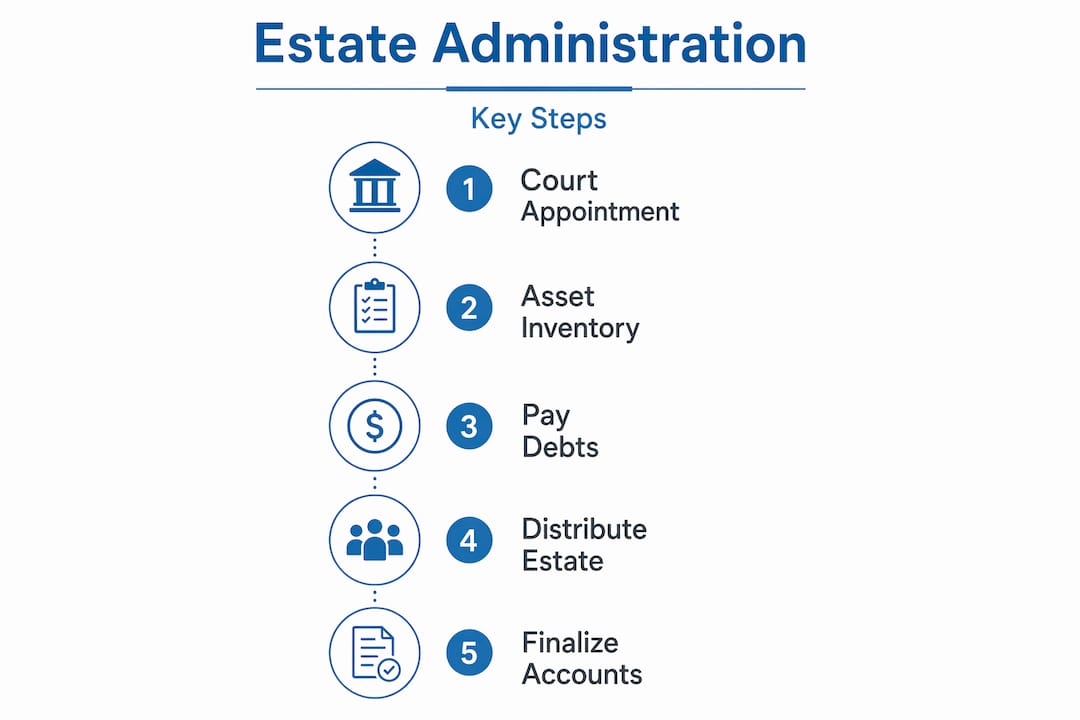
Once appointed, the estate administrator takes on a detailed and often demanding set of duties. Understanding these responsibilities upfront helps you avoid mistakes that can create legal complications or personal financial exposure. The duties of an estate administrator generally follow this sequence:

  1. Locate and secure all assets. This means identifying every bank account, investment, piece of real estate, vehicle, business interest, and personal item that belonged to the deceased. Nothing should be removed, sold, or transferred until you have formal authority to act.

  2. Open a dedicated estate bank account. All estate funds must flow through a separate account. Commingling estate funds with your personal finances can trigger legal challenges and expose you to personal liability.

  3. File an initial inventory. You are required to file an inventory of all estate assets, typically within three months of your formal appointment. Missing this deadline can result in court sanctions, including removal from the role.

  4. Notify creditors. You must publish a legal notice to alert creditors of the death and open a claims period. Creditors notified via notice are given a standard window of around four months to submit claims against the estate.

  5. Pay valid debts, taxes, and expenses. Once the creditor period closes, you settle legitimate debts in the correct legal order. Paying the wrong creditor first, or paying a beneficiary before all debts are cleared, can make you personally liable for any resulting shortfall.

  6. Maintain estate property. If the estate includes real property, it must be kept in reasonable condition throughout the administration. This includes paying insurance, rates, and utilities as required to preserve the asset’s value.

  7. Distribute the remaining assets. After debts and taxes are paid, you distribute what remains to heirs according to the rules of intestacy. These statutory rules dictate who inherits and in what proportion when there is no will.

  8. File a final accounting. Before the estate can be formally closed, you must submit a detailed account of every financial transaction made during administration. The court or beneficiaries review this record before approving distribution.

Pro Tip: Keep every receipt, bank statement, letter, and correspondence related to the estate in one organised folder. Your final accounting will be far easier to prepare, and you will have a clear paper trail if any beneficiary questions your decisions.

Timelines and key milestones

Infographic showing estate administration steps

One of the most common sources of stress for new administrators is not knowing how long the process takes or when key steps must happen. The table below provides a general framework. Specific deadlines vary by jurisdiction, so always confirm requirements with a qualified solicitor.

Stage Typical timeframe
Court appointment and letters of administration Weeks 1 to 8
Initial inventory filed Within 3 months of appointment
Creditor notice published and claims period open Months 2 to 6
Debts and taxes paid Following creditor claims period
Final accounting prepared and filed Months 12 to 24
Assets distributed to beneficiaries Months 12 to 24

The overall duration of administration typically falls between 9 months and 2 years, depending on the size and complexity of the estate, the number of beneficiaries, and whether any disputes arise. A straightforward estate with minimal assets and cooperative heirs may close well within 12 months. An estate involving contested property, business interests, or uncooperative beneficiaries can stretch considerably longer.

Man updating timeline calendar in office

Missing key deadlines has real consequences. Failing to file the inventory on time can result in the court removing you as administrator. Delaying creditor notices can expose the estate to additional claims. Rushing to distribute assets before debts are fully settled can leave you personally responsible for any unpaid obligations.

The role of estate administrator is not simply an administrative task. You are a fiduciary, which means the law holds you to the highest standard of care and loyalty. Administrators must prioritise beneficiaries’ interests above their own and maintain absolute transparency in every decision they make.

The practical implications of this duty are significant:

  • You cannot use estate funds for personal benefit, even temporarily
  • You must not favour one beneficiary over another unless the law expressly requires a priority
  • You are personally liable if you distribute assets prematurely, pay creditors in the wrong order, or fail to preserve estate property
  • You have no authority to act before your court appointment is formally granted. Acting before appointment risks legal complications that can undermine the entire administration

Many administrators are surprised to learn that good intentions are not a legal defence. If you make an honest mistake that causes a financial loss to the estate, you may be required to cover that loss from your own funds. This is not meant to discourage you from accepting the role. It is meant to underscore why getting the process right matters so much.

Pro Tip: Before taking any action with estate assets, confirm with a probate lawyer in Sydney that your letters of administration are in order. Acting even a day early can create problems that take months and considerable expense to resolve.

Administrators also represent the interests of creditors, not just beneficiaries. You are required to deal with creditors honestly and in accordance with legal priority rules. Hiring a probate attorney is widely considered one of the most effective ways to protect yourself from inadvertent mistakes during this process.

Practical tips for managing the process well

Managing an estate effectively comes down to organisation, communication, and patience. Here are the habits that make the biggest difference:

  • Document everything from day one. Start a dedicated file the moment you are appointed. Record every phone call, decision, and transaction with dates and details.
  • Communicate regularly with beneficiaries. Keeping heirs informed reduces suspicion and prevents disputes. You do not need to share every legal document, but regular updates on progress go a long way.
  • Understand your tax obligations. The estate may have outstanding income tax returns to file, and there may be tax implications for the distribution itself. Engage an accountant early if the estate has any complexity.
  • Seek professional advice sooner rather than later. The estate administration process involves legal, financial, and sometimes property-related decisions. Lawyers and accountants can identify issues before they become costly problems.
  • Pace yourself. Administration takes months. Rushing decisions to close the estate quickly is one of the most common causes of errors and disputes.

My perspective on what this role actually demands

I have seen many families step into the administrator role with the best intentions and still find themselves overwhelmed within the first few weeks. The reason is almost always the same: they did not realise the role carries genuine legal weight, not just administrative duties.

What strikes me most is how often people assume they can start managing the estate immediately after a death. That assumption is understandable. You are grieving, there are urgent practical matters to address, and waiting feels impossible. But acting before formal appointment is one of the most consequential mistakes an administrator can make. It can invalidate transactions, expose you to personal liability, and create disputes that damage family relationships for years.

In my experience, the administrators who handle this role most effectively share a few common traits. They ask questions early. They keep records obsessively. They do not try to manage complex estates alone. And they remain patient even when beneficiaries are pressing for faster action.

The emotional dimension of this work is real and often underestimated. You are managing a legal process while also grieving. That combination is genuinely difficult, and there is no shame in acknowledging it. Transparency with the people around you, combined with proper legal guidance, is the most reliable path through.

— Gaurav

How GKE Lawyers can help you through this process

If you are facing the responsibility of administering an estate in New South Wales, you do not need to navigate it alone.

https://gkelawyers.com.au

GKE Lawyers is a full-service Sydney law firm with dedicated expertise in wills and estate administration. Our team helps administrators understand their legal obligations, apply for letters of administration, manage creditor notices, and complete the final accounting and distribution process. We also assist with the property-related aspects of estates, including transfers and sales under our property law services. Whether you are just starting the process or have hit a difficult point mid-administration, our solicitors can provide clear guidance tailored to your situation. Contact GKE Lawyers to arrange a consultation and take the guesswork out of estate administration.

FAQ

What is the difference between an executor and an administrator?

An executor is named in a will by the deceased, while an administrator is appointed by a court when there is no will or the executor is unavailable. Both roles carry the same fiduciary duties once formally authorised.

When can an estate administrator start acting?

An administrator can only act after receiving a formal court appointment and the grant of letters of administration. Acting before that point carries significant legal risk and can complicate the entire estate process.

How long does estate administration typically take?

Estate administration generally takes between 9 months and 2 years, depending on the estate’s size, the number of beneficiaries, and whether any disputes arise among heirs or creditors.

Can an administrator be held personally liable?

Yes. Administrators can be held personally liable for losses caused by errors such as premature distributions, incorrect creditor payments, or failure to maintain estate assets properly.

Do I need a lawyer to administer an estate?

While you are not legally required to engage a solicitor, doing so is strongly advisable. A probate lawyer helps you meet all legal deadlines, avoid personal liability, and manage complex decisions with confidence.

Categories
Uncategorized

Buying Property in NSW Checklist

The difference between a smooth purchase and an expensive headache often comes down to what happens before you sign. A proper buying property in NSW checklist is not just a to-do list. It is a way to catch legal issues, finance problems and property risks early, when they are still manageable.

In New South Wales, buying property moves quickly once a contract is issued. Buyers who wait until the last minute to review documents or arrange advice can end up under pressure, especially at auction or in competitive private treaty sales. The safest approach is to know what needs checking at each stage and get clear advice before you are committed.

Buying property in NSW checklist: what to do first

Start with your budget, but be realistic about the full cost of the purchase. The price on the listing is only part of the equation. You also need to account for stamp duty, legal fees, search costs, lender fees and moving expenses. If the property is an investment or part of a development strategy, holding costs and future compliance obligations also matter.

Finance pre-approval is usually the next step, but it should be treated carefully. Pre-approval is not the same as unconditional finance. Lenders can still decline approval if the property does not meet lending criteria, the valuation comes in low or your circumstances change. That is why buyers should avoid assuming that pre-approval guarantees settlement.

It also helps to be clear on the type of property you are buying. A freestanding house, strata unit, vacant land and off-the-plan apartment all carry different legal and practical risks. The right checks for one may not be enough for another.

Before you make an offer

Before making an offer, ask for a copy of the contract for sale. In NSW, this document is available early in the campaign and should be reviewed before you commit. It usually includes the title search, plan, drainage diagram, zoning certificate and prescribed documents, but what is attached can vary.

This is where many buyers make avoidable mistakes. They focus on price and presentation, but overlook easements, restrictions on use, unapproved structures or special conditions that change the usual position. A contract review can identify issues such as rights of way, sewer mains, boundary discrepancies, zoning limits or unusual settlement terms.

If the property is in a strata scheme, the records need attention as well. A strata inspection can reveal levy arrears, pending special levies, building defect disputes, combustible cladding concerns or ongoing issues between the owners corporation and residents. A unit may look well maintained on inspection day while the records tell a very different story.

Building and pest inspections are also worth arranging before exchange wherever possible. These reports are not legal documents, but they often raise legal and commercial questions. For example, if a deck, carport or granny flat appears to have been added without approval, that should be investigated properly rather than brushed aside as a minor issue.

The contract review stage matters more than buyers think

A contract review is one of the most important parts of any buying property in NSW checklist because this is the point where risks are visible and options still exist. Once contracts are exchanged, your room to negotiate narrows quickly.

A careful review should consider whether the seller has good title, whether there are restrictions affecting your plans for the property and whether the contract terms expose you to unnecessary risk. If you are buying with someone else, ownership structure also matters. Joint tenants and tenants in common have different legal consequences, particularly for estate planning and future disputes.

It may also be necessary to check whether the property is affected by road widening proposals, heritage controls, flood risk, bushfire planning requirements or local council restrictions. These issues do not always stop a purchase, but they can affect insurance, renovation plans, future value and finance approval.

For investors and developers, the checklist becomes more detailed. Existing leases, use rights, zoning permissibility and development potential should be assessed early. A site that looks promising on an agent’s brochure may be less flexible once planning controls and title restrictions are examined closely.

Auction purchases need earlier preparation

Auction buyers need to complete almost all due diligence before bidding. There is no cooling-off period for residential property bought at auction in NSW, and the contract becomes binding as soon as the hammer falls. That means finance, inspections and legal review should be done in advance.

This is where timing matters. If you plan to bid, do not wait until the morning of the auction to ask for legal advice. You need enough time to understand the contract, request amendments if needed and decide on your limit with confidence.

Auction contracts are not always standard in practical effect. A seller may include special conditions that shorten settlement, shift risk or alter default provisions. Those terms should be reviewed before auction day, not after.

Exchange of contracts and cooling-off period

For most private treaty residential purchases in NSW, there is a five-business-day cooling-off period after exchange unless it is waived, shortened or does not apply. During this period, a buyer can withdraw, but there is usually a financial cost. That makes the cooling-off period useful, but not something to rely on as a substitute for proper pre-contract checks.

Before exchange, confirm the deposit amount, settlement period and any special conditions. If your finance is still progressing, your legal representative may be able to negotiate terms that better protect your position, depending on the circumstances. Not every seller will agree, especially in a strong market, but it is far better to ask than to assume.

You should also make sure the name or names on the contract are correct. Errors in the purchasing entity can cause delays, stamp duty complications and lender issues. This is particularly relevant where a trust, company or SMSF is involved.

What to check between exchange and settlement

Once contracts are exchanged, the focus shifts from investigation to completion. Your lender will work towards formal approval and loan documentation, while your conveyancer or property lawyer handles settlement preparation, adjustments and required searches.

At this stage, buyers should arrange insurance where appropriate. In NSW, the risk position can depend on the contract terms and the type of property, so this should not be left to guesswork. Utility connections, final finance documents and available funds for settlement also need to be organised early enough to avoid last-minute problems.

A final inspection is another important step. This is not a fresh building inspection. It is a practical check that the property is in the same condition as when sold, inclusions remain in place and no significant damage has occurred before settlement. If something is wrong, it is easier to raise it before settlement takes place.

Your representative will also calculate settlement adjustments, including council rates, water rates and strata levies where relevant. These figures ensure each party pays the correct share up to the settlement date.

Common issues that can derail settlement

Delays usually come from one of a few predictable problems. Finance may not be ready, the purchaser’s name may not match the loan documents, funds may be short because costs were underestimated, or title issues may take longer than expected to resolve.

Sometimes the issue is with the property itself. An unregistered plan, missing occupation certificate, unresolved strata matter or discrepancy in the contract documents can slow things down. In other cases, settlement is delayed because one party assumes something has been handled when it has not.

This is why responsive advice matters. Quick, clear communication can often prevent a manageable issue from becoming an expensive one.

A practical checklist for NSW buyers

If you want a simple framework, make sure you have covered these points before settlement: confirm your budget including stamp duty and fees, obtain finance pre-approval, review the contract before signing, investigate title and zoning issues, arrange building, pest or strata inspections where relevant, understand the cooling-off or auction position, check the ownership structure, secure formal finance approval, arrange insurance if needed, complete the final inspection and make sure settlement funds are ready.

That list sounds straightforward, but each step can involve legal detail that affects your rights. For that reason, many buyers prefer to get practical advice early rather than deal with surprises later. Firms such as GKE Lawyers focus on giving NSW buyers fast, plain-English guidance so decisions can be made with confidence instead of guesswork.

Buying property is a major financial decision, but it should not feel like a blind leap. When the process is handled properly, you can move forward knowing the property, the contract and the risks have all been checked with care.

Categories
Uncategorized

What is estate distribution NSW: your legal guide

When someone dies in New South Wales, their assets do not simply transfer to loved ones overnight. Understanding what is estate distribution NSW means understanding a structured legal process governed by specific laws, timelines, and protections. Many people assume distribution happens quickly. In reality, executors must follow a defined sequence of steps to protect beneficiaries, creditors, and themselves. Whether you are a beneficiary, an executor, or someone planning ahead, knowing how the estate distribution process NSW works can save you from costly mistakes and unnecessary conflict.

Table of Contents

Key takeaways

Point Details
Distribution takes time Executors typically wait up to 12 months before distributing assets to manage debts and potential claims.
Notices protect executors A Notice of Intended Distribution gives creditors 30 days to make claims before assets are released.
Intestacy has clear rules Without a valid will, the Succession Act 2006 (NSW) dictates who receives what and in what order.
Joint tenancy bypasses wills Property held as joint tenancy passes automatically to the surviving owner, regardless of will provisions.
Family provision claims are broad Eligible claimants include close personal friends with domestic relationships, not just immediate family.

Estate distribution in New South Wales rests on a clear legal framework. When a person dies leaving a valid will, their appointed executor applies to the Supreme Court of NSW for a grant of probate. Probate confirms the will is valid and authorises the executor to act. Once granted, the executor has the legal authority to collect assets, pay debts, and distribute what remains to the named beneficiaries.

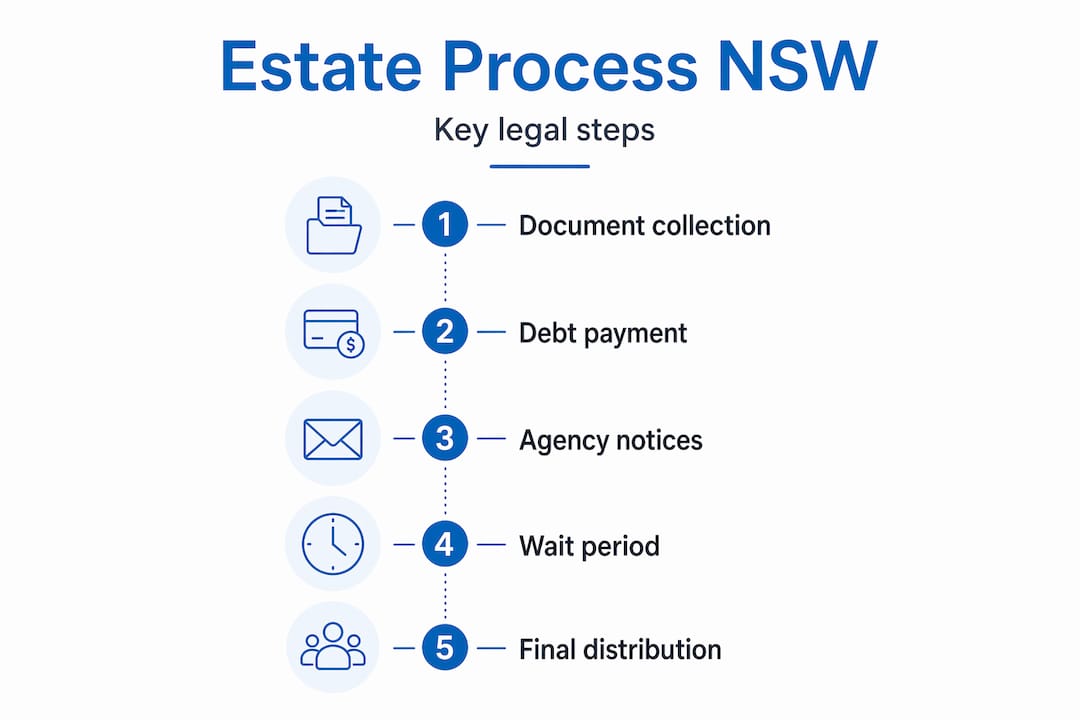
Estate administration involves collecting documents, paying debts, notifying agencies, waiting out challenge periods, and distributing assets according to the will or intestacy rules. The NSW Trustee and Guardian can act as executor when no suitable person is available or willing to take on the role.

When no valid will exists, the person is said to have died intestate. In that case, a family member or other eligible person applies to the court for letters of administration. Under NSW estate distribution laws, the administrator must follow the rules set out in the Succession Act 2006. These rules define who is entitled to benefit from the estate and in what proportions, based on the deceased’s surviving relatives.

The key players in the NSW will and estate distribution process include:

  • The executor or administrator, who manages the estate and carries out distribution
  • The Supreme Court of NSW, which grants probate or letters of administration
  • Beneficiaries, who are entitled to receive assets after debts are settled
  • Creditors, who must be paid before any distribution to beneficiaries occurs
  • The NSW Trustee and Guardian, who can step in when no suitable private administrator is available

NSW estate distribution laws prioritise debts and liabilities above all else. No beneficiary can receive their share until outstanding financial obligations are settled. This is a fundamental principle that often surprises people unfamiliar with the process.

The estate distribution process and timing in NSW

One of the most common misconceptions people hold is that estate distribution happens within weeks of a person’s death. The reality is more measured, and for good reason.

Infographic showing estate distribution steps NSW

Executors often wait up to 12 months before distributing assets to allow time for debts to be identified and potential claims to be resolved. This waiting period, sometimes called the “executor’s year,” is a recognised practice in NSW law. Distributing too early can expose the executor to personal liability if a creditor or claimant appears after assets have already been transferred.

The typical estate distribution process NSW follows these steps:

  1. Obtain probate or letters of administration. This is the first formal step and authorises the executor or administrator to act on behalf of the estate.
  2. Identify and collect all estate assets. This includes bank accounts, property, investments, personal belongings, and any other assets the deceased owned.
  3. Notify relevant government agencies and financial institutions. Centrelink, the Australian Taxation Office, and banks must all be informed of the death.
  4. Pay outstanding debts, liabilities, and taxes. All creditors must be paid before beneficiaries receive anything.
  5. Publish a Notice of Intended Distribution. This notice is published through the NSW Online Registry and gives creditors and potential claimants at least 30 days to notify the executor before assets are distributed.
  6. Wait for the notice period to expire. Once the 30-day period has passed without valid claims, the executor can proceed with confidence.
  7. Transfer assets to beneficiaries. Property is transferred, accounts are closed, and other assets are distributed according to the will or intestacy rules.

The Notice of Intended Distribution deserves particular attention. While not strictly mandatory, it is highly recommended by the Law Society of NSW as it significantly reduces the executor’s personal liability. Publishing the notice signals to the world that distribution is imminent and invites any outstanding claims to come forward.

In some circumstances, an executor may make interim distributions to beneficiaries while the estate is still being administered. This can help beneficiaries who have immediate financial needs. Any interim distribution should be carefully documented and accounted for against the final distribution figure.

Pro Tip: If you are an executor considering distributing before the 12-month mark, seek legal advice before acting. The personal financial risk of premature distribution is real and can be avoided with proper guidance.

Intestacy and succession rules for NSW estates

When a person dies without a valid will, NSW intestacy laws determine who receives the estate. Many people assume a spouse automatically receives everything. That is not always correct under the Succession Act 2006.

Couple reading estate succession paperwork

When a person dies intestate in NSW, courts grant administration to the person with the greatest entitlement, who must then follow the intestacy rules strictly. The administrator must fully resolve one category of entitled relatives before moving to the next.

The following table shows how intestacy entitlement works in common family situations:

Family situation Who receives the estate
Spouse or de facto partner only (no children) Entire estate to the spouse or partner
Spouse and children from that relationship Entire estate to the spouse or partner
Spouse and children from another relationship Spouse receives personal effects, a statutory legacy, and half the remainder; children share the other half
No spouse, but children survive Entire estate shared equally among the children
No spouse, no children Estate passes to parents, then siblings, then more distant relatives
No surviving relatives Estate passes to the NSW Government as bona vacantia

When the family structure is complex or relatives are difficult to locate, genealogical research may be required to identify all eligible beneficiaries. The NSW Trustee and Guardian can assist in these situations and may be appointed to administer the estate when private administration is not practicable.

Understanding your estate distribution rights NSW under intestacy rules is particularly relevant if you are in a de facto relationship. A de facto partner who lived with the deceased for at least two years may be entitled to a share of the estate, but this must be established and is not assumed automatically.

Common complexities and disputes in estate distribution

Even when a will exists and the executor is acting in good faith, estate distribution in NSW can become complicated. Several factors regularly lead to disputes, delays, or unintended outcomes.

Joint tenancy and its impact on distribution

Property ownership structure has a significant effect on how to distribute estate NSW assets. Property held as joint tenancy passes automatically to the surviving owner by the right of survivorship, regardless of what the will says. This means a person could have a carefully drafted will leaving their property to their children, but if that property is held in joint tenancy with a spouse or partner, the will’s provisions are overridden entirely.

Severing a joint tenancy before death is the only way to bring the property into the estate and allow it to be distributed according to the will. Legal advice is critical here. A solicitor’s duty of care extends to intended beneficiaries, meaning that errors in will drafting that fail to account for joint tenancy can create liability for the advising solicitor.

Family provision claims

Beneficiary rights estate NSW law extends beyond what a will provides. Eligible persons can apply to the Supreme Court for a family provision order if they believe they have not been adequately provided for. Family provision claims can be made by a wide group of people, including children, spouses, former spouses, and in some cases, close personal friends.

A 2026 NSW Supreme Court decision confirmed that close personal relationships involving cohabitation and mutual support may qualify a person as an eligible claimant. Evidence such as shared bills, rent receipts, or proof of domestic arrangements can establish the required relationship. This is a significant development that broadens the scope of who can contest an estate distribution.

Common triggers for disputes and complexities include:

  • Ambiguous or poorly drafted will provisions that create uncertainty about the testator’s intentions
  • Multiple beneficiaries with conflicting interests, particularly in blended families
  • Delays in obtaining probate that freeze estate assets and cause financial hardship for dependants
  • Disputes over asset valuation, especially for property, businesses, or investments
  • Executors who fail to act promptly or who have a conflict of interest

Pro Tip: If you suspect you have grounds to contest a distribution or make a family provision claim, time limits apply in NSW. You generally have 12 months from the date of death to make a family provision application. Acting promptly protects your position.

My perspective on estate disputes I’ve seen

I have worked through enough estate matters in NSW to say with confidence that most disputes do not start with bad intentions. They start with assumptions. Families assume the house will go to them. Executors assume they can distribute quickly. Beneficiaries assume a will covers everything.

In my experience, the joint tenancy issue catches more families off guard than almost anything else. I have seen well-drafted wills rendered ineffective because no one reviewed the property title before the testator died. The legal outcome was technically correct, but it was not what anyone intended. That kind of outcome is entirely preventable with proper estate planning advice.

The 12-month waiting period frustrates beneficiaries more than any other part of the process. People are grieving and facing financial pressure, and being told to wait feels unreasonable. But I have also seen what happens when executors rush. Creditors appear. Claims are lodged. And suddenly the executor faces personal liability for assets they distributed too early. Patience genuinely protects everyone.

What I have also learned is that family provision claims are not always about greed. Many are about people who were genuinely dependent on the deceased and were simply left out of a will that had not been updated in years. The law in NSW is structured to catch those situations, and that is appropriate.

If you are an executor, a beneficiary, or someone facing a contested estate, get proper legal advice early. The cost of early advice is a fraction of the cost of resolving a dispute that was allowed to develop unchecked.

— Gaurav

How GKE Lawyers can help with estate distribution

Dealing with an estate after a death is rarely straightforward, and the legal obligations on executors and administrators are real. GKE Lawyers provides clear, practical guidance through every stage of the NSW estate distribution process.

https://gkelawyers.com.au

Whether you need assistance obtaining probate in NSW, advice on executor duties, support with an intestacy matter, or representation in a family provision dispute, GKE Lawyers has the experience to help. Our wills and estates team works with clients across Sydney and throughout New South Wales to protect their rights and achieve fair outcomes. We also assist with property law matters that intersect with estate distribution, including joint tenancy issues and title transfers. Contact GKE Lawyers today to discuss your situation with a solicitor who understands the full picture.

FAQ

What is estate distribution in NSW?

Estate distribution NSW is the legal process of transferring a deceased person’s assets to beneficiaries after debts, taxes, and liabilities are paid. It follows either the terms of a valid will or the intestacy rules under the Succession Act 2006.

How long does estate distribution take in NSW?

Executors typically wait up to 12 months before making a final distribution to allow time for debts to be settled and claims to be resolved. Publishing a Notice of Intended Distribution helps reduce executor liability during this period.

What happens if someone dies without a will in NSW?

If a person dies intestate in NSW, an administrator is appointed by the court to distribute the estate according to the Succession Act 2006 intestacy rules. These rules specify which relatives are entitled and in what order and proportion.

Can a will be contested in NSW?

Yes. Eligible persons can apply to the Supreme Court for a family provision order if they believe the will does not make adequate provision for them. Recent NSW case law confirms this includes people in close personal relationships with the deceased, beyond immediate family.

Does jointly owned property form part of an estate in NSW?

Not automatically. Property held as joint tenancy passes directly to the surviving owner by right of survivorship and does not form part of the estate. Only property held as tenants in common can be distributed through a will or under intestacy rules.

Categories
Uncategorized

Can a Lawyer Handle Conveyancing in NSW?

If you are buying or selling property, one of the first questions you may ask is: can a lawyer handle conveyancing? In New South Wales, the answer is yes. A solicitor can manage the full conveyancing process, and in many matters that brings an added layer of legal advice that goes beyond processing paperwork.

That distinction matters more than many people realise. A property transaction is not just an administrative exercise. It can involve contract negotiation, title issues, easements, zoning concerns, stamp duty, finance deadlines, tenancy questions, and last-minute disputes before settlement. When those issues arise, having a lawyer involved can save time, reduce risk, and make the process far easier to manage.

Can a lawyer handle conveyancing from start to finish?

Yes. In NSW, a qualified lawyer can handle conveyancing from the initial contract review through to settlement and post-settlement requirements. That includes acting for buyers, sellers, investors, developers, and businesses dealing with commercial property.

A solicitor can prepare or review the contract for sale, advise on special conditions, explain cooling-off rights, conduct due diligence, liaise with the other side, work with your lender, calculate adjustments, and complete settlement through the relevant electronic platform. If legal complications emerge during the transaction, the same lawyer can also advise on the broader legal position rather than referring you elsewhere.

This is often where clients see the practical difference. A standard transaction may look straightforward at first, but property matters in NSW can become complex quickly. Issues involving unapproved structures, caveats, rights of way, strata by-laws, council orders, deceased estates, family law interests, or business use of the property can all affect how a matter should be handled.

What conveyancing actually involves

Many people think conveyancing means lodging forms and moving money at settlement. In reality, it is the legal transfer of ownership from one party to another, supported by a series of checks, disclosures, and contractual steps.

For a purchaser, that may include reviewing the contract before signing, checking title details, arranging searches, confirming inclusions, advising on stamp duty, tracking finance approval, and making sure settlement can proceed on time. For a seller, it usually includes preparing the contract, ensuring prescribed documents are attached, responding to requisitions, coordinating discharge of mortgage, and settling the sale proceeds correctly.

In NSW, conveyancing is shaped by state-specific legislation, local council requirements, and practical property market conditions. That is one reason local experience matters. A transaction in Sydney may raise issues around zoning, heritage, strata defects, development potential, road widening, flood planning, or use restrictions that are not obvious from a quick reading of the contract.

Lawyer or conveyancer – what is the difference?

Both lawyers and licensed conveyancers can handle many property transfers. The difference is not that one can do conveyancing and the other cannot. The difference is in the scope of legal service they can provide.

A licensed conveyancer focuses on conveyancing work. A solicitor can do that work too, but can also advise on connected legal issues if the matter becomes more complicated. That broader legal capacity can be valuable where the transaction overlaps with tax structuring, family law settlements, commercial leases, probate, disputes, option agreements, trust arrangements, or development projects.

That does not mean every matter requires a lawyer. For a very simple transfer, a licensed conveyancer may be suitable. But many clients only discover the legal complexity of their matter after the contract is signed. By that stage, timing pressure can be significant.

When using a lawyer for conveyancing makes particular sense

There are situations where instructing a solicitor from the outset is often the safer course.

If you are buying at auction, there is no cooling-off period, so the contract should be reviewed before you bid. If you are purchasing through a trust or company, the ownership structure needs to be handled properly from the start. If the property has a tenant, is part of a deceased estate, has an informal building addition, or is affected by a family law arrangement, legal advice is not a luxury – it is part of protecting your position.

The same applies to commercial property. Retail leases, GST treatment, going concern provisions, land tax adjustments, assignment terms, and development conditions can all affect value and risk. In those matters, conveyancing is only one piece of the transaction.

Property investors also benefit from legal advice that looks beyond settlement day. The contract terms, title restrictions, strata records, planning controls, and leasing arrangements can all influence what you can actually do with the property after purchase.

Can a lawyer handle conveyancing more effectively in complex matters?

Often, yes. The key reason is that complex property matters rarely stay confined to conveyancing alone. They move into legal interpretation, negotiation, and risk management.

Take a common example: a buyer discovers an unapproved granny flat after exchanging contracts. That issue may affect value, insurance, lending, and future use of the property. A solicitor can advise on the contractual position, possible remedies, disclosure obligations, and whether there is scope to negotiate or terminate. A similar issue can arise where an easement limits development plans, or where a caveat appears on title unexpectedly.

In those moments, clients usually want one clear answer from one professional who can see the whole picture. That is where a lawyer’s broader training becomes especially useful.

Cost – is a lawyer more expensive?

Sometimes, but not always. Many firms offer fixed-fee conveyancing for standard matters, with clear disclosure if additional work is required. The better question is not just what the upfront fee is, but what value you are receiving for that fee.

A lower quote may not include contract negotiation, detailed advice on risks, attendance to unusual title issues, or support if the matter becomes disputed. On the other hand, a transparent legal fee can be cost-effective if it helps avoid delays, contract breaches, or expensive mistakes.

For buyers and sellers, certainty on pricing matters. So does clarity on scope. Before appointing anyone, ask what is included, what may trigger additional charges, and who will actually run your file.

What to look for in a property lawyer

If you decide to use a solicitor, choose someone with real experience in NSW property transactions rather than general legal practice alone. Conveyancing is highly procedural, but good property law service is also strategic. You want advice that is technically accurate, commercially sensible, and easy to understand.

Look for a lawyer who explains the contract in plain English, identifies issues early, responds promptly, and knows how local council processes and NSW land rules affect the deal. If your matter involves development potential, strata issues, business use, or a dispute risk, that experience becomes even more important.

For many clients, the best service is not the longest advice letter. It is clear guidance at the right time, with practical recommendations about what to do next.

The NSW position in practical terms

In NSW, a lawyer can handle conveyancing for residential, commercial, strata, off-the-plan, and vacant land transactions. They can also assist with related matters such as transfers between family members, deceased estate property, refinancing, and ownership changes involving trusts or companies.

That breadth can make the process more efficient. Instead of treating the transaction as a narrow administrative file, a property lawyer can assess the legal and practical consequences together. For clients who want quick, quality legal advice they can actually understand, that approach tends to be more useful than simply being told where to sign.

At GKE Lawyers, this is exactly how we approach property matters – with clear advice, transparent pricing, and strong working knowledge of NSW real property law and local processes.

So, can a lawyer handle conveyancing?

Yes, absolutely. In NSW, a lawyer can handle conveyancing and, in many cases, provide broader protection than a service limited to the transfer itself. Whether that is the right choice for you depends on the nature of the property, the contract terms, your risk tolerance, and whether there is any chance the matter may become more complicated.

If your transaction is simple, you may have options. If there is any uncertainty, legal complexity, or real money on the line, instructing a property lawyer early is often the more prudent decision. A property deal should feel properly managed, not merely processed – and the right advice at the start can make all the difference by settlement day.

Categories
Uncategorized

Commercial lease clauses checklist for NSW tenants

Signing a commercial lease without understanding its critical clauses is one of the most common and costly mistakes NSW business owners make. A thorough commercial lease clauses checklist is not just useful before you sign — it is essential to protecting your business finances, your operational freedom, and in some cases, your personal assets. Many tenants focus solely on the base rent figure and miss the provisions that can quietly erode profitability over the life of the lease. This guide gives you the clarity and structure to read your lease with confidence.

Table of Contents

Key Takeaways

Point Details
Understand lease clauses Knowing key commercial lease clauses helps you avoid unexpected costs and restrictions.
Prioritise negotiation Focus on clauses that match your lease term and business needs to best protect your interests.
Watch for hidden costs Operating expenses and personal guarantees can add significant financial risk beyond base rent.
Seek expert advice Professional legal help ensures your lease terms are fair and your business is safeguarded.

Key criteria to evaluate in a commercial lease

Before you work through individual clauses, you need a framework for deciding what matters most. Not every clause carries equal weight for every business. A retail tenant in a Sydney shopping strip has different priorities to a warehouse operator in Western Sydney or a professional services firm in the CBD.

When approaching your lease agreement checklist, consider these core criteria:

  • Lease length and flexibility. A longer lease offers rent certainty but reduces your ability to respond to business changes. Shorter leases carry renewal risk.
  • Total financial exposure. Base rent is only one component. Operating expenses, insurance contributions, and council rates can add significantly to your monthly outgoings.
  • Exit and transfer rights. Can you assign the lease, sublet the space, or exit early if your business circumstances change? These provisions are often overlooked until they become urgent.
  • Permitted use. Does the lease allow the full scope of what your business does today, and what you might do in the future? A clause that is too narrow can restrict growth.
  • Operational obligations. Some leases include continuous operation requirements, meaning you must trade during set hours regardless of your business performance.
  • Your business size and stage. A start-up has very different risk tolerance compared to an established business with predictable revenue. Negotiate accordingly.

These criteria should shape how you prioritise every other clause in the lease. Work through your key lease provisions with these factors front of mind.

Critical lease clauses every tenant should know

With the key criteria defined, here are the important lease clauses that warrant careful negotiation.

Base rent and escalation terms

The starting rent figure matters less than how it changes over time. Common escalation mechanisms include fixed annual increases (such as 3–4%), CPI-linked increases, or market rent reviews. Market reviews in particular can be unpredictable and may lack a cap, so insist on a ratchet clause that prevents rent from falling below the current level, or negotiate a cap on any upward review.

Operating expenses and CAM charges

Common area maintenance (CAM) charges cover shared building costs such as cleaning, security, landscaping, and building management fees. In triple net (NNN) arrangements, operating expenses can increase total occupancy costs by 30% to 100% above base rent. This is a figure most tenants do not anticipate when they first compare properties. Negotiate a cap on controllable expenses and request specific exclusions for capital expenditure items and management fees above market rates.

Property manager with CAM charges checklist

Tenant improvement allowances and build-out provisions

If you need to fit out the space, tenant improvement (TI) allowances become critical. TI allowances typically range between $50 and $150 per square foot and are structured as reimbursements, meaning you pay costs upfront and claim them back. Negotiate for milestone-based reimbursements and confirm how unspent allowance is treated if fit-out costs come in under budget.

Personal guarantees

This clause deserves more attention than most tenants give it. A personal guarantee can make a business owner personally liable for the entire remaining lease term. On a five-year lease with three years remaining, that could represent $144,000 or more in potential liability. Try to limit the guarantee to 12 months of rent, seek a sunset clause that removes the guarantee after consistent payment, or offer a bank guarantee as an alternative.

Renewal options and rent reset mechanisms

A renewal option gives you the right to extend the lease, but the rent reset process on renewal matters just as much. If the reset is to market rent with no floor, you could face a significant increase. Seek a defined process with independent arbitration if parties cannot agree.

Assignment and subletting rights

Your ability to review commercial property exit options before signing is critical. If you need to sell your business, you will almost certainly need to assign the lease. Understand what landlord consent requires and whether unreasonable refusal is prohibited.

Key negotiation points to add to your commercial lease highlights list:

  1. Cap on annual rent escalation
  2. CAM expense cap with defined exclusions
  3. TI allowance with milestone payments
  4. Personal guarantee limited to 12 months
  5. Market rent review with independent arbitration
  6. Assignment rights with defined consent standards

Understanding critical clauses helps, but tenants must also navigate hidden risks and challenges that are often overlooked in negotiations.

When you seek to assign your lease or sublet the space, the landlord must usually consent. What many tenants do not realise is that landlord consent for assignment may include recapture rights, where the landlord can terminate the lease entirely rather than approve the transfer. This kills your exit strategy if you are trying to sell the business. Negotiate to exclude recapture rights entirely, or limit them to specific circumstances.

Make good obligations

A “make good” clause requires you to restore the premises to its original condition at the end of the lease. In practice, “make good” clauses can cost tens of thousands of dollars in demolition and reinstatement work. The alternative, a “surrender in place” arrangement, allows you to leave the space in its current condition at lease end. This is one of the most financially significant negotiation points you can make, and many tenants miss it entirely.

Important: Always clarify what “original condition” actually means in your specific lease. If the landlord handed you an unfinished shell, does that mean you must demolish all your fit-out at your own expense? Get this defined in writing before you sign.

Unreasonable personal guarantees

Landlords often request guarantees that extend to the full lease term with no limit. This is negotiable. If you cannot remove the guarantee entirely, push to cap it at 6 to 12 months of rent.

Pro Tip: If you are operating through a company, consider whether a bank guarantee or security deposit can substitute for a personal guarantee. This protects your personal assets while still giving the landlord the security they want.

Narrow permitted use clauses

A permitted use clause that lists only your current business activity leaves no room for pivoting. If your café starts selling packaged goods, or your gym adds allied health services, you may be in breach of your lease. Push for broader permitted use language such as “retail and related activities” rather than a specific description.

Comparison of lease clause types and negotiation priorities

To effectively negotiate, you need to compare these clauses and prioritise based on your business context and lease length.

As a general guide, long leases of seven or more years should focus on CAM caps and termination rights, while short leases of three to five years should prioritise renewal options and limiting personal guarantees.

Clause Short lease (3–5 years) Long lease (7+ years) Priority level
Rent escalation cap Important Critical High
CAM expense cap Moderate Critical High
TI allowance High if fitting out Moderate Medium
Personal guarantee limit Critical High High
Renewal option Critical Moderate High
Make good / surrender Important Critical High
Assignment rights Moderate Critical High
Permitted use breadth Important Critical High

Additional priorities based on business type:

  • Retail tenants: Focus on co-tenancy clauses, trading hour requirements, and signage rights.
  • Office tenants: Prioritise parking allocations, after-hours access, and services provisions.
  • Industrial tenants: Review structural modification rights, power capacity allowances, and exclusive use of hardstand areas.

Pro Tip: Before entering negotiations, obtain two or three comparable lease deals in the same precinct. Landlords are far more receptive to adjustments when you can show that nearby tenants secured better terms.

Practical steps for reviewing and finalising your commercial lease

Beyond knowing clauses and priorities, here are practical steps to confidently review and finalise your lease.

  1. Obtain market comparisons. Research current lease terms in comparable properties nearby. This gives you a factual basis for negotiation rather than relying on the landlord’s representations.
  2. Map each clause to your business. Work through your commercial lease review line by line, noting every clause that affects your operations, costs, or exit options.
  3. Rank your negotiation priorities. Identify your non-negotiables, your preferred positions, and the points you are willing to concede. This structure keeps negotiations focused.
  4. Engage a property lawyer before signing. This is not optional if the lease is over two years or involves significant fit-out costs. A lawyer identifies risks you will not see on your own and often saves far more than their fee in avoided liabilities.
  5. Confirm all amendments are documented. Verbal agreements during negotiations mean nothing. Every agreed change must appear in the final executed lease document. Review the final version against your negotiation notes before signing.

Pro Tip: Ask your lawyer to provide a written summary of the key commercial lease terms agreed upon, including any deviations from the landlord’s standard form. This protects you if a dispute arises later about what was actually agreed.

Why most tenants underestimate the true cost of commercial leases

Most tenants walk into lease negotiations focused on one number: the base rent. It is understandable. Rent is visible, comparable, and easy to budget. Everything else feels secondary until it is not.

The reality is that operating expenses often add 30% to 100% above base rent in a triple net arrangement, yet many tenants do not discover this until they receive their first outgoings reconciliation statement months after moving in. By then, the lease is signed and the costs are locked in.

Personal guarantees present a similar blind spot. We regularly see business owners who are surprised to learn they are personally exposed for the entire remaining lease term after their company experiences difficulty. The assumption that the corporate structure provides complete protection is wrong when an unlimited personal guarantee is in place.

Operational clauses are the third area where tenants routinely underestimate risk. A continuous operation clause sounds innocuous until your business has a slow quarter and you face a formal breach notice for reducing trading hours. A narrow permitted use clause sounds fine until you want to add a new revenue stream that technically falls outside the defined category.

The pattern we observe is that tenants treat legal review as a final formality rather than a negotiation tool. Engaging a property lawyer at the heads of agreement stage, before the formal lease is drafted, gives you far more leverage than reviewing a completed document after the landlord considers terms settled. Understanding commercial lease costs in full, including the hidden ones, is what separates well-protected tenants from those who discover problems too late.

Navigating a commercial lease without legal guidance is a risk that rarely pays off. The clauses discussed throughout this guide can collectively expose your business to significant financial and operational liability, and the terms are always negotiable when you know what to ask for.

https://gkelawyers.com.au

At GKE Lawyers, our property lawyers in Sydney work with NSW business owners and tenants to review lease agreements, identify unfavourable clauses, and negotiate terms that protect your interests. Whether you are entering a new lease, renewing, or facing a property dispute, we provide clear, practical advice tailored to your business circumstances. Our property and conveyancing team understands the full commercial and legal picture. Contact us today to arrange a lease review before you sign.

Frequently asked questions

What is a personal guarantee in a commercial lease?

A personal guarantee is a clause where the business owner agrees to be personally liable for all lease obligations if the business defaults. As noted in commercial lease guidance, personal guarantee clauses can make business owners liable for the entire remaining lease term, which can represent a substantial personal financial exposure.

How can I limit my liability from operating expenses in a commercial lease?

Negotiate a cap on controllable CAM charges and request exclusions for capital expenditure items and above-market management fees. This is especially important in triple net leases, where operating expenses can increase occupancy costs by 30% to 100% above the base rent figure.

Can I assign or sublet my leased commercial space?

Most leases allow assignment or subletting subject to landlord consent, but you should check whether recapture rights apply. Landlord consent for assignment may include a recapture right where the landlord terminates your lease rather than approving the transfer, which can seriously undermine your ability to sell the business.

What happens if I stay in the commercial space after my lease expires?

You become a holdover tenant and are typically liable to pay a higher rent penalty, often between 125% and 200% of your normal rent. Negotiating clear renewal or termination terms well before expiry is always the better approach.

How are tenant improvement allowances usually paid?

Tenant improvement allowances are commonly structured as reimbursements, meaning you cover build-out costs upfront and claim them back from the landlord. TI allowances typically range from $50 to $150 per square foot, and negotiating milestone-based payments can ease the pressure on your working capital during the fit-out period.

Categories
Uncategorized

What Is Commercial Residential Property?

A block of serviced apartments, a boarding house, student accommodation, a hotel with long-stay rooms – they all involve people living on site, but they are not treated the same way as an ordinary house or unit. That is usually where the confusion starts when clients ask, what is commercial residential property?

In plain terms, commercial residential property is property used to provide accommodation to the public in a way that operates more like a business than a private home. The key issue is not simply whether someone sleeps there. It is how the property is used, who it is offered to, and whether the operation has the features of commercial accommodation.

For buyers, sellers, landlords, developers and investors in New South Wales, that distinction matters. It can affect GST treatment, land tax, planning approvals, financing, leasing arrangements and the legal obligations that apply to the premises.

What is commercial residential property in practical terms?

The phrase is most commonly used in tax and property law contexts to describe premises such as hotels, motels, inns, hostels, boarding houses, caravan parks, camping grounds and similar accommodation businesses. Depending on the facts, it can also extend to some serviced apartment operations, student accommodation and retirement-style accommodation models, although those examples are not automatic. Classification depends on the actual use and structure of the operation.

What separates commercial residential property from ordinary residential property is the commercial character of the accommodation. A standard residential investment property is generally leased to a tenant who treats it as their home. Commercial residential property is usually run as accommodation for multiple occupants or guests, often with central management, shorter stays, shared facilities, reception-style services, or business systems for booking and occupancy.

That sounds straightforward, but in practice there are grey areas. A duplex rented to two long-term tenants is usually just residential property. A large boarding house with rotating occupants, house rules, common kitchens and active on-site management may be commercial residential property. A serviced apartment can fall either way depending on how the building and units are owned, managed and supplied.

Why the classification matters

People often assume this is just a technical label. It is not. If a property is classified as commercial residential property, the legal and financial consequences can be significant.

GST is often the first issue. The sale or lease of ordinary residential premises is treated differently from the sale or supply of commercial residential premises. That can affect whether GST applies, whether input tax credits may be available, and how a transaction should be structured. Getting this wrong can be expensive, especially where a contract has already been signed on assumptions that do not hold up.

Planning and zoning also matter. In NSW, whether a site can lawfully operate as a boarding house, hotel, serviced apartment complex or other accommodation business depends on the relevant environmental planning instruments, council controls and, in some cases, development consent conditions. A property might physically suit a use, but that does not mean the use is approved.

Financing is another practical issue. Lenders often assess commercial residential property differently from a standard home or residential investment unit. Loan terms, valuation methods, deposit requirements and serviceability analysis can all change where the income depends on business-style occupancy rather than a conventional residential lease.

Then there is the day-to-day legal framework. Residential tenancy law may apply in some situations, but not all. Occupancy agreements, management agreements, building compliance obligations, fire safety standards and local operational requirements may also come into play.

Common examples of commercial residential property

The clearest examples are hotels, motels, hostels and boarding houses. These properties exist to provide accommodation to paying guests or residents as part of an ongoing business. They are not simply passive investment assets.

Caravan parks and camping grounds can also fall within the category, because they are designed and operated as accommodation businesses. Student accommodation may qualify where it is centrally managed and run in a way that resembles commercial accommodation rather than ordinary residential leasing.

Serviced apartments are where many investors get caught out. Some buildings are effectively run like hotels, with reception, booking systems, linen services, housekeeping and short-stay guests. Others are just ordinary strata units used for residential occupation. The label on the brochure does not decide the issue. The legal and factual reality does.

Retirement villages and aged care facilities raise their own separate considerations. Some may share features with commercial residential operations, but the legal treatment can differ depending on the statutory regime, the services provided and the occupancy structure.

What courts and regulators usually look at

There is no single test that answers every case, but several factors tend to matter.

One is whether the accommodation is offered to the public or a broad class of occupants rather than a single household under a standard residential arrangement. Another is whether there is central management controlling bookings, check-in, house rules or resident services.

The nature of the stay also matters. Short-term, transient or rotating occupancy points more strongly towards commercial residential use, although some long-term arrangements can still qualify if the premises operate like a boarding or accommodation business.

Courts and regulators also look at the physical setup and services. Shared facilities, reception areas, cleaning, linen changes, meals, concierge-style support or active site management can all support a commercial classification. None of these factors is decisive on its own. It is the overall character of the property and its use that counts.

The NSW planning angle

In New South Wales, the legal use of land is not determined only by what an owner wants to do with it. Zoning, permitted uses, development consent, complying development pathways and building classifications all matter.

A property used as a boarding house, backpackers’ accommodation, hotel or serviced apartment development may require a specific approval pathway under the relevant local environmental plan and state planning framework. Building Code and fire safety requirements may also differ depending on the use classification.

This is where many property owners run into trouble. They buy a building because the income figures look attractive, then find out the current use is non-compliant, the approval history is unclear, or the intended use needs further council consent. Sorting that out after settlement is harder and more expensive than identifying the issue during due diligence.

Risks buyers and investors should not ignore

The biggest risk is assuming a property is one thing because the selling agent, brochure or prior operator called it that. Legal classification is based on substance, not marketing language.

Another common problem is contract drafting that does not deal properly with GST, going concern treatment, approval status, existing occupancy arrangements or management rights. If the property has mixed-use features, the analysis can become more complicated again.

Buyers should also look closely at whether income depends on active management, licences, staffing or service delivery. That is very different from owning a standard residential investment with a fixed-term lease. Higher returns may be possible, but the operational risk is usually higher as well.

Developers face a different set of concerns. If the project is being designed as serviced apartments, co-living accommodation or a boarding house model, the structure needs to align with planning controls, strata implications, tax outcomes and the intended management model from the outset. Fixing those issues later can limit value or delay the project.

When the answer is not clear

Some properties sit on the border between residential and commercial residential use. Mixed-use developments are a good example. A building may contain retail at ground level, serviced apartments on one floor and long-term residential units on another. In those cases, there may not be one simple answer for the whole asset.

Similarly, a single apartment in a building that includes hotel-style facilities may not itself be commercial residential property in the same way the overall operation is. Ownership structure, rights of use, management arrangements and how the premises are supplied all matter.

That is why broad rules can be misleading. The right question is not just what category sounds closest. The right question is how the law is likely to treat this specific property, in this specific transaction, for this specific purpose.

Getting advice before you commit

If you are buying, selling, leasing or developing this type of asset, legal advice should come early, not after heads of agreement or exchange. A proper review can help identify whether the property is likely to be treated as commercial residential property, whether the current use is lawfully approved, and whether the contract documents reflect the actual risk.

At GKE Lawyers, that usually means looking at the whole picture rather than one label on a brochure – title and contract terms, council records, zoning controls, approval history, leasing or occupancy arrangements, and the tax and commercial issues flowing from the proposed deal.

For many clients, the real value is clarity. You want to know what you are actually buying, what rules apply, and where the pressure points sit before money changes hands.

A property can house people and still be treated as a commercial asset. That distinction is where costly mistakes often begin, but it is also where careful legal advice can make a deal much safer.