

Most people assume that when a legal dispute arises, court is the inevitable destination. That assumption is wrong. 94% of workers compensation disputes in NSW are resolved without a formal court determination, and that pattern holds across family law, commercial disagreements, and civil claims throughout the state. Alternative dispute resolution (ADR) is not a workaround or a compromise. It is the primary mechanism through which most disputes in NSW are actually settled, and understanding how it works gives you a genuine strategic advantage before you spend a dollar on litigation.
Table of Contents
Key Takeaways
| Point | Details |
|---|---|
| ADR solves most disputes | In NSW, the majority of civil disputes—including personal injury and workers’ compensation—are resolved through ADR, not in court. |
| Different ADR approaches | Mediation focuses on negotiated agreement, while arbitration provides a binding decision by a neutral third party. |
| ADR can be mandatory | Courts in NSW may require parties to use ADR before progressing to a formal hearing. |
| Mediation preserves control | Parties always have the final say in mediation—it’s never forced. |
| Get experienced support | Legal advice is vital to choosing the right ADR process and ensuring your rights are protected. |
What is alternative dispute resolution?
ADR is a collective term for structured processes that resolve disputes outside the traditional court system. It includes mediation, arbitration, conciliation, and negotiation, but it does not include the formal adversarial hearing before a judge that most people picture when they think of “going to court.”
The NSW legal system actively encourages ADR. The Civil Procedure Act 2005 sets out the objective of achieving a “just, quick and cheap resolution” of civil disputes, and ADR is central to that objective. Courts in NSW are not merely tolerant of ADR. They are required to actively promote it, and in many cases they will direct parties to attempt it before allowing a matter to proceed to a full hearing.
ADR applies across a wide range of dispute types. Family law matters, including property settlements and parenting arrangements, are among the most common. Commercial disputes involving contract breaches, partnership disagreements, and business debts are also frequently resolved through ADR. Personal injury claims, employment conflicts, and neighbourhood disputes all fall within its reach.
The core benefits of ADR, compared to full litigation, include:
Speed: Most ADR processes resolve in weeks or months, not years
Cost: Legal fees and preparation costs are significantly lower than a full trial
Confidentiality: Proceedings and outcomes are generally private, unlike court judgments which are public
Flexibility: Parties can agree on processes, timelines, and outcomes that a court could not legally impose
Preservation of relationships: ADR encourages dialogue, which matters when ongoing business or family relationships are involved
“ADR refers to processes that resolve disputes outside the traditional court system, encouraged in NSW for a ‘just, quick and cheap resolution.’” — Judicial Commission of NSW
Understanding these principles helps you approach any dispute with a clearer sense of what is actually available to you and what the legal system expects you to consider before filing a claim.
ADR pathways in New South Wales
NSW offers several structured pathways for ADR, and knowing which one applies to your situation is the first practical step. The main types are mediation, arbitration, conciliation, and negotiation. Each operates differently, involves different levels of formality, and produces different kinds of outcomes.
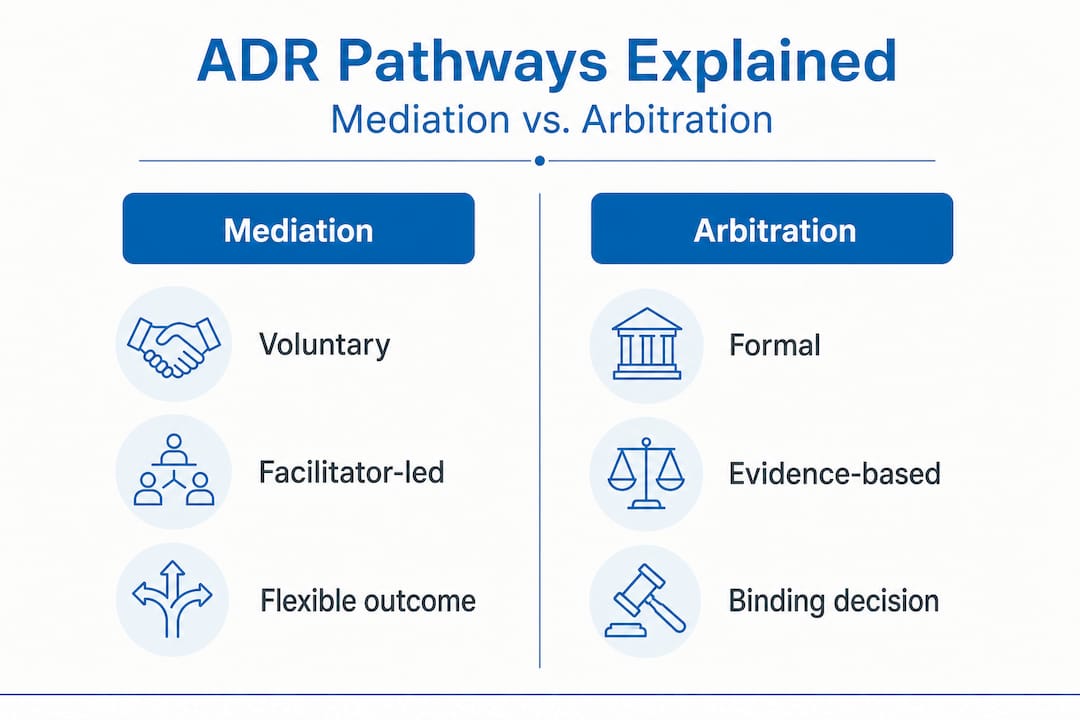
Mediation is the most widely used form of ADR. A neutral third party, the mediator, facilitates discussion between the disputing parties. The mediator does not decide who is right. Their role is to help both sides communicate clearly, identify their real interests, and work toward a mutually acceptable agreement.
Arbitration is more formal. An arbitrator hears evidence and submissions from both sides, then makes a decision. Depending on the agreement between the parties, that decision can be binding, meaning it has the same force as a court order.
Conciliation is similar to mediation but the conciliator plays a more active role, often suggesting possible outcomes and guiding parties toward resolution. It is commonly used in employment and consumer disputes.
Negotiation is the most informal option. Parties, usually through their lawyers, communicate directly to reach a settlement without any third-party involvement.
How a dispute enters the ADR process varies. You may agree voluntarily with the other party to attempt mediation before taking any formal steps. Your contract may contain a clause requiring arbitration before litigation. Or a court may direct you to ADR after proceedings have already commenced.
Court-ordered mediation under Part 4 and court-referred arbitration under Part 5 of the Civil Procedure Act 2005 are the two main statutory mechanisms. Under Part 4, the court can order parties to attend mediation at any stage of proceedings. Under Part 5, the court can refer specific questions or the entire dispute to an arbitrator.
Courts in NSW may order or refer parties to ADR in the following circumstances:
When the matter involves a factual dispute that could be resolved without judicial determination
When the parties have not yet attempted any form of negotiation or mediation
When the complexity of the matter makes early resolution more cost-effective
When a statutory scheme (such as the Personal Injury Commission) mandates ADR before formal determination
When the court determines that the relationship between parties warrants a less adversarial process
Pro Tip: If you want maximum control over the final outcome, start with mediation. You retain the right to reject any proposed agreement, and nothing is binding unless you sign it.
In family law, mediation through a registered Family Dispute Resolution practitioner is generally required before applying to the Federal Circuit and Family Court of Australia for parenting orders. This is a statutory requirement, not optional, and it reflects how seriously NSW and federal law take ADR as the preferred first step.
Mediation and arbitration: Key differences explained
Mediation and arbitration are the two most commonly used ADR methods in NSW, but they operate very differently. Understanding those differences helps you choose the right process for your specific dispute.
Mediation is a structured negotiation where a neutral facilitator helps the parties reach their own agreement. The mediator has no authority to impose a decision. If you cannot agree, you leave mediation without a resolution and may need to pursue other options.

Arbitration is more formal and involves the presentation of evidence and legal submissions. The arbitrator listens to both sides and then makes a decision, which is typically binding if the parties agreed to binding arbitration at the outset.
| Feature | Mediation | Arbitration |
|---|---|---|
| Decision-maker | The parties themselves | The arbitrator |
| Outcome | Voluntary agreement | Binding or non-binding award |
| Formality | Low to moderate | Moderate to high |
| Evidence rules | Flexible | More structured |
| Confidentiality | Generally yes | Generally yes |
| Cost | Lower | Higher than mediation |
| Speed | Usually faster | Slower than mediation |
| Best for | Preserving relationships, flexible outcomes | Finality, complex factual disputes |
When deciding which process suits your situation, consider the following:
Do you need a binding decision? If the other party is unlikely to honour a voluntary agreement, arbitration provides an enforceable outcome without going to court.
Is the relationship ongoing? If you need to continue working with or co-parenting with the other party, mediation’s collaborative approach is far less damaging.
How complex is the evidence? Arbitration is better suited to disputes involving technical evidence, expert witnesses, or detailed financial records.
What is your risk tolerance? In mediation, you control the outcome. In arbitration, you hand that control to a third party. That is a significant difference if the stakes are high.
What does your contract say? Many commercial agreements specify arbitration as the required dispute resolution method. Check your contract before deciding.
The choice between these two processes is not simply about cost or formality. It is about who you want making the final call, and whether you can live with an outcome you did not choose.
Does ADR work? Results and real-world impact
The evidence that ADR works in NSW is not theoretical. It is documented in published data from the institutions that administer it.
The Personal Injury Commission, which handles workers compensation and motor accident disputes in NSW, reported that 94% of disputes were resolved without a formal determination in its 2024-25 Annual Review. That means the overwhelming majority of people who entered the Commission’s processes reached an outcome through conciliation, mediation, or negotiated settlement rather than a formal hearing.
“The vast majority of disputes before the Personal Injury Commission are resolved through alternative processes, reflecting the effectiveness of structured ADR in reducing the burden on formal legal proceedings.” — Personal Injury Commission Annual Review 2024-25
This outcome is not unique to personal injury matters. Across family law, commercial disputes, and civil claims, ADR consistently resolves the majority of matters before they reach a courtroom.
| Dispute type | ADR mechanism | Typical resolution rate |
|---|---|---|
| Workers compensation (NSW) | Conciliation/mediation | ~94% resolved without determination |
| Family law parenting disputes | Family Dispute Resolution | Majority resolved pre-court |
| Commercial contract disputes | Mediation/arbitration | High resolution rates reported |
| Consumer and tenancy disputes | Conciliation | Significant pre-hearing resolution |
The efficiency gains are real. A mediation session might cost a few thousand dollars in legal preparation and mediator fees. A defended court hearing in the NSW District Court or Supreme Court can cost tens of thousands of dollars, take years to reach a hearing date, and still produce an uncertain outcome.
ADR also reduces the emotional toll. Court proceedings are adversarial by design. They require each party to build the strongest possible case against the other, which entrenches conflict and makes future cooperation very difficult. ADR encourages a different posture, one focused on interests and solutions rather than winning and losing.
Pro Tip: Do not assume the other party needs to be willing before you raise ADR. Courts can and do refer unwilling parties to mediation. Raising ADR early also signals good faith, which courts notice.
The practical lesson from the data is straightforward. If you are facing a dispute in NSW, ADR is not a fallback position. It is the most likely path to resolution, and approaching it strategically, with proper legal advice, gives you the best chance of a fair and efficient outcome.
A fresh perspective: Why the right ADR approach depends on your goals
Here is something most articles about ADR do not say clearly enough: the choice between mediation and arbitration is fundamentally a question about who you trust to make the decision.
In mediation, you trust yourself. You retain full authority over the outcome. Nothing is agreed unless you agree to it. That is enormously powerful, but it also means you need to be clear about what you actually want, not just what you think you are entitled to. Parties who enter mediation focused on “winning” often leave frustrated, because mediation is not designed to produce winners and losers. It is designed to produce workable agreements.
In arbitration, you trust the process. You present your case, the other side presents theirs, and an experienced arbitrator decides. There is real value in that, particularly when the dispute involves complex facts, when one party has been acting in bad faith, or when you simply need certainty and closure. Losing in arbitration can feel better than years of unresolved conflict.
The conventional wisdom that ADR is always cheaper and faster than litigation is broadly true, but it misses a more important point. The right ADR method depends on whether you need an agreement or a decision, and on the nature of your specific dispute. A commercial landlord with a tenant who has repeatedly breached a lease may need the finality of arbitration. A separated couple with young children almost certainly benefits more from the collaborative framework of mediation.
We consistently advise clients to identify their deepest interest before choosing an ADR method. Not their legal position, but their actual goal. Do you want money, an apology, a changed behaviour, or simply for the dispute to end? The answer shapes which process serves you best. ADR is not one size fits all, and treating it as such is one of the most common and costly mistakes people make.
How GKE Lawyers can help you navigate ADR in NSW
Choosing the right ADR pathway and preparing effectively for it requires more than a general understanding of the process. It requires legal advice tailored to your specific dispute, your goals, and the strengths and weaknesses of your position.
At GKE Lawyers, we work with clients across Sydney and throughout NSW on family law disputes, commercial matters, personal injury claims, and civil litigation. We help you understand which ADR pathway suits your situation, prepare you thoroughly for mediation or arbitration, and protect your legal interests at every stage. Whether you are entering ADR voluntarily or have been directed to it by a court, having experienced legal representation makes a measurable difference to the outcome. Contact us today to arrange a consultation and take the first clear step toward resolving your dispute.
Frequently asked questions
Is alternative dispute resolution mandatory in NSW civil cases?
ADR can be court-ordered under the Civil Procedure Act 2005, making it mandatory in some instances, particularly when a court determines that the parties should attempt resolution before proceeding to a full hearing.
Does mediation mean I have to agree if I don’t want to?
No. Mediators facilitate but do not impose decisions, and any agreement reached in mediation must be voluntary. You retain full authority to reject any proposed outcome.
Are arbitration decisions always binding?
Arbitration awards are typically binding if both parties agreed to binding arbitration before the process began, but non-binding arbitration is also available in some contexts.
What types of disputes are best suited for ADR in NSW?
ADR covers a broad range of dispute types, and it is particularly well-suited for family, commercial, personal injury, and general civil matters where parties have an interest in a timely and cost-effective resolution.
How much does ADR cost compared to going to court?
ADR is generally significantly less expensive and quicker than a full court hearing, with mediation in particular often resolving disputes in a single session at a fraction of the cost of defended litigation.