

When someone dies in New South Wales, their assets do not simply transfer to loved ones overnight. Understanding what is estate distribution NSW means understanding a structured legal process governed by specific laws, timelines, and protections. Many people assume distribution happens quickly. In reality, executors must follow a defined sequence of steps to protect beneficiaries, creditors, and themselves. Whether you are a beneficiary, an executor, or someone planning ahead, knowing how the estate distribution process NSW works can save you from costly mistakes and unnecessary conflict.
Table of Contents
- Key takeaways
- Legal foundations of estate distribution in NSW
- The estate distribution process and timing in NSW
- Intestacy and succession rules for NSW estates
- Common complexities and disputes in estate distribution
- My perspective on estate disputes I’ve seen
- How GKE Lawyers can help with estate distribution
- FAQ
Key takeaways
| Point | Details |
|---|---|
| Distribution takes time | Executors typically wait up to 12 months before distributing assets to manage debts and potential claims. |
| Notices protect executors | A Notice of Intended Distribution gives creditors 30 days to make claims before assets are released. |
| Intestacy has clear rules | Without a valid will, the Succession Act 2006 (NSW) dictates who receives what and in what order. |
| Joint tenancy bypasses wills | Property held as joint tenancy passes automatically to the surviving owner, regardless of will provisions. |
| Family provision claims are broad | Eligible claimants include close personal friends with domestic relationships, not just immediate family. |
Legal foundations of estate distribution in NSW
Estate distribution in New South Wales rests on a clear legal framework. When a person dies leaving a valid will, their appointed executor applies to the Supreme Court of NSW for a grant of probate. Probate confirms the will is valid and authorises the executor to act. Once granted, the executor has the legal authority to collect assets, pay debts, and distribute what remains to the named beneficiaries.
Estate administration involves collecting documents, paying debts, notifying agencies, waiting out challenge periods, and distributing assets according to the will or intestacy rules. The NSW Trustee and Guardian can act as executor when no suitable person is available or willing to take on the role.
When no valid will exists, the person is said to have died intestate. In that case, a family member or other eligible person applies to the court for letters of administration. Under NSW estate distribution laws, the administrator must follow the rules set out in the Succession Act 2006. These rules define who is entitled to benefit from the estate and in what proportions, based on the deceased’s surviving relatives.
The key players in the NSW will and estate distribution process include:
- The executor or administrator, who manages the estate and carries out distribution
- The Supreme Court of NSW, which grants probate or letters of administration
- Beneficiaries, who are entitled to receive assets after debts are settled
- Creditors, who must be paid before any distribution to beneficiaries occurs
- The NSW Trustee and Guardian, who can step in when no suitable private administrator is available
NSW estate distribution laws prioritise debts and liabilities above all else. No beneficiary can receive their share until outstanding financial obligations are settled. This is a fundamental principle that often surprises people unfamiliar with the process.
The estate distribution process and timing in NSW
One of the most common misconceptions people hold is that estate distribution happens within weeks of a person’s death. The reality is more measured, and for good reason.
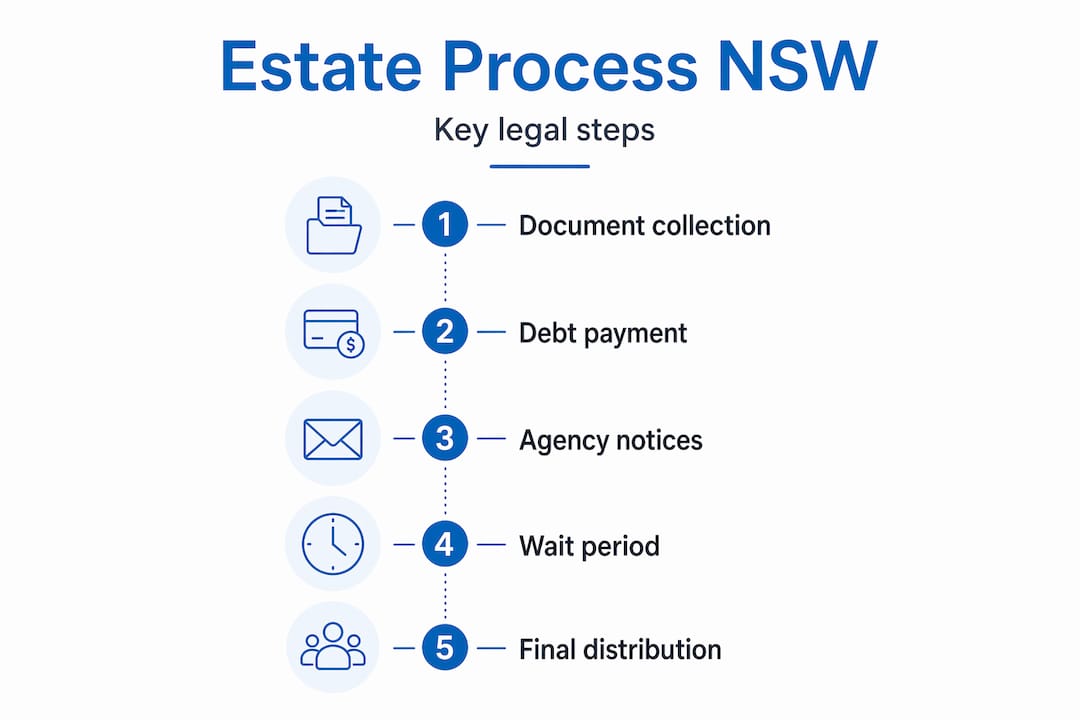
Executors often wait up to 12 months before distributing assets to allow time for debts to be identified and potential claims to be resolved. This waiting period, sometimes called the “executor’s year,” is a recognised practice in NSW law. Distributing too early can expose the executor to personal liability if a creditor or claimant appears after assets have already been transferred.
The typical estate distribution process NSW follows these steps:
- Obtain probate or letters of administration. This is the first formal step and authorises the executor or administrator to act on behalf of the estate.
- Identify and collect all estate assets. This includes bank accounts, property, investments, personal belongings, and any other assets the deceased owned.
- Notify relevant government agencies and financial institutions. Centrelink, the Australian Taxation Office, and banks must all be informed of the death.
- Pay outstanding debts, liabilities, and taxes. All creditors must be paid before beneficiaries receive anything.
- Publish a Notice of Intended Distribution. This notice is published through the NSW Online Registry and gives creditors and potential claimants at least 30 days to notify the executor before assets are distributed.
- Wait for the notice period to expire. Once the 30-day period has passed without valid claims, the executor can proceed with confidence.
- Transfer assets to beneficiaries. Property is transferred, accounts are closed, and other assets are distributed according to the will or intestacy rules.
The Notice of Intended Distribution deserves particular attention. While not strictly mandatory, it is highly recommended by the Law Society of NSW as it significantly reduces the executor’s personal liability. Publishing the notice signals to the world that distribution is imminent and invites any outstanding claims to come forward.
In some circumstances, an executor may make interim distributions to beneficiaries while the estate is still being administered. This can help beneficiaries who have immediate financial needs. Any interim distribution should be carefully documented and accounted for against the final distribution figure.
Pro Tip: If you are an executor considering distributing before the 12-month mark, seek legal advice before acting. The personal financial risk of premature distribution is real and can be avoided with proper guidance.
Intestacy and succession rules for NSW estates
When a person dies without a valid will, NSW intestacy laws determine who receives the estate. Many people assume a spouse automatically receives everything. That is not always correct under the Succession Act 2006.

When a person dies intestate in NSW, courts grant administration to the person with the greatest entitlement, who must then follow the intestacy rules strictly. The administrator must fully resolve one category of entitled relatives before moving to the next.
The following table shows how intestacy entitlement works in common family situations:
| Family situation | Who receives the estate |
|---|---|
| Spouse or de facto partner only (no children) | Entire estate to the spouse or partner |
| Spouse and children from that relationship | Entire estate to the spouse or partner |
| Spouse and children from another relationship | Spouse receives personal effects, a statutory legacy, and half the remainder; children share the other half |
| No spouse, but children survive | Entire estate shared equally among the children |
| No spouse, no children | Estate passes to parents, then siblings, then more distant relatives |
| No surviving relatives | Estate passes to the NSW Government as bona vacantia |
When the family structure is complex or relatives are difficult to locate, genealogical research may be required to identify all eligible beneficiaries. The NSW Trustee and Guardian can assist in these situations and may be appointed to administer the estate when private administration is not practicable.
Understanding your estate distribution rights NSW under intestacy rules is particularly relevant if you are in a de facto relationship. A de facto partner who lived with the deceased for at least two years may be entitled to a share of the estate, but this must be established and is not assumed automatically.
Common complexities and disputes in estate distribution
Even when a will exists and the executor is acting in good faith, estate distribution in NSW can become complicated. Several factors regularly lead to disputes, delays, or unintended outcomes.
Joint tenancy and its impact on distribution
Property ownership structure has a significant effect on how to distribute estate NSW assets. Property held as joint tenancy passes automatically to the surviving owner by the right of survivorship, regardless of what the will says. This means a person could have a carefully drafted will leaving their property to their children, but if that property is held in joint tenancy with a spouse or partner, the will’s provisions are overridden entirely.
Severing a joint tenancy before death is the only way to bring the property into the estate and allow it to be distributed according to the will. Legal advice is critical here. A solicitor’s duty of care extends to intended beneficiaries, meaning that errors in will drafting that fail to account for joint tenancy can create liability for the advising solicitor.
Family provision claims
Beneficiary rights estate NSW law extends beyond what a will provides. Eligible persons can apply to the Supreme Court for a family provision order if they believe they have not been adequately provided for. Family provision claims can be made by a wide group of people, including children, spouses, former spouses, and in some cases, close personal friends.
A 2026 NSW Supreme Court decision confirmed that close personal relationships involving cohabitation and mutual support may qualify a person as an eligible claimant. Evidence such as shared bills, rent receipts, or proof of domestic arrangements can establish the required relationship. This is a significant development that broadens the scope of who can contest an estate distribution.
Common triggers for disputes and complexities include:
- Ambiguous or poorly drafted will provisions that create uncertainty about the testator’s intentions
- Multiple beneficiaries with conflicting interests, particularly in blended families
- Delays in obtaining probate that freeze estate assets and cause financial hardship for dependants
- Disputes over asset valuation, especially for property, businesses, or investments
- Executors who fail to act promptly or who have a conflict of interest
Pro Tip: If you suspect you have grounds to contest a distribution or make a family provision claim, time limits apply in NSW. You generally have 12 months from the date of death to make a family provision application. Acting promptly protects your position.
My perspective on estate disputes I’ve seen
I have worked through enough estate matters in NSW to say with confidence that most disputes do not start with bad intentions. They start with assumptions. Families assume the house will go to them. Executors assume they can distribute quickly. Beneficiaries assume a will covers everything.
In my experience, the joint tenancy issue catches more families off guard than almost anything else. I have seen well-drafted wills rendered ineffective because no one reviewed the property title before the testator died. The legal outcome was technically correct, but it was not what anyone intended. That kind of outcome is entirely preventable with proper estate planning advice.
The 12-month waiting period frustrates beneficiaries more than any other part of the process. People are grieving and facing financial pressure, and being told to wait feels unreasonable. But I have also seen what happens when executors rush. Creditors appear. Claims are lodged. And suddenly the executor faces personal liability for assets they distributed too early. Patience genuinely protects everyone.
What I have also learned is that family provision claims are not always about greed. Many are about people who were genuinely dependent on the deceased and were simply left out of a will that had not been updated in years. The law in NSW is structured to catch those situations, and that is appropriate.
If you are an executor, a beneficiary, or someone facing a contested estate, get proper legal advice early. The cost of early advice is a fraction of the cost of resolving a dispute that was allowed to develop unchecked.
— Gaurav
How GKE Lawyers can help with estate distribution
Dealing with an estate after a death is rarely straightforward, and the legal obligations on executors and administrators are real. GKE Lawyers provides clear, practical guidance through every stage of the NSW estate distribution process.

Whether you need assistance obtaining probate in NSW, advice on executor duties, support with an intestacy matter, or representation in a family provision dispute, GKE Lawyers has the experience to help. Our wills and estates team works with clients across Sydney and throughout New South Wales to protect their rights and achieve fair outcomes. We also assist with property law matters that intersect with estate distribution, including joint tenancy issues and title transfers. Contact GKE Lawyers today to discuss your situation with a solicitor who understands the full picture.
FAQ
What is estate distribution in NSW?
Estate distribution NSW is the legal process of transferring a deceased person’s assets to beneficiaries after debts, taxes, and liabilities are paid. It follows either the terms of a valid will or the intestacy rules under the Succession Act 2006.
How long does estate distribution take in NSW?
Executors typically wait up to 12 months before making a final distribution to allow time for debts to be settled and claims to be resolved. Publishing a Notice of Intended Distribution helps reduce executor liability during this period.
What happens if someone dies without a will in NSW?
If a person dies intestate in NSW, an administrator is appointed by the court to distribute the estate according to the Succession Act 2006 intestacy rules. These rules specify which relatives are entitled and in what order and proportion.
Can a will be contested in NSW?
Yes. Eligible persons can apply to the Supreme Court for a family provision order if they believe the will does not make adequate provision for them. Recent NSW case law confirms this includes people in close personal relationships with the deceased, beyond immediate family.
Does jointly owned property form part of an estate in NSW?
Not automatically. Property held as joint tenancy passes directly to the surviving owner by right of survivorship and does not form part of the estate. Only property held as tenants in common can be distributed through a will or under intestacy rules.