

Separating from a partner is one of the most stressful experiences you can face, and the legal process of dividing property and assets adds a significant layer of complexity and uncertainty. Many people in New South Wales make costly mistakes during this period, simply because they do not understand the rules, the deadlines, or the difference between a handshake agreement and a legally binding arrangement. This guide walks you through every critical stage of property settlement after separation in NSW, from identifying your relationship type and compiling your financial picture, to choosing the right legal pathway and avoiding the pitfalls that derail even the most amicable splits.
Table of Contents
- What to do first: understanding property settlement basics in NSW
- Key requirements and timelines: what you must know
- How to formalise your agreement: legal options and enforceability
- Settlement methods: agreement, mediation, or court?
- A lawyer’s perspective: common pitfalls in NSW property settlements
- Get expert help with your property settlement in NSW
- Frequently asked questions
Key Takeaways
| Point | Details |
|---|---|
| Know your time limits | Missing the property settlement deadline could forfeit your rights, so check which rules apply to your situation. |
| Documentation is vital | Start by organising all your financial information to make negotiation and resolution smoother. |
| Formalise your agreement | Use a binding financial agreement or consent orders if you want your property settlement to be legally enforceable. |
| Explore all settlement methods | Agreement and mediation can avoid lengthy court processes when you act early and cooperatively. |
What to do first: understanding property settlement basics in NSW
Property settlement is the legal process of dividing assets, debts, and financial resources between two people after the end of a relationship. In NSW, this process is governed by both federal legislation for married couples and state legislation for de facto couples, which means the rules, timelines, and available remedies can differ depending on your circumstances.
Understanding family law basics before you begin negotiating is essential. Married couples are governed by the Family Law Act 1975 (Cth), while de facto couples in NSW are governed by the Property (Relationships) Act 1984 (NSW) for state-based matters, though federal de facto provisions also apply in many situations. Knowing which legislation applies to you determines which court has jurisdiction, what deadlines you face, and what evidence matters most.
One of the first and most important things you need to establish is your separation date. This is the date on which the relationship effectively ended, and it has direct legal consequences for calculating application deadlines. Courts look at factors such as living arrangements, communication, financial separation, and social conduct when determining this date. Disputes about the separation date are common and can affect your rights significantly, so it is worth getting clarity on this early.
Before any negotiations begin, compile a thorough inventory of all assets and debts. This includes:
- Real property (family home, investment properties, land)
- Bank accounts, savings, and term deposits
- Superannuation balances for both parties
- Vehicles, boats, and other personal property
- Shares, managed funds, and business interests
- Joint and individual debts, including mortgages, personal loans, and credit cards
- Inheritances or gifts received during the relationship
In NSW, you must start property settlement proceedings within strict time limits that depend on whether you were married or in a de facto relationship. Missing these windows can be extremely costly, and the courts are not always sympathetic to late applicants.
| Relationship type | Governing legislation | Key deadline |
|---|---|---|
| Married couple | Family Law Act 1975 (Cth) | 12 months after divorce is finalised |
| De facto couple (NSW) | Property (Relationships) Act 1984 (NSW) | 2 years after separation |
Pro Tip: Start gathering financial documents, bank statements, mortgage paperwork, and superannuation records as soon as possible after separation. The earlier you have a complete picture, the less stressful the negotiation process will be, and the less likely you are to overlook an asset or undervalue your entitlements.
Understanding family law in Sydney and how it applies to your specific situation is a foundational step that can protect you from making decisions you will regret later.
Key requirements and timelines: what you must know
Time limits in property settlement law are not soft guidelines. They are strict legal requirements, and missing them can mean you lose the right to make a claim altogether. Here is a clear breakdown of the major timelines you need to be aware of.
For married couples:
- You must be separated for 12 months before you can apply for divorce.
- Once the divorce order is made, you have exactly 12 months to commence property settlement proceedings.
- If you miss this window, you must apply to the court for “leave” to proceed out of time.
For de facto couples:
- The relationship must have broken down before the clock starts.
- NSW de facto law provides a 2-year application window after the relationship ceases, with limited ability to get leave after that time passes.
- Establishing the exact date of separation becomes critically important.
| Factor | Married couples | De facto couples |
|---|---|---|
| Deadline to apply | 12 months after divorce | 2 years after separation |
| Governing court | Federal Circuit and Family Court | NSW courts (or federal, depending on the matter) |
| Out-of-time applications | Leave required under Family Law Act | Leave required, hardship test applies |
| Super splitting available | Yes | Yes, under federal provisions |
| Key documents needed | Marriage certificate, financial disclosure | Evidence of de facto relationship, separation date |
Critical warning: If you allow either deadline to pass without formalising your settlement or commencing proceedings, you may permanently lose the ability to make a claim. Even if both parties are on good terms, the absence of a formal legal order means either party could later dispute what was agreed. Do not rely on goodwill alone.
The concept of “leave” to apply out of time is important to understand. If you have missed the deadline, you can ask the court for permission to proceed, but this is not automatic. Late de facto applications may be allowed only where hardship considerations favour the late applicant. The court will examine factors such as whether a child would suffer hardship, whether the applicant would be left without adequate support, and whether the other party would be prejudiced by a late claim.
Getting property dispute advice from a qualified lawyer well before any deadline approaches is strongly recommended. Acting early gives you options. Waiting until the deadline passes removes them.
Pro Tip: Set a calendar reminder for your relevant deadline the moment you separate. Write it down, tell your lawyer, and treat it as a hard stop. The difference between lodging one day inside and one day outside the window can determine whether you have any legal recourse at all.
How to formalise your agreement: legal options and enforceability
Reaching an agreement with your former partner is genuinely a positive outcome, but it only protects you if that agreement is formalised correctly. Many people in NSW make the mistake of assuming that a verbal agreement, a written email exchange, or even a signed document prepared without legal input will be enough to protect them. This is rarely the case.
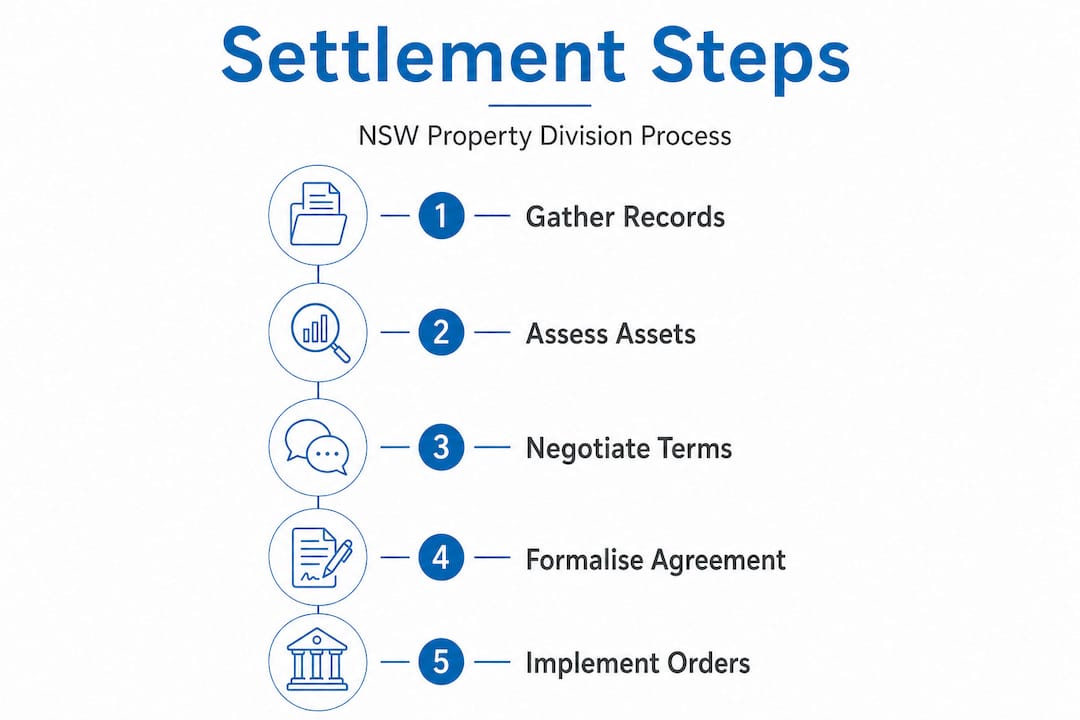
The main legal pathways to settle property after separation are:
- Informal agreement — A verbal or written understanding between parties. Not legally binding and unenforceable in most circumstances.
- Mediation — A structured negotiation facilitated by a neutral third party. Can lead to a binding outcome if documented properly, but the mediation itself does not create a legally enforceable order.
- Binding financial agreement (BFA) — A private contract between the parties that sets out how assets and debts will be divided. Must meet strict legal requirements, including independent legal advice for both parties, to be valid.
- Consent orders — An agreement lodged with the court and approved by a registrar or judge. Once approved, it has the same force as a court order.
- Court order — Issued by a judge following a contested hearing. Used when parties cannot agree. The most expensive and time-consuming option.
If you want asset transfers or super splitting to be legally effective, you generally need consent orders or a binding financial agreement, not just an informal arrangement. Banks will not transfer a mortgage or update title records based on a handshake. The Titles Registry requires formal legal documentation. Superannuation funds have their own compliance requirements before they will action a split.
Informal agreements can leave you exposed in ways that only become apparent years later, such as when one party seeks to revisit the division, when a bank requires proof of legal entitlement, or when a new partner or creditor enters the picture.

When considering property transfers after separation, it is critical to understand that only a formal legal order or BFA will give you the certainty and protection you need.
Pro Tip: Never sign any document, whether labelled as a “settlement deed,” “agreement,” or “arrangement,” without having a qualified lawyer review it first. What seems straightforward in plain language can have significant legal implications, particularly around stamp duty exemptions, future financial claims, and superannuation entitlements.
Settlement methods: agreement, mediation, or court?
Choosing the right method to resolve your property settlement is one of the most consequential decisions you will make throughout this process. The approach that suits you depends on the level of conflict between parties, the complexity of your asset pool, and how quickly you need a resolution.
Here is a clear breakdown of the three main approaches:
- Negotiated agreement: Best suited when both parties are cooperative, have a clear understanding of their assets, and are willing to compromise. This approach is the fastest and least expensive. It works best when formalised through consent orders to ensure enforceability.
- Mediation: Well suited when there is one or more disputed items but both parties are broadly willing to resolve matters without a judge’s intervention. A skilled mediator can help parties find common ground efficiently. You can negotiate property settlement directly, but if agreement is not reached, mediation or court may be necessary.
- Court proceedings: Reserved for situations where there is an irretrievable breakdown in communication, allegations of asset concealment, significant power imbalances, or complex financial structures that require judicial determination. Court is the most expensive, time-consuming, and emotionally draining option.
Understanding mediation options in NSW can help you determine whether this step is right for your situation before committing to litigation.
When preparing for mediation, you should gather all financial documents, prepare a list of your priorities and non-negotiables, and attend with a clear understanding of your legal entitlements. When preparing for court, you need to engage a solicitor, comply with disclosure requirements, and be ready for a process that can take months or years.
Before escalating any dispute, consider using dispute resolution methods that can achieve a fair outcome without the financial and emotional cost of litigation. If you are unsure which path suits your circumstances, speaking with a lawyer who handles property disputes in Sydney is the most reliable first step.
A lawyer’s perspective: common pitfalls in NSW property settlements
After working through a wide range of property settlements in NSW, we have seen certain mistakes appear repeatedly. Understanding these pitfalls is often what separates a clean, protected outcome from one that causes problems for years after the relationship ends.
The separation date dispute is more common than people expect. Many clients come to us believing their separation date is obvious, only to find that the other party disputes it. This matters because the separation date determines which assets are included in the pool and when the legal clock starts ticking on deadlines. Documenting your separation clearly and early is not optional.
Informal agreements create a false sense of security. We have seen clients accept a split of the family home, hand over keys, and genuinely believe the matter is resolved, only to face a claim from their former partner years later. Without consent orders or a BFA, no division of property is final. Banks, superannuation funds, and the courts do not recognise informal arrangements as binding.
Delaying paperwork is one of the most preventable risks. People frequently put off gathering financial records, assuming they can do it later. By the time a deadline approaches, bank records are harder to access, valuations become contentious, and stress levels are high. Starting the paperwork process immediately after separation is always the right move.
Rushing to court can backfire. Some clients arrive convinced that court is the only option. In practice, many of these matters are resolved through out-of-court solutions that cost a fraction of litigation and produce equally binding results. Court should be a last resort, not a first response.
Even amicable separations need professional documentation. A friendly split today can become a disputed one tomorrow if circumstances change, such as one party remarrying, experiencing financial difficulty, or simply having a change of heart. The only way to truly protect yourself is through a legally formalised agreement.
Get expert help with your property settlement in NSW
Property settlement in NSW is one of the most legally complex processes a person can face outside of a courtroom, and the stakes are high. Whether you are trying to protect your share of the family home, secure a fair division of superannuation, or simply understand your rights and obligations, having the right legal support makes a measurable difference to outcomes.

At GKE Lawyers, our property lawyers in Sydney work closely with clients navigating separation and asset division across NSW. We help you understand your entitlements, meet critical deadlines, and formalise agreements that are legally binding and enforceable. Our property dispute lawyers are experienced in both negotiated settlements and contested proceedings, giving you confident representation at every stage. If you are ready to take the next step, contact us to book a consultation and get clarity on your situation today.
Frequently asked questions
Can you make a legally binding property settlement without going to court in NSW?
Yes, you can formalise your settlement through consent orders or a binding financial agreement, both of which are legally enforceable without requiring a contested court hearing.
What happens if property settlement is not done within the time limit?
You may lose the automatic right to apply, but courts can sometimes allow late applications if you can demonstrate hardship. Late de facto applications may be permitted only where hardship considerations favour the applicant.
Is mediation compulsory before applying to court for property settlement in NSW?
Mediation is strongly encouraged and widely used before court, but it is not strictly compulsory in all circumstances, particularly if urgent or complex issues exist. Negotiation and mediation are generally recommended as first steps.
What is the difference between consent orders and binding financial agreements?
Consent orders are submitted to the court and approved by a judicial officer, making them enforceable as a court order. Binding financial agreements are private contracts that do not require court approval but must meet strict legal requirements, including independent legal advice for both parties, to be valid.