

Many people assume family law is simply about divorce. In reality, family law in NSW is primarily governed by the federal Family Law Act 1975 (Cth), which applies uniformly across Australia and covers a much broader range of issues, including parenting arrangements, property settlements, de facto relationships, financial disclosure obligations, and even what happens to the family pet. Whether you are considering separation, dealing with a custody dispute, or trying to understand your rights after a long-term relationship ends, this guide explains the key elements of family law in NSW, recent major reforms, and the practical steps you can take to protect yourself and your family.
Table of Contents
- How family law works in NSW
- Divorce and separation: Key processes in NSW
- Parenting arrangements and child-focused decisions
- Property settlement, family violence and pets: Recent changes explained
- Resolving disputes and next steps
- A fresh perspective on family law in NSW
- How expert family lawyers can help
- Frequently asked questions
Key Takeaways
| Point | Details |
|---|---|
| Broad coverage | Family law in NSW covers divorce, children, property, and relationships beyond just marriage. |
| Major 2025 changes | Recent reforms affect how courts handle family violence, economic abuse, and pets in settlements. |
| Focus on children | Parenting decisions always prioritise the child’s best interests and safety after 2024 amendments. |
| Dispute resolution first | Most family law issues require mediation before court is considered. |
| Expert advice matters | Unique situations need professional legal guidance to get the right result under NSW law. |
How family law works in NSW
Family law in NSW operates under a federal framework, meaning the same laws apply whether you live in Sydney, regional NSW, or any other state. This is an important distinction: NSW does not have its own separate family law system. Instead, the Family Law Act 1975 (Cth) sets out the rules for divorce, parenting arrangements, property division, and more, with matters heard in the Federal Circuit and Family Court of Australia (FCFCOA).
As a starting point for anyone seeking an introduction to family law, it helps to understand exactly which situations the Act covers:
- Divorce and separation for married couples
- Parenting arrangements (previously called “custody”) for children of both married and de facto couples
- Property settlement and superannuation splitting for married and de facto couples
- De facto relationships (including same-sex couples) that have broken down
- Binding Financial Agreements as an alternative to court-ordered settlements
- Family violence, including economic abuse and dowry abuse, and their effect on outcomes
Recent legislative changes have made the framework even broader. From June 2025, the Family Law Amendment Act 2024 introduced significant updates: courts must now consider the impact of family violence, including economic abuse and dowry abuse, when determining property settlements; immediate full financial disclosure between parties is mandatory from the outset; and there are new provisions around pet ownership following separation. These changes apply to both new and existing cases, unless a final hearing has already started.
Who is covered and common scenarios
| Situation | Who is covered | Key issue |
|---|---|---|
| Married couple separating | Both spouses | Divorce, property, parenting |
| De facto couple separating | Both partners (2+ years or child involved) | Property, parenting (no divorce needed) |
| Dispute over children | Either parent or carer | Parenting arrangements, safety |
| Financial disagreement | Married or de facto | Property settlement, disclosure |
| Family violence situation | Victim and dependants | Protective orders, adjusted settlements |
Understanding which category your situation falls into is the first practical step. Each category involves different processes, timelines, and legal requirements.
Divorce and separation: Key processes in NSW

Once you understand what family law covers, the next concern for many people is how divorce and separation actually work. In NSW, divorce is a no-fault process, which means neither party needs to prove wrongdoing. The only ground for divorce is irretrievable breakdown of the marriage, evidenced by 12 months of separation. At least one party must have an Australian connection, either by being an Australian citizen, ordinarily resident in Australia, or present in Australia on the application date.
Here is a step-by-step overview of the divorce process:
- Confirm 12 months of separation. This period can include time spent separated while living under the same roof, but additional evidence will be required.
- Lodge an application. Applications are filed with the FCFCOA, either as a sole application or jointly with your former spouse.
- Serve the application. If filing alone, the other party must be formally served with the divorce application.
- Attend a hearing (if required). Hearings are typically brief; you may only need to attend if children under 18 are involved.
- Receive the divorce order. If granted, the divorce becomes final one month and one day after the order is made.
It is important to understand that divorce and property settlement are two separate legal processes. A divorce order does not resolve financial matters. Property settlement must be initiated within 12 months of the divorce becoming final, or you may lose the right to apply.
Separation under one roof
Many couples in NSW continue to live in the same home for financial or practical reasons even after the relationship ends. This is known as “separation under one roof” and it is legally recognised, but it does require additional evidence. Courts will look for proof that you and your former partner genuinely led separate lives within the shared home.
“Separation under one roof” requires affidavits from the separating parties and, ideally, a supporting statement from a third party such as a friend, family member, or counsellor who can confirm the living arrangement and the nature of the separation.
Pro Tip: If you are in this situation, start documenting the separation clearly and early. Keep records of separate finances, separate social activities, and any communications that clearly reflect the relationship has ended. A well-prepared affidavit can make the difference between a straightforward application and a contested hearing.
Parenting arrangements and child-focused decisions
After separation, decisions about children are often the most emotionally charged part of the process. The term “custody” is no longer used in Australian family law. Instead, the focus is on parenting arrangements that serve the child’s best interests.
The best interests of the child remain the paramount consideration in all parenting decisions. Following the 2024 amendments, there is no longer a presumption of equal shared parental responsibility or equal time. This is a significant shift. Courts now start from a neutral position and assess each case individually, prioritising safety above all else.
What courts consider when making parenting decisions
| Factor | Why it matters |
|---|---|
| Safety from family violence or abuse | Highest priority; overrides time arrangements |
| The child’s own views | Considered in proportion to the child’s age and maturity |
| The child’s relationship with each parent | Supports continuity and emotional wellbeing |
| Each parent’s capacity to meet the child’s needs | Practical ability to provide care, stability, schooling |
| Impact of change on the child | Courts minimise disruption where possible |
| Cultural and Aboriginal or Torres Strait Islander identity | Recognised and preserved where relevant |
Before applying to the court for parenting orders, parties are generally required to attempt Family Dispute Resolution (FDR), a structured mediation process designed to help parents reach agreement without litigation. There are important exemptions, however. If there is a history of family violence, child abuse, or urgent safety concerns, you are not required to attend FDR before going to court.
- FDR is conducted by accredited practitioners, often through services such as Relationships Australia or Legal Aid NSW.
- If agreement is reached in FDR, the parties can formalise this through consent orders, which are legally binding.
- If FDR fails, the practitioner issues a certificate allowing you to apply to court.
Pro Tip: One of the most common mistakes parents make during negotiations is confusing their own needs with the child’s. Courts are not interested in what is fair to you as a parent; they are focused entirely on what is best for your child. Keeping this distinction clear in all communications and documentation will strengthen your position.
Property settlement, family violence and pets: Recent changes explained
Property matters after separation are more complex than most people expect. The process involves identifying the total asset pool (including superannuation), assessing each party’s financial and non-financial contributions, and then considering future needs before arriving at a fair division.
Key elements of property settlement in NSW include:
- Identifying the property pool: All assets, liabilities, and superannuation interests of both parties are included, regardless of whose name they are in.
- Assessing contributions: Both financial contributions (income, property brought into the relationship) and non-financial contributions (homemaking, parenting) are recognised.
- Future needs adjustment: The court considers factors such as age, health, earning capacity, and primary care of children.
- Superannuation splitting: Super is treated as property and can be split between parties by agreement or court order.
- Binding Financial Agreements (BFAs): Couples can opt for a private agreement rather than a court-determined settlement, but these must be drafted carefully to be enforceable.
The Family Law Amendment Act 2024 brought three major changes to property matters that every NSW resident should understand.
Family violence and economic abuse. Courts must now actively consider the effect of family violence, including economic abuse (such as controlling finances, restricting employment, forcing debt) and dowry abuse, when assessing property settlements. This means that if you experienced financial control during the relationship, it can directly affect the outcome of your settlement. This is a genuinely transformative change for many victims.
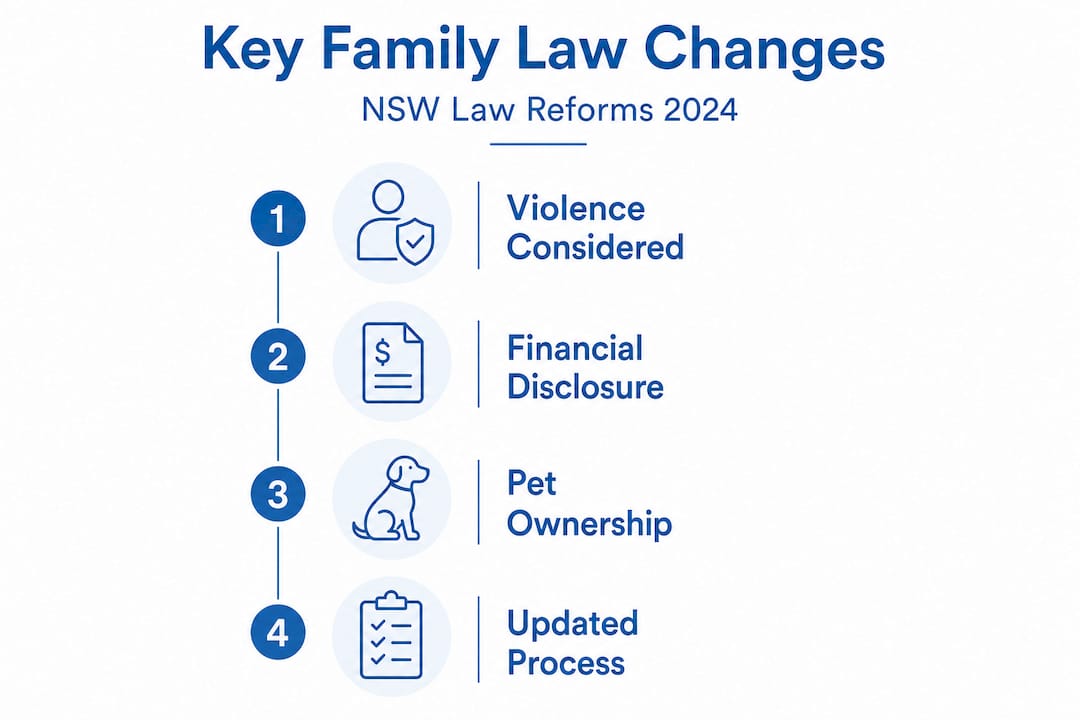
Mandatory immediate financial disclosure. From the outset of any property dispute, both parties are required to fully and immediately disclose all financial information. Non-disclosure is treated seriously by courts and can result in adverse findings. This obligation begins before formal proceedings, not only after they commence.
Pet ownership. Previously, pets were treated as chattels (personal property assessed by monetary value). Under the new laws, courts must consider pet ownership more thoughtfully, looking at who purchased the pet, who has primarily cared for it, and what living arrangements exist. This reflects the reality that pets are members of the family, not simply possessions.
Pro Tip: If you believe economic abuse has affected your financial position during the relationship, document every instance you can recall and gather any available evidence, including bank records, communications, or witness accounts. These details can substantially shift the outcome of a property settlement under the 2024 reforms.
Resolving disputes and next steps
No matter the issue, resolving disputes in family law usually follows a structured path. Dispute resolution is encouraged, and in many cases required, before a matter proceeds to court. This is because litigation is expensive, time-consuming, and emotionally taxing for everyone involved, especially children.
The main resolution pathways available in NSW include:
- Mediation: A neutral third party helps both parties negotiate an agreement outside of court.
- Family Dispute Resolution (FDR): Specifically for parenting matters; required before court in most cases.
- Collaborative law: Both parties and their lawyers commit to resolving matters without court proceedings.
- Consent orders: Once an agreement is reached, it can be formalised as a court order without a contested hearing.
If agreement cannot be reached, here is what to do:
- Obtain a certificate from your FDR practitioner confirming that resolution was attempted but failed.
- File an application in the FCFCOA for parenting or property orders.
- Participate in any court-ordered mediation or case management steps.
- Attend the final hearing, where a judge will make binding orders.
Family violence situations are treated as exemptions to the requirement to attempt FDR. If there is risk to your safety or the safety of your children, you can go directly to court and also apply for protection orders through the NSW Local Court.
A fresh perspective on family law in NSW
Having worked with many families navigating these issues, we have noticed something consistent: the legal framework matters, but the practical realities of each person’s situation often shape outcomes just as much as the law itself.
Many people underestimate how much preparation and organisation can affect the result. The introduction of mandatory financial disclosure and the recognition of economic abuse are not just technical legal reforms. They are a reflection of what practitioners have long observed: that financial control and manipulation are frequently central to family breakdown, yet they were historically hard to address within the legal system.
The same is true for some of the edge-case issues that have moved into mainstream family law. Separation under one roof, binding financial agreements, and now pet ownership are all areas where getting the details right early matters enormously. A poorly drafted agreement or an undocumented separation can unravel a case that seemed straightforward.
Our honest advice is this: do not wait until things become adversarial before seeking legal guidance. The earlier you get clear, tailored advice about your specific situation, the better placed you are to protect your rights and reach an outcome that actually works for your family. The system is rules-based, but it is also deeply nuanced, and no two situations are the same.
How expert family lawyers can help
Navigating family law in NSW, especially after the significant 2024 reforms, requires more than a general understanding of the rules. It requires advice that is specific to your circumstances.

At GKE Lawyers, our family law solicitors work with clients across Sydney and NSW to provide clear, practical guidance on divorce, parenting arrangements, property settlements, and financial agreements. Whether you are dealing with economic abuse, complex asset structures, or a parenting dispute, we are here to help you understand your options and move forward with confidence. Contact our team today for a confidential consultation and find out how we can support you through every step of the process.
Frequently asked questions
Do I have to go to court for all family law issues in NSW?
No, many family law matters are resolved through mediation or consent orders without court involvement; court proceedings are considered a last resort after other resolution pathways have been exhausted.
What is considered economic abuse in family law?
Economic abuse includes restricting access to finances, controlling spending, or dowry abuse, and under 2024 reforms courts must now consider its impact directly when determining property settlements.
Is there a difference between custody and parenting arrangements?
Yes, Australian courts now use “parenting arrangements” rather than “custody,” with the child’s best interests as the paramount and only focus, rather than any presumption about parental rights.
How are pets treated in family law disputes?
Since the 2024 amendments took effect in June 2025, pets are treated as owned property with courts considering who purchased and primarily cared for the animal, rather than simply assigning them a monetary value as chattels.
Do I need an affidavit if we separated under one roof?
Yes, if you and your former partner were still living together during the 12 months of separation, you will need supporting affidavits and ideally a third-party statement to confirm the genuine end of the relationship.