

Co-ownership of property in New South Wales can work smoothly for years until it doesn’t. Many co-owners assume that disputes only arise from dramatic fallouts or major financial betrayals. The reality is far more ordinary and, in many ways, more unsettling. A difference of opinion about whether to rent or sell, a disagreement over who pays for urgent repairs, or simply diverging life plans can be enough to trigger a legal conflict that becomes costly and time-consuming. Understanding your rights from the outset is the most effective way to protect yourself and your investment.
Table of Contents
- What is a co-ownership dispute?
- Types of co-ownership arrangements and typical dispute causes
- The legal framework for resolving co-ownership disputes in NSW
- Practical steps to prevent and resolve co-ownership disputes
- Why most co-owners underestimate the complexity of disputes
- Get expert legal support for your co-ownership dispute
- Frequently asked questions
Key Takeaways
| Point | Details |
|---|---|
| Co-ownership disputes defined | A co-ownership dispute arises when property co-owners cannot agree on key issues like maintenance, use, or sale. |
| Arrangements impact risks | Your co-ownership structure (e.g., joint tenancy or tenancy in common) affects the types of disputes and solutions available. |
| Legal options are available | NSW law provides structured ways to resolve disputes, including court orders for sale or partition when needed. |
| Prevention is best | Early expert legal advice and thorough agreements are the most effective way to prevent serious disputes. |
What is a co-ownership dispute?
Co-ownership in New South Wales refers to any arrangement where two or more people hold legal title to the same property. This includes family members who inherit property together, business partners who purchase commercial premises jointly, and friends or couples who buy residential property as an investment. It is a common and practical arrangement, but it comes with shared rights and shared responsibilities that do not always align neatly over time.
Co-ownership disputes typically occur when two or more parties with shared ownership of a property disagree on rights, responsibilities, or future use. These disagreements can arise gradually, often without any single dramatic event. A co-owner who wants to sell while the other wants to hold, one party failing to contribute to mortgage repayments, or conflicting views on renovation decisions are all common starting points.
Common triggers for co-ownership disputes include:
- Disagreements about selling the property, including timing, price expectations, and choice of agent
- Unequal financial contributions to mortgage repayments, council rates, or maintenance costs
- Disputes over the use of the property, such as whether to lease it out or occupy it personally
- Differences in long-term plans, where one owner’s circumstances change significantly
- Poor communication and the absence of any formal co-ownership agreement
“A co-ownership arrangement without a written agreement is an arrangement built on assumptions. Assumptions are exactly where legal disputes begin.”
Clarity in your co-ownership arrangement is not just a legal formality. It is a practical safeguard. A detailed, legally binding agreement that outlines each party’s rights, obligations, and exit strategy dramatically reduces the risk of disputes escalating to a point where court intervention becomes necessary. Seeking legal guidance for co-ownership before any conflict arises is always preferable to addressing it after the fact.
Types of co-ownership arrangements and typical dispute causes
Once you understand what constitutes a co-ownership dispute, it is important to recognise that the nature of your property arrangement can influence the risks you face. In NSW, there are two primary forms of co-ownership, each carrying distinct legal implications.
Different kinds of co-ownership, such as joint tenancy and tenancy in common, have distinct legal implications that directly affect how disputes are handled and resolved.

| Feature | Joint tenancy | Tenancy in common |
|---|---|---|
| Ownership shares | Equal shares | Can be unequal shares |
| Right of survivorship | Yes, automatically transfers to surviving co-owner | No, share passes through the deceased’s estate |
| Ability to sell your share | Requires agreement or severance | Can sell your share independently |
| Common in | Married couples, domestic partners | Business partners, investors, unrelated parties |
| Risk of dispute | Lower initially, higher if relationship breaks down | Higher due to flexible structure |
Understanding joint tenancy versus tenancy in common is an essential starting point when evaluating your co-ownership risk. Joint tenants hold equal shares and are legally treated as a single entity in some respects, which can simplify decisions but also create friction when one party wants to exit. Tenants in common can hold unequal shares, can sell or transfer their interest without the other owner’s consent, and do not benefit from the right of survivorship.
Typical sources of conflict in both arrangements include:
- One co-owner wanting to sell and the other refusing, which can stall the property indefinitely
- Disputes about rental income distribution where the property is leased to a third party
- Disagreements about capital improvements and whether costs should be shared proportionally
- Breakdown of the personal relationship between co-owners, particularly in family law contexts
- One co-owner becoming insolvent and a trustee in bankruptcy seeking to realise the property
Pro Tip: If you are entering into a co-ownership arrangement as tenants in common, always specify the ownership percentages and contribution obligations in a formal co-ownership agreement drafted by a solicitor. This single step can prevent years of costly litigation.
The legal framework for resolving co-ownership disputes in NSW
Knowing which legal avenues are available in New South Wales can help you better plan your next step if conflicts arise. The good news is that NSW law provides several structured options for resolving these disputes, ranging from informal negotiation through to formal court proceedings.
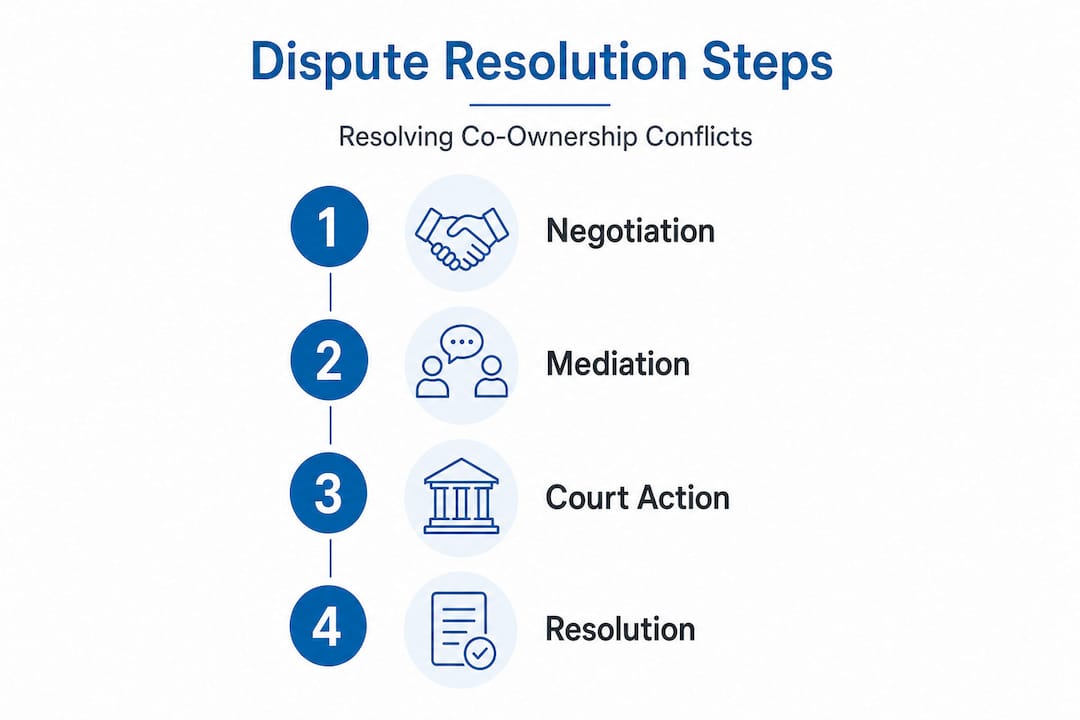
NSW law provides statutory methods for resolving disputes, including applications to the Supreme Court for sale or partition of the property where co-owners cannot reach an agreement voluntarily.
The three primary resolution pathways are:
- Negotiation: Direct discussion between co-owners, often assisted by legal representatives, to reach a mutually acceptable outcome. This is the fastest and least expensive option and should always be attempted first.
- Mediation: A neutral third-party mediator facilitates structured discussions between the parties. Mediation is confidential, flexible, and significantly less costly than litigation. In NSW, community mediation services and private commercial mediators are both available.
- Litigation: Where negotiation and mediation fail, either party may apply to the NSW Supreme Court. The court has broad powers under the Conveyancing Act 1919 (NSW) to order the sale or partition of a co-owned property.
| Resolution method | Estimated timeframe | Approximate cost range | Outcome control |
|---|---|---|---|
| Negotiation | Days to weeks | Low | High |
| Mediation | Weeks to months | Moderate | Moderate |
| Supreme Court application | Months to years | High | Low |
When the Supreme Court becomes involved, it can order a partition of the property (dividing it physically between co-owners where practicable) or a sale of the property with proceeds divided according to each co-owner’s interest. Courts generally consider partition only when it is physically feasible and equitable. For most residential properties, a court-ordered sale is the more common outcome.
You should consult expert property dispute guidance as early as possible if a dispute is developing. Understanding the full scope of your legal options before emotions and costs escalate is critical. Delay often results in more entrenched positions and higher legal fees for all parties.
It is also worth noting that costs orders in Supreme Court proceedings are entirely at the court’s discretion. There is no guarantee that the winning party will recover all or any of their legal costs, which is another strong reason to explore negotiated or mediated outcomes wherever possible.
Practical steps to prevent and resolve co-ownership disputes
Understanding the legal routes is important, but many disputes can be prevented, or efficiently resolved, by taking some proactive steps before the situation deteriorates. Prevention is almost always cheaper and less stressful than litigation.
Draft a formal co-ownership agreement before settlement. This document should clearly specify each party’s ownership share, their financial obligations, how decisions about the property will be made, and the process for exiting the arrangement. It should also address what happens if one party defaults on their obligations.
Maintain transparent financial records. Keep accurate documentation of all contributions to mortgage repayments, maintenance, insurance, and council rates. Disputes over financial contributions are much harder to resolve without clear records.
Communicate in writing. Even between close friends or family members, important decisions about the property should be confirmed in writing, whether by email or formal letter. This creates a contemporaneous record that can be relied upon if a dispute later arises.
Review your agreement periodically. Life circumstances change. A co-ownership agreement that was suitable five years ago may not reflect the current situation. Schedule a review whenever there is a significant change, such as a relationship breakdown, change in financial circumstances, or market shift.
Seek mediation early. If disagreements begin to surface, do not wait for them to escalate. Engaging a professional mediator while both parties are still willing to communicate can resolve issues in a fraction of the time and cost of litigation.
Consult a property lawyer at the first sign of serious conflict. Seeking legal help early gives you a clear picture of your rights and options before the dispute becomes entrenched.
Professional legal advice can clarify the rights and responsibilities in co-ownership situations and reduce the risk of escalation. This is not merely a caution but a practical recommendation. A solicitor can review your existing arrangements, identify vulnerabilities, and propose practical solutions that protect your interests without unnecessarily antagonising the other party.
Pro Tip: The most overlooked clause in co-ownership agreements is the exit mechanism. Always specify what happens when one co-owner wants to sell or exit the arrangement, including a right of first refusal for the remaining co-owner and a valuation process. Omitting this clause is one of the most common causes of expensive disputes.
Why most co-owners underestimate the complexity of disputes
After years of advising clients on property matters across New South Wales, we have observed a consistent pattern. Most co-owners who come to us in the middle of a dispute share one thing in common: they genuinely did not expect it to happen. This is not naivety. It is a reflection of how co-ownership disputes actually develop.
People enter co-ownership arrangements during a period of goodwill and mutual trust. The legal structure feels like a formality, not a safeguard. A written agreement seems almost insulting when you are buying property with someone you love or trust completely. This is precisely why disputes so often come as a shock.
The complexity deepens because co-ownership disputes rarely exist in isolation. Emotional ties to the property, personal relationships between the parties, fluctuating market values, and the financial interdependence of the co-owners all add layers that purely legal frameworks do not fully address. A court can order a sale, but it cannot resolve the grief or resentment that led to the dispute. These factors often cause parties to make decisions that are not in their best financial interest.
We also see that many co-owners hold a common myth: that the person who contributes more financially has more say in decisions. Under a joint tenancy, this is not the case at all. Equal ownership means equal rights, regardless of who has paid more over the years. Under a tenancy in common, the percentage of ownership determines legal rights, not the history of contributions.
Our view, grounded in property law expertise developed across hundreds of property matters, is that the single most effective investment any co-owner can make is a well-drafted co-ownership agreement prepared before any conflict arises. The cost is modest. The protection it provides is substantial. No amount of goodwill replaces a clear, legally binding document that both parties have had the chance to understand and negotiate.
Get expert legal support for your co-ownership dispute
Co-ownership disputes can move quickly from minor tension to serious legal conflict. When that happens, having the right legal team beside you makes a measurable difference to both the outcome and the experience.

At GKE Lawyers, we have extensive experience advising property co-owners across Sydney and throughout New South Wales. Whether you are at the earliest stages of a disagreement or facing Supreme Court proceedings, we can help you understand your rights, explore your options, and pursue a resolution that protects your interests. To speak with a property lawyer about your co-ownership situation, contact our team today. We offer clear, practical advice tailored to your specific circumstances, so you can make informed decisions with confidence.
Frequently asked questions
What are the main causes of co-ownership disputes in NSW?
Disagreements typically arise from differences in opinions about usage, investment, and rights, with the most common triggers being disputes over selling the property, unequal financial contributions, and conflicting plans for the property’s future.
Can one co-owner force the sale of the property in NSW?
NSW law allows for court applications for sale or partition where co-owners cannot agree, meaning yes, one co-owner can apply to the Supreme Court to seek a court-ordered sale in appropriate circumstances.
How can co-ownership disputes be prevented?
Legal advice and robust agreements help reduce the risk of dispute escalation, and most conflicts can be avoided through clearly drafted co-ownership agreements, consistent communication, and early mediation when tensions first appear.
What is the first step if a dispute arises?
It is advised to attempt negotiation or mediation prior to litigation, as these approaches preserve relationships, cost significantly less, and often result in outcomes that both parties find more acceptable than those imposed by a court.