

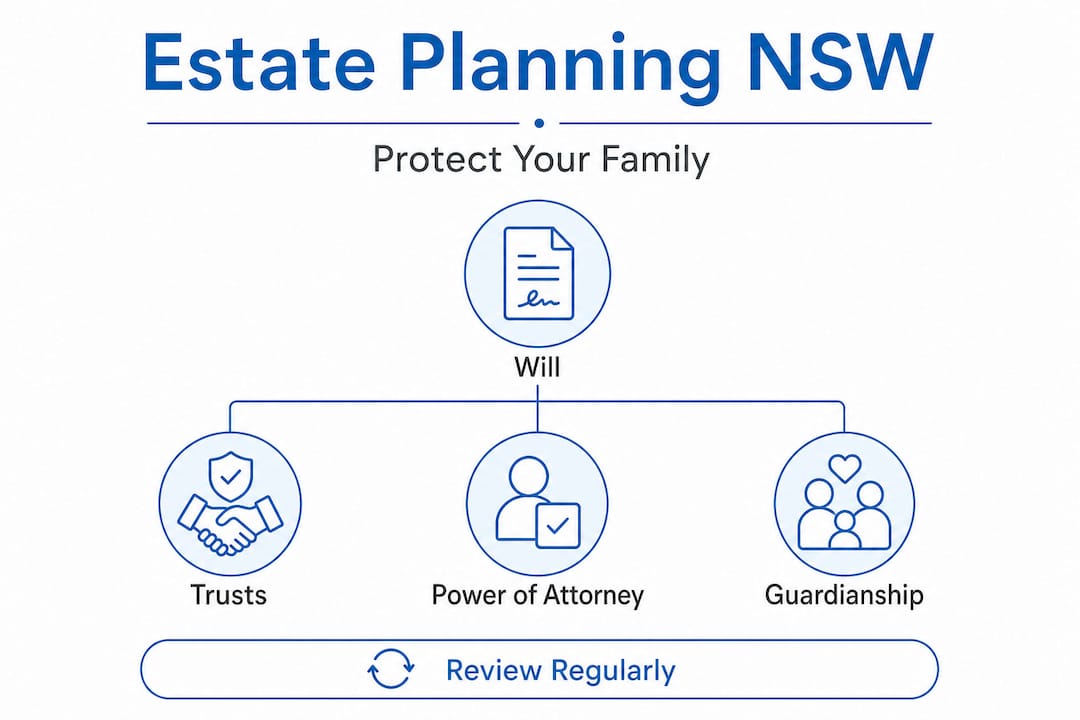
Estate planning is far more than writing a Will. According to the NSW Government, estate planning involves putting legal documents in place to direct what happens to your estate when you die and to manage important decisions if you lose capacity. For NSW residents, this means considering everything from asset distribution and guardianship appointments to powers of attorney and trust structures. Getting these elements right requires local legal knowledge, because NSW laws and requirements shape every document in your plan.
Table of Contents
- Understanding estate planning in New South Wales
- The role of a Will in estate planning
- Trusts and testamentary trusts explained
- Incapacity planning: Powers of attorney and guardianship
- Choosing executors, trustees, and storage solutions
- What most people in NSW miss about estate planning
- Get help with estate planning in NSW
- Frequently asked questions
Key Takeaways
| Point | Details |
|---|---|
| Estate planning is multi-faceted | It covers asset distribution, trust management, incapacity planning, and key legal roles. |
| A valid Will is essential | Having a properly executed Will guides asset distribution and avoids complex court processes. |
| Choose your representatives wisely | Executors and trustees should be reliable and capable of carrying out your intentions. |
| Incapacity planning matters | Assigning an Enduring Power of Attorney and guardian protects you and your family if you lose capacity. |
| Professional help makes a difference | Legal advice and secure document storage strengthen compliance and peace of mind. |
Understanding estate planning in New South Wales
Estate planning is a structured legal process that covers a wider range of decisions than most people realise. Estate planning in NSW involves putting legal documents in place to direct what happens to your estate when you die and to manage important decisions if you lose capacity. That single sentence carries enormous weight, because it confirms that your plan must work in two distinct scenarios: after your death, and while you are still alive but unable to make decisions for yourself.
The core documents in a NSW estate plan typically include:
- Will: Directs the distribution of your estate after death and appoints an executor
- Enduring Power of Attorney: Authorises someone to make legal and financial decisions on your behalf
- Appointment of Enduring Guardian: Authorises someone to make health, lifestyle, and accommodation decisions if you lose capacity
- Testamentary trust: A structure created within your Will that activates after death to manage assets for beneficiaries
Critically, estate planning is broader than just a Will because incapacity planning and the correct choice of roles affect family protection and implementation in ways that asset distribution alone cannot address. Many NSW families discover this the hard way, when an unforeseen illness or accident occurs and no incapacity documents are in place. Estate planning advice from a qualified solicitor can help you avoid these gaps before they become crises.
Key estate planning documents and their function:
| Document | When it applies | Primary function |
|---|---|---|
| Will | After death | Asset distribution and executor appointment |
| Enduring Power of Attorney | During incapacity | Legal and financial decisions |
| Enduring Guardian | During incapacity | Health and lifestyle decisions |
| Testamentary trust | After death (via Will) | Asset management for beneficiaries |
Pro Tip: Do not treat estate planning as a one-time event. Review your plan every three to five years or whenever a major life event occurs, such as marriage, divorce, the birth of a child, or acquiring significant assets.
The role of a Will in estate planning
A Will sits at the centre of any sound estate plan. A Will states your instructions for distributing your estate after death and appoints an executor to administer the estate. That executor has the legal responsibility to locate your assets, pay any outstanding debts, and distribute what remains to your nominated beneficiaries according to your stated wishes.
A valid Will in NSW typically covers:
- Beneficiaries: The people or organisations who receive your assets
- Executor: The person responsible for carrying out your instructions
- Guardianship: Who cares for minor children if both parents pass away
- Specific bequests: Particular items, sums of money, or property you wish to leave to named individuals
- Residuary estate: What happens to everything not specifically mentioned
“Without a valid Will, your estate may not be distributed the way you intended, and the administration process becomes significantly more complex and stressful for your family.”
When a person dies with a valid Will, the executor typically applies for a grant of probate from the Supreme Court of NSW. Probate is the court’s formal recognition that the Will is valid and that the executor has authority to act. When a person dies without a valid Will (known as dying intestate), administration of the estate changes and the family must apply for letters of administration, a separate court process where the court appoints an administrator.
| Situation | Court process | Who applies | Outcome |
|---|---|---|---|
| Valid Will exists | Grant of probate | Named executor | Estate distributed per Will |
| No valid Will | Letters of administration | Next of kin | Estate distributed per intestacy laws |
The intestacy rules in NSW follow a set statutory formula, which may not reflect your personal wishes or family circumstances. For example, a long-term de facto partner might not receive what you intended, or assets could be divided in ways that create financial hardship. Getting Will preparation in Sydney right from the start avoids these complications entirely.
Understanding the probate process in NSW is also important for executors, as the timeframes, required documents, and court fees all need to be managed correctly after a loved one passes.
Trusts and testamentary trusts explained
While a Will answers many questions about what happens to your estate, trusts provide additional flexibility and protection, particularly for families with young children, blended family arrangements, or significant assets.
Trusts in NSW involve one person holding property on behalf of, and for the benefit of, another, with a trustee managing trust assets according to the trust deed or Will. The key benefit is control: assets are not handed over outright but managed according to specific terms you set.
Here are the main reasons NSW families use trusts in estate planning:
- Protecting minor beneficiaries: Children cannot legally manage significant assets. A trust ensures their inheritance is managed responsibly until they reach a suitable age, often 18, 21, or 25 depending on your instructions.
- Providing for vulnerable beneficiaries: Adults with disabilities or mental health conditions benefit from managed distributions rather than lump sums that could be misused or affect their eligibility for government support payments.
- Tax efficiency: Testamentary trusts can offer income-splitting benefits for adult beneficiaries, which may reduce the overall tax burden on the estate’s earnings over time.
- Protecting assets from relationship breakdown: If a beneficiary goes through a divorce, assets held in trust may be better protected than those transferred outright.
- Managing complex family structures: Blended families with children from multiple relationships often use trusts to ensure fair distribution across all family members.
Testamentary trusts are created within a Will and come into effect only after the person dies. This is an important distinction: they have no legal effect during your lifetime and do not require any separate ongoing management before your death. Once the Will is executed and the estate is administered, the trustee steps in to manage the assets according to your instructions.
| Trust type | When it activates | Managed by | Primary use |
|---|---|---|---|
| Testamentary trust | After death (via Will) | Appointed trustee | Protecting beneficiaries long-term |
| Inter vivos trust | During lifetime | Appointed trustee | Asset management now and after death |
| Superannuation trust | After death (via binding nomination) | Fund trustee | Directing super death benefits |
Pro Tip: If you have children under 18 or a beneficiary with a disability, discuss a testamentary trust with your solicitor. It can make a significant difference to how well their inheritance is managed and preserved over time.
If you are concerned about disputes or the validity of your estate arrangements, understanding the options around contesting a Will in NSW is also worth exploring with your legal adviser.
Incapacity planning: Powers of attorney and guardianship
Many NSW residents focus heavily on what happens after they die, but preparing for incapacity during your lifetime is equally important. Incapacity can result from a sudden accident, a progressive illness, or age-related cognitive decline. Without the right documents in place, your family may face an urgent and costly legal process to gain authority to manage your affairs.

An Enduring Power of Attorney authorises someone to make legal and financial decisions when you are unable to. Your chosen attorney can manage your bank accounts, pay bills, manage investments, and deal with property transactions on your behalf. The word “enduring” is critical here: it means the power continues even if you lose mental capacity, unlike a general power of attorney, which automatically ends at that point.
An enduring guardian is appointed to make accommodation, healthcare, lifestyle, and medical decisions if you become unable to make your own decisions. This is the person who can decide where you live, what medical treatment you receive, and what support services you access. These are deeply personal decisions, and you want someone who genuinely understands your values and wishes.
Key considerations when appointing these roles:
- Choose someone you trust completely. They will have real authority over significant aspects of your life.
- Consider practical capacity. A person who is unorganised, lives overseas, or has competing personal interests may not be suitable, regardless of your relationship with them.
- Appoint a substitute. If your primary attorney or guardian is unable or unwilling to act, a named substitute ensures there is no gap in authority.
- Review your appointments regularly. Life circumstances change, and the person you appoint today may not be the right person in ten years.
Pro Tip: Your attorney and guardian do not need to be the same person. In fact, separating financial and personal decisions between two trusted individuals can create a useful system of checks and provide greater family confidence in the process.
Working with estate administration support professionals ensures your incapacity documents are drafted correctly and legally valid in NSW.
Choosing executors, trustees, and storage solutions
Selecting the right executor and trustee is one of the most consequential decisions in your entire estate plan. It is not simply a matter of choosing the most senior family member or your closest friend. These roles carry real legal responsibilities, and the person you choose must be able to manage them effectively.
What a good executor or trustee looks like:
- Organised and reliable, capable of managing paperwork and meeting legal deadlines
- Financially literate enough to understand account management and distributions
- Emotionally resilient, as they may need to make difficult decisions during a period of grief
- Free from conflicts of interest with beneficiaries
- Willing and available to act, which takes more time than most people realise
Trustee honesty and capacity are essential qualities in asset management. An executor who lacks organisational skills or becomes overwhelmed can delay the administration of your estate by months or even years.
Common document storage and management options in NSW:
| Storage option | Benefits | Considerations |
|---|---|---|
| With your solicitor | Secure, professional, easily retrieved | Ongoing storage fee may apply |
| NSW Trustee and Guardian | Government-backed, integrated with service | Fees apply for preparation and storage |
| Home safe | Accessible | Risk of loss, damage, or being overlooked |
| Safety deposit box | Secure | Access may be difficult for executor after death |
NSW Trustee and Guardian provides estate planning services including preparing Wills, Powers of Attorney, and Appointment of Enduring Guardian, and can also store these documents securely. This is a practical option for many NSW residents, particularly those who want a government-backed service with integrated document management.
Seeking probate application advice early also helps your executor understand what will be required of them when the time comes, reducing stress and uncertainty for your family.
What most people in NSW miss about estate planning
After working with NSW families on estate planning matters, we have observed a consistent pattern: most people believe that signing a Will is enough. They draft it, file it away, and consider the task complete. This approach leaves significant gaps that can have serious consequences for the people they care most about.
Estate planning is broader than just a Will because incapacity planning and the correct choice of roles affect family protection and implementation just as profoundly as the distribution of assets. A perfectly drafted Will becomes far less effective if the executor lacks the skills to carry it out, or if no enduring guardian has been appointed and a family member must urgently apply to the NSW Civil and Administrative Tribunal for decision-making authority during a health crisis.
The choice of executor and trustee deserves the same careful thought as asset distribution. We have seen estates where the named executor was well-intentioned but completely unprepared for the administrative and emotional demands of the role. Delays, errors, and family tension followed. Choosing the right person, and having an honest conversation with them beforehand, changes real outcomes.
Incapacity planning is also frequently postponed because people associate it with old age. In reality, incapacity can occur at any life stage. Reviewing your estate planning detail regularly and ensuring all documents are current is one of the most practical things any NSW resident can do for their family’s protection.
Get help with estate planning in NSW
Understanding estate planning is the first step. Acting on it is what protects your family.

At GKE Lawyers, our estate planning solicitors help NSW residents prepare Wills, testamentary trusts, Powers of Attorney, and Appointment of Enduring Guardian documents that are legally sound and tailored to your specific circumstances. We take the time to understand your family structure, your assets, and your wishes so that every document works together as a coherent plan. Whether you are starting your estate plan for the first time or reviewing documents that have not been updated in years, our team is ready to assist. Contact GKE Lawyers today to book a consultation and take the next practical step towards protecting the people who matter most to you.
Frequently asked questions
What if I die without a Will in NSW?
If you die without a valid Will, your estate will be administered through a court process called letters of administration, and assets are distributed according to the NSW intestacy rules, which may not reflect your personal wishes. Administration changes significantly without a valid Will, and the process is more burdensome for your family.
What is an Enduring Power of Attorney?
An Enduring Power of Attorney authorises a person you choose to make legal and financial decisions on your behalf when you are no longer able to do so yourself. Unlike a general power of attorney, it continues to operate even after you lose mental capacity.
How do trusts fit into estate planning?
Trusts allow assets to be held and managed by a trustee for the benefit of your chosen beneficiaries, providing protection and control over how wealth is distributed. Testamentary trusts are created within a Will and only come into effect after the person dies.
Who should I choose as executor or trustee?
Choose someone who is honest, organised, and capable of managing legal and financial responsibilities, as trustee honesty and capacity are essential to effective asset management. Speak with your chosen person beforehand to confirm they are willing and prepared to take on the role.
Can professionals help with estate planning in NSW?
Yes. Legal solicitors and NSW Trustee and Guardian both offer estate planning services including Will preparation, Powers of Attorney, Enduring Guardian appointments, and secure document storage across New South Wales.