

Many business owners assume a commercial dispute will inevitably end in a courtroom showdown. In reality, understanding what does commercial litigation mean reveals a far broader process, one that begins well before any hearing and often resolves without a judge ever delivering a verdict. Commercial litigation covers everything from the moment formal legal action is considered through to enforcement of any judgment. For NSW business owners currently facing a dispute, grasping this full picture early is not just useful. It is the difference between making decisions with confidence and reacting under pressure.
Table of Contents
- What is commercial litigation and why does it matter
- Common types of disputes that lead to commercial litigation
- Understanding the commercial litigation process in New South Wales
- Common challenges and costs in commercial litigation
- How to prepare for commercial litigation and protect your business
- Why understanding commercial litigation early changes your business outcomes
- How GKE Lawyers support NSW business owners with commercial litigation
- Frequently asked questions
Key Takeaways
| Point | Details |
|---|---|
| Definition | Commercial litigation occurs when one business takes legal action against another to resolve a dispute. |
| Dispute types | Common issues include contract breaches, shareholder conflicts, intellectual property, and debt collection. |
| Litigation process | It involves stages like pleadings, discovery, trial, or alternative dispute resolution. |
| Costs and complexity | Litigation can be costly and complex due to legal fees, discovery, and expert consultations. |
| Preparation | Early legal advice and understanding of the process help protect business interests and manage risks. |
What is commercial litigation and why does it matter
“Commercial litigation” means a situation where one company or other commercial entity takes legal action against another, typically to resolve a business-related dispute such as suing for breach of contract. It is not limited to full courtroom trials. The commercial litigation definition also captures the pre-trial stages, evidence exchange, negotiations, and any settlement discussions that occur along the way.
Commercial litigation is the civil-court process for business disputes where claims and defences are developed, and sometimes a trial occurs, after a breakdown in business negotiations or contractual relationships. This distinction matters because many businesses only discover how involved the process is once they are already inside it.
For NSW business owners, understanding the commercial litigation overview helps you:
- Assess whether your dispute is likely to escalate to formal legal proceedings
- Identify the right time to engage specialist legal counsel
- Understand your rights and obligations from the outset
- Weigh up the cost and time implications before committing to a course of action
- Approach commercial dispute resolution with realistic expectations about what the process involves
What is commercial litigation at its core? It is a civil law mechanism for resolving business conflicts where informal methods have failed or are unsuitable. Grasping this early gives you an immediate advantage in any dispute.
Common types of disputes that lead to commercial litigation
Commercial litigation covers a wide range of issues, including contract breaches, partner and shareholder disputes, intellectual property, debt collection, and employment matters. Knowing which category your situation falls into helps you assess how complex the process is likely to be and what specialist advice you need.
Common disputes that trigger commercial litigation in NSW include:
- Breach of contract: A supplier fails to deliver goods on time, a client refuses to pay an invoice, or a service agreement is terminated without proper notice.
- Shareholder and partnership disputes: Disagreements over profit distribution, management decisions, or alleged breaches of shareholders’ agreements.
- Intellectual property disputes: Unauthorised use of trademarks, copyright infringement, or misappropriation of confidential business information.
- Debt recovery: A creditor pursues a debtor through formal legal channels after informal demands fail. Business debt collection matters represent a significant proportion of commercial disputes in NSW courts.
- Property disputes: Disagreements over commercial leases, development agreements, or ownership of business property. Property dispute litigation requires specific expertise given the interaction between property law and commercial obligations.
- Employment disputes: Unfair dismissal claims, restraint of trade breaches, or disputes over employment contracts.
Recognising the category of your dispute early allows you to anticipate likely evidence requirements, potential counterclaims, and the likely forum in which the matter will be heard.
Pro Tip: If you are unsure whether your situation qualifies as a commercial dispute, document every relevant communication, contract, and transaction record immediately. Organised documentation strengthens your position at every stage, including pre-litigation negotiations.
Understanding the commercial litigation process in New South Wales
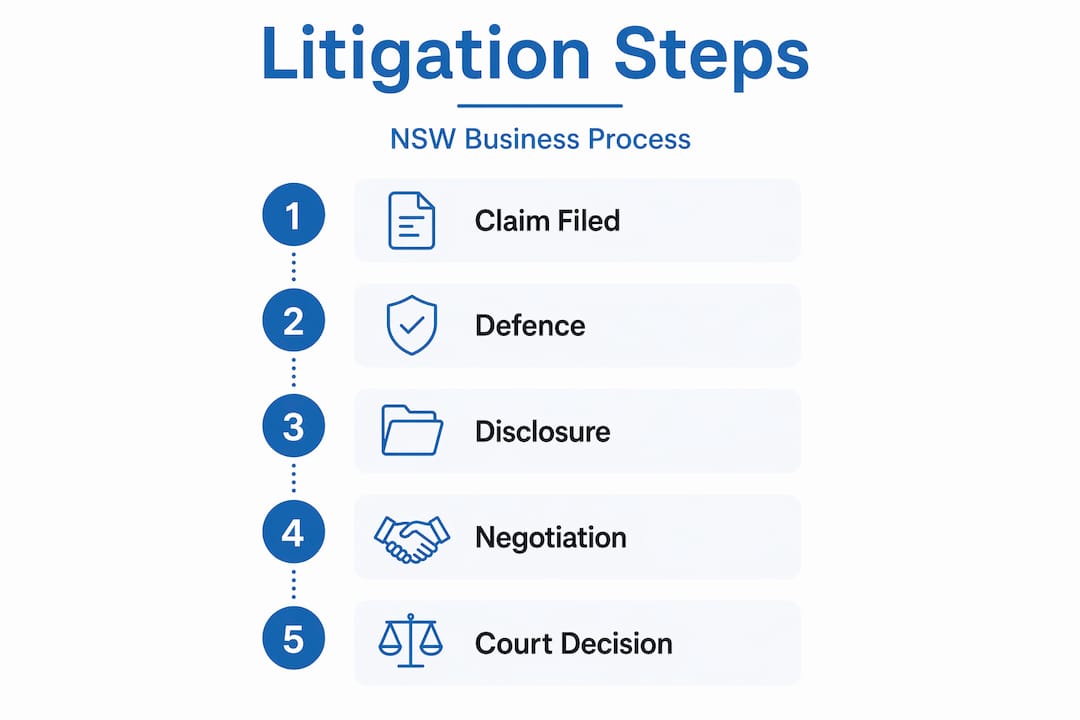
Now that you know the kinds of disputes involved, it helps to understand how the process actually unfolds for NSW businesses. Commercial litigation does not jump straight to a trial. It moves through defined stages, and your leverage as a business owner shifts at each one.
The key stages of commercial litigation in NSW:
- Pre-litigation: Parties attempt to resolve the matter through letters of demand, negotiations, or informal discussions. This is often the most cost-effective point at which to reach a resolution.
- Pleadings: If negotiations fail, formal documents are filed with the court. The plaintiff files a statement of claim; the defendant files a defence. Counterclaims may also be raised here.
- Discovery and disclosure: Both parties disclose relevant documents and information. This stage is critical because it can reveal evidence that changes the entire complexion of the dispute.
- Alternative dispute resolution (ADR): Many NSW courts require parties to attempt mediation or arbitration before proceeding to trial. ADR can resolve matters faster and at lower cost.
- Trial: If ADR fails, the matter proceeds to a hearing where evidence is presented and a judge delivers a judgment.
- Enforcement: Winning a judgment does not automatically mean the money arrives. Enforcement steps may be required if the losing party does not comply voluntarily.
Commercial litigation can involve significant cost and complexity due to legal fees, court fees, evidence disclosure, and expert reports. The complexity escalates considerably once formal claims and defences are filed.
Once a dispute turns into formal claims, defences, and evidence, the leverage and decision points for businesses change. What seemed like a straightforward recovery action can quickly involve counterclaims that put your own position under scrutiny.

| Stage | Typical duration | Key cost drivers | ADR available? |
|---|---|---|---|
| Pre-litigation | Weeks to months | Legal advice, demand letters | Yes, informally |
| Pleadings | 1 to 3 months | Drafting, filing fees | Yes |
| Discovery | 2 to 6 months | Document review, legal hours | Yes |
| ADR | 1 to 3 months | Mediator fees, preparation | Core stage |
| Trial | 1 to 5+ days | Barrister fees, expert witnesses | No |
| Enforcement | Variable | Court orders, process fees | No |
Understanding NSW property dispute resolution timelines gives you a concrete reference point for how long commercial disputes can realistically run.
Pro Tip: Do not wait until pleadings are filed to think about ADR. Proposing mediation early signals commercial reasonableness, can reduce costs substantially, and is looked upon favourably by courts if the matter does proceed to trial.
Common challenges and costs in commercial litigation
Commercial litigation can be expensive and time-consuming due to legal fees, expert consultations, court fees, and discovery expenses. For NSW business owners, the financial exposure often surprises people who expected a straightforward process.
Major cost components to anticipate:
- Solicitor and barrister fees: Charged at hourly rates or on agreed fee arrangements. Complex matters involving senior counsel attract significantly higher costs.
- Court filing fees: NSW Supreme Court filing fees for commercial matters can run into thousands of dollars depending on the claim amount.
- Expert witness reports: Disputes involving valuations, accounting, engineering, or technology often require paid expert opinions.
- Discovery costs: Reviewing and producing large volumes of documents, particularly electronically stored information, can add tens of thousands of dollars to a matter.
- Enforcement costs: Even after judgment, collecting the money can require additional court orders and legal steps.
| Cost component | Typical range (NSW) | Variable factors |
|---|---|---|
| Solicitor fees | $300 to $700+ per hour | Seniority, firm size, complexity |
| Barrister fees | $500 to $5,000+ per day | Experience, matter complexity |
| Expert reports | $5,000 to $50,000+ | Discipline, report length |
| Court filing fees | $1,000 to $10,000+ | Claim amount, court level |
| Discovery review | $5,000 to $100,000+ | Volume of documents involved |
“Disclosure and evidence gathering often reveal hidden issues that broaden claims and defences, increasing costs and settlement leverage.”
Understanding civil litigation costs and challenges in detail before you commit to a course of action allows you to make genuinely informed decisions rather than being caught off guard mid-process.
How to prepare for commercial litigation and protect your business
Understanding conflicts early and seeking legal advice helps businesses manage leverage and outcomes realistically. Preparation is not just about gathering paperwork. It is about entering the process with a clear strategy.
Steps to prepare effectively:
- Identify and assess the dispute early. As soon as you recognise that a business relationship is breaking down, take stock of what obligations exist, what has gone wrong, and what your exposure might be on both sides.
- Seek specialist legal advice promptly. Commercial litigation is not an area for general legal advice. You need a lawyer who regularly works in this space and understands the NSW courts and procedural requirements.
- Organise your documentation. Contracts, emails, invoices, meeting notes, and financial records are all potentially relevant. Do not delete or alter anything. Preserve everything.
- Assess ADR options seriously. Mediation and arbitration are not signs of weakness. They are often faster, cheaper, and more predictable than a full trial. Consider them as genuine alternatives, not as a last resort.
- Build a realistic budget and timeline. Work with your legal team to model out likely costs and durations at each stage. This informs whether settling early makes commercial sense compared to pursuing full judgment.
- Review your contracts for dispute resolution clauses. Many commercial agreements include mandatory mediation or arbitration provisions. These clauses affect your options before you even file a claim.
Commercial litigation preparation that starts early gives you better options at every stage, including the ability to negotiate from a position of greater knowledge and organisation.
Pro Tip: Ask your lawyer to prepare a litigation risk assessment before you commit to formal proceedings. A clear-eyed view of your chances, costs, and likely recovery helps you weigh litigation against settlement with actual numbers rather than assumptions.
Why understanding commercial litigation early changes your business outcomes
Most business owners who come to us mid-dispute say the same thing: they wish they had understood the process earlier. Not because early understanding would have prevented the dispute, but because it would have changed the decisions they made in the weeks before legal action began.
Here is what we see consistently: businesses that wait until proceedings are served before seeking proper advice have already made concessions, sent damaging emails, or discarded documents that would have been useful. The negotiation positions they took in the weeks before formal action often reflect a fundamental misunderstanding of what commercial litigation explained actually looks like in practice.
Disputes initially thought narrow often widen after pleadings and disclosure, affecting costs and settlement leverage. A straightforward breach of contract claim can attract a counterclaim for lost profits, reputational damage, or unconscionable conduct. When you understand this risk early, you approach pre-litigation negotiations differently.
There is also a perception element that most commentary ignores. Courts and opposing parties both read how a business enters the litigation process. A party that arrives organised, legally advised, and genuinely open to ADR is treated differently from one that appears reactive and unprepared. That perception affects settlement offers, the willingness of the other side to negotiate, and even how a judge interprets your conduct if costs are being assessed.
Our view is that commercial litigation insights are most valuable before the dispute becomes entrenched. Once both sides have filed, positions harden and costs accumulate quickly. Early understanding of what commercial litigation means for your specific situation is not a luxury. It is the most cost-effective legal investment you can make.
How GKE Lawyers support NSW business owners with commercial litigation
Understanding commercial litigation explained in theory is one thing. Navigating it for your actual business is another matter entirely. GKE Lawyers is a full-service Sydney law firm with direct experience in commercial dispute resolution across the NSW courts, from straightforward debt recovery through to complex multi-party commercial proceedings.

Our team provides tailored advice for commercial litigation lawyers in Sydney matters, with a focus on realistic cost management and practical outcomes. We assist with everything from pre-litigation strategy and contract review through to ADR facilitation and trial representation. We also handle property dispute lawyers Sydney matters and business debt recovery services for NSW clients who need to recover what they are owed. If you are facing a commercial dispute and want to understand your options before things escalate, contact GKE Lawyers for a consultation with our litigation team.
Frequently asked questions
What types of disputes are usually handled by commercial litigation?
Commercial litigation covers contract breaches, partner and shareholder disputes, intellectual property, debt collection, and employment matters between businesses. Most disputes involve a breakdown in a contractual or commercial relationship between two or more parties.
Is commercial litigation always resolved through a court trial?
No. Many commercial disputes are resolved through mediation, arbitration, or negotiated settlement well before any trial takes place. Litigation in commercial matters can also encompass negotiations and settlements to avoid the time and cost associated with trials.
How costly can commercial litigation be for NSW businesses?
Commercial litigation can be expensive due to legal fees, court fees, expert reports, and discovery costs, which is why early legal advice and realistic budget planning are essential for any NSW business considering formal proceedings.
What is evidence disclosure in commercial litigation?
Evidence disclosure, known as discovery, is the process where both parties share relevant documents and information before trial. Disclosure often reveals hidden issues that broaden claims and defences, which can significantly affect both the cost and the settlement leverage of each party.
How can NSW business owners prepare to deal with commercial litigation?
Understanding conflicts early and seeking specialist legal advice helps businesses manage leverage and outcomes realistically. Gathering documentation, assessing ADR options, and building a clear budget and timeline are the most important first steps.
Recommended
- Litigation Lawyers in Sydney | Commercial Dispute Resolution | GKE Lawyers
- Sydney Civil Litigation Lawyers – Leading Civil Litigation and Dispute Resolution Specialists – GKE Lawyers
- Expert Property Lawyers Guide to Buying Commercial Properties in NSW
- Debt Recovery Lawyers Sydney NSW | Business & Commercial Debt Collection | GKE Lawyers