

A broken promise does not automatically become a breach of contract in New South Wales. That assumption catches many individuals and businesses off guard when they discover that what felt like a clear violation may not entitle them to any meaningful legal remedy. Under NSW law, a breach occurs when a party fails to perform a contractual obligation, whether through non-performance, late performance, or substandard performance, but the consequences of that breach depend heavily on contract wording and whether you can demonstrate real, quantifiable harm. This guide unpacks exactly how breach of contract works in NSW, what courts look for, and what your practical options are.
Table of Contents
- What counts as a breach of contract in NSW?
- How courts assess the seriousness of breach
- Establishing harm and proving loss in breach cases
- Limitation periods and timelines for breach claims in NSW
- Practical next steps after a breach of contract
- Why breach of contract is misunderstood in NSW
- Need expert help with contract disputes in Sydney?
- Frequently asked questions
Key Takeaways
| Point | Details |
|---|---|
| Clear breach criteria | NSW law requires clear evidence of non-performance, late delivery, or substandard fulfilment to prove breach. |
| Essential vs technical terms | Serious breaches of essential terms trigger more remedies than minor technical issues. |
| Proving loss | Courts will only award substantial damages if you can demonstrate real financial loss. |
| Strict timeframes | Most breach claims must be filed within 6 years, or 12 years for claims under deeds. |
| Action steps | Practical options include negotiation, dispute resolution, and professional legal advice in Sydney. |
What counts as a breach of contract in NSW?
With the legal foundation set, let’s break down exactly what constitutes a breach under NSW contract law.
A contract is a legally binding agreement between two or more parties. For a breach to occur, there must first be a valid, enforceable contract in place. Once that threshold is met, a breach happens when a party fails to perform an obligation under that agreement, including by failing to perform entirely, performing late, or performing in a way that does not meet the required standard. Not every shortfall will carry the same legal weight.
Types of breach you need to know
NSW law distinguishes between several categories of breach:
- Non-performance: One party simply does not do what they agreed to do. A builder who walks off a job halfway through is a clear example.
- Late performance: The work or payment is delivered, but not within the agreed timeframe. Whether this constitutes a serious breach depends on whether time was expressed as “of the essence” in the contract.
- Defective performance: The party performs their obligation, but not to the contractual standard. Poor workmanship on a renovation or a goods supplier delivering incorrect specifications both fall into this category.
- Anticipatory breach: This is where one party clearly communicates, before the performance date, that they will not be meeting their obligations. A tenant announcing they will not pay rent next month gives rise to an anticipatory breach, and the other party can act immediately rather than waiting.
Essential vs non-essential terms
The distinction between essential and non-essential contract terms is fundamental to how courts assess breach claims in NSW. An essential term, sometimes called a condition, goes to the heart of the agreement. Breaching it entitles the innocent party to terminate the contract and claim damages. A non-essential term, sometimes called a warranty, is less central. Breaching it may entitle the innocent party to damages, but not to terminate the contract outright.
| Term type | Also known as | Breach consequence |
|---|---|---|
| Essential term | Condition | Right to terminate and claim damages |
| Non-essential term | Warranty | Right to damages only |
| Intermediate term | Innominate term | Depends on severity of the breach |
“A breach of contract occurs when a party fails to perform an obligation under a legally binding agreement, including by failing to perform, performing late, or performing in a way that does not meet the contractual standard.” NSW Law Handbook
How courts assess the seriousness of breach
Now that you know what constitutes a breach, it’s crucial to understand how NSW courts treat different types of breaches.
Courts do not treat all breaches equally. Even where something has clearly gone wrong, the remedy available to you will depend on how serious the breach is and what the contract itself says about consequences. This is where many people are surprised by the outcome of their dispute.

What courts focus on
NSW courts look carefully at three primary considerations:
- The precise wording of the contract, particularly whether a term was expressed as essential or time-sensitive
- Whether the breach went to the root of the agreement, or was merely a technical shortfall
- Whether the innocent party suffered an actual, measurable loss as a direct result
The practical implication is significant. As highlighted in how breach of contract law works in Australia, courts focus on contractual wording, seriousness, and whether you can prove actual loss. Technical breaches with no real harm may not produce substantial damages. This means that even if you are technically correct that a breach occurred, you could receive nominal damages or nothing at all if you cannot prove financial loss.
Comparison: Technical breach vs serious breach
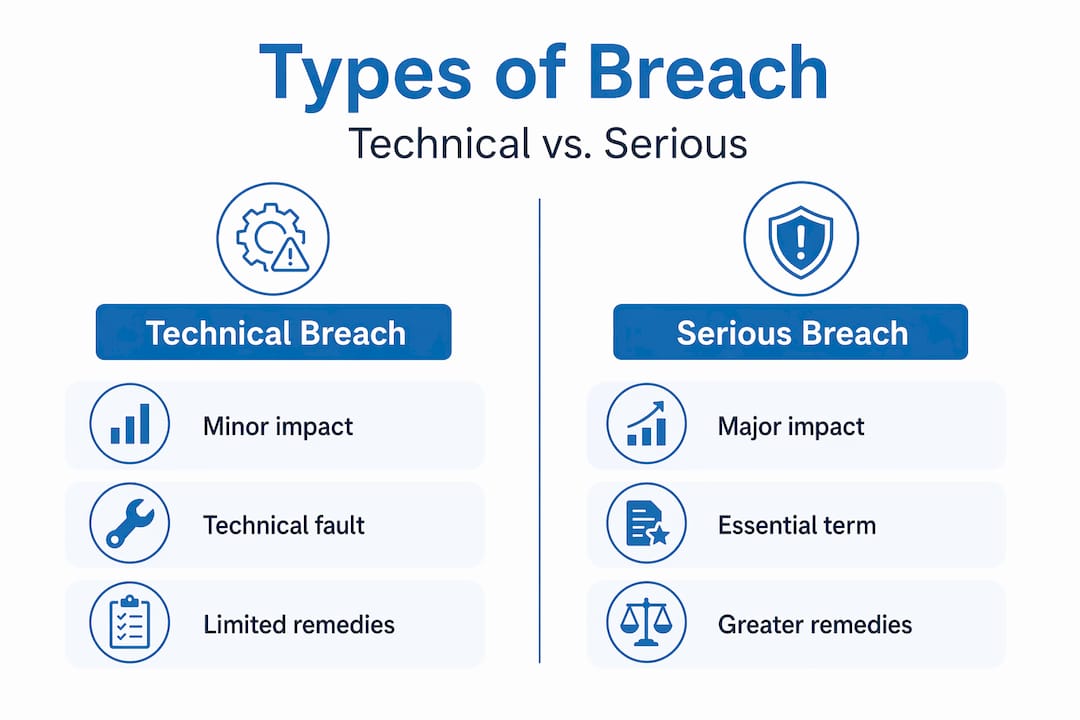
| Factor | Technical breach | Serious breach |
|---|---|---|
| Impact on contract | Minor, does not undermine purpose | Substantial, undermines core purpose |
| Typical remedy | Nominal damages or none | Damages, possible termination |
| Time is of the essence | Usually not relevant | Often relevant |
| Courts’ typical approach | May decline significant award | More likely to grant full relief |
Pro Tip: Before you assume you can walk away from a contract because the other party missed a deadline, check whether your contract expressly states that time is of the essence. If it does not, late performance may only entitle you to damages, not termination.
Our litigation lawyers Sydney frequently see clients who believe they have a strong case, only to discover their contract wording weakens their position significantly. Getting advice early is far more cost-effective than discovering this mid-dispute.
Property transactions require particular care here. When buying a property in Sydney, the contract for sale will contain both essential and non-essential terms, and understanding which is which can mean the difference between terminating the deal and being locked in.
Establishing harm and proving loss in breach cases
Understanding breach severity flows directly into proving whether you’re entitled to compensation.
Proving that a breach occurred is only half the battle. To receive substantial compensation, you must demonstrate that you suffered an actual, quantifiable loss as a result of that breach. This is the step where many claims either succeed or fail.
The process for proving loss
- Identify your loss clearly. What exactly did you lose because of the breach? Lost profit, additional costs you incurred, or the difference between the contract price and what you paid a replacement supplier are all valid heads of loss.
- Calculate the financial impact. NSW courts award damages aimed at putting you in the position you would have been in had the contract been performed. This is known as expectation damages. You may also be entitled to reliance damages if you incurred expenses in anticipation of the contract being fulfilled.
- Gather supporting documents. Invoices, bank statements, correspondence, quotes from replacement suppliers, and expert reports all help substantiate your loss claim. Undocumented loss is difficult to establish convincingly in court.
- Address consequential losses. Where your loss flows beyond the immediate breach, such as lost business opportunities or downstream contract failures, you must show these losses were reasonably foreseeable at the time the contract was made.
- Mitigate your loss. You have a legal obligation to take reasonable steps to reduce your loss. If you could have found a replacement supplier at a similar price but chose not to, the court may reduce your damages accordingly.
What courts will and will not award
- Courts will award compensation that directly flows from the breach and was foreseeable
- Courts will award costs you incurred in attempting to mitigate your loss
- Courts will generally not award damages for emotional distress in commercial contracts
- Courts will not award speculative losses without evidence to support them
As reinforced by the breach of contract guidance on Australian contract law, proving actual loss is essential. This is true whether you are pursuing a commercial dispute or a claim arising from a personal agreement.
Pro Tip: Start collecting and organising your evidence from the moment you suspect a breach. The longer you wait, the harder it becomes to reconstruct the paper trail you need.
Our litigation lawyers Sydney work closely with clients to prepare detailed loss assessments before filing any claim, which strengthens your position from the outset. For disputes involving estate-related contracts, our estate lawyers Sydney can assist where the breach intersects with deceased estate matters. For personal harm resulting from a breach, compensation claims may also be relevant depending on the facts.
Limitation periods and timelines for breach claims in NSW
Knowing when you must act is essential. Let’s clarify the time limits for breach claims.
Time limits are a critical and often overlooked dimension of breach of contract claims. Waiting too long to act can extinguish your right to bring a claim entirely, regardless of how strong it might otherwise be.
Under NSW law, breach of contract proceedings are generally subject to limitation periods, with a common rule of 6 years for most ordinary (simple) contract claims and 12 years for claims under deeds. These periods typically begin from the date of the breach, not when you discovered it.
Key limitation periods at a glance
| Contract type | Limitation period | Period starts from |
|---|---|---|
| Simple contract (oral or written) | 6 years | Date of breach |
| Deed | 12 years | Date of breach |
| Contracts involving minors | May vary | Seek legal advice |
| Fraud or concealment | May be extended | Discovery of the fraud |
Important points about limitation periods in NSW
- The clock starts ticking from the date the breach occurred, which may be earlier than you realise
- If the breach is ongoing, different rules may apply to determine when time started running
- Limitation periods can be extended in limited circumstances, such as where the breach was actively concealed
- Filing your claim one day after the limitation period expires can result in your claim being permanently barred
- Limitation periods apply even if negotiations are ongoing, so do not assume that talking to the other party stops the clock
Where contracts relate to succession disputes, contesting a will in Sydney also carries strict time limits under NSW law, reinforcing just how important it is to act within defined timeframes across all legal matters.
Practical next steps after a breach of contract
Armed with timelines and a clear understanding of breach, here’s what you can do next.
Knowing your rights is useful. Acting on them effectively is what actually matters. If you believe a contract has been breached, follow these steps methodically.
- Review the contract in detail. Read every clause carefully, paying attention to how terms are defined, whether any notice requirements exist, and what remedies the contract itself specifies for breach.
- Gather and preserve all relevant evidence. This includes written communications, emails, text messages, invoices, photographs, and any other records related to the contract and the alleged breach.
- Send a formal letter of demand. Put the other party on notice in writing. Specify the breach, the loss you have suffered, and what you require to resolve the matter. This step also demonstrates that you attempted to resolve the dispute before escalating.
- Consider negotiation or mediation. Many contract disputes in NSW are resolved without going to court. Mediation is cost-effective, faster, and gives both parties more control over the outcome.
- Seek legal advice before committing to litigation. Dispute resolution in Sydney is a specialist area, and your lawyer will help you assess the realistic value of your claim against the cost and time of court proceedings.
- Escalate to litigation when necessary. Where negotiation has failed and the stakes are high, court proceedings may be the only way to protect your interests.
Under general NSW contract law principles, the innocent party has both a right to act and an obligation to act reasonably. Sitting on your rights without taking steps to mitigate your loss can reduce or even eliminate your entitlement to damages.
Why breach of contract is misunderstood in NSW
In our experience, the biggest mistakes people make in contract disputes have very little to do with the facts of what happened. They almost always come down to two things: misunderstanding what the contract actually says, and overestimating how easy it is to prove loss.
Many clients come to us certain they have a strong case. A supplier did not deliver. A contractor did a poor job. A business partner failed to pay. In isolation, each of these sounds like a clear breach. But once we read the contract carefully, a different picture often emerges. The payment term was ambiguous. The delivery clause had no express time requirement. The workmanship standard was not properly defined. Suddenly, what felt like an open-and-shut case becomes considerably more complex.
The other issue we see repeatedly is the assumption that suffering a breach automatically entitles someone to significant compensation. Courts in NSW are rigorous about requiring evidence of actual financial loss. We have seen technically valid breach claims produce very modest results because the claimant could not substantiate their losses with adequate documentation. As underscored by Australian breach of contract law, technical breaches with no real harm may not produce substantial damages.
The uncomfortable truth is that contract disputes are won or lost on preparation. The party that has clear documentation, well-evidenced loss, and a thorough understanding of the contract terms almost always achieves a better outcome, whether in court or in settlement negotiations. This is not something you can retrofit at the end of a dispute. It starts the moment a contract is signed, or at the very latest, the moment you suspect something has gone wrong.
Our advice to anyone entering a commercial relationship is straightforward: treat your contract as a living document. Understand it before you sign it, keep records throughout the relationship, and get legal advice at the first sign of trouble. Making a prior commitment to commercial property legal checks and contract review before any dispute arises is always a more cost-effective approach than litigating afterwards.
Need expert help with contract disputes in Sydney?
If your contract situation feels complex or urgent, here’s where professionals can step in.
Facing a breach of contract situation in NSW is stressful, but you do not have to navigate it alone. At GKE Lawyers, our team brings focused experience across property, commercial, and dispute resolution matters to help you understand your position and make informed decisions quickly.
Whether you need property dispute lawyers Sydney to assist with a real estate contract issue, litigation lawyers for contracts to prepare or defend a claim, or conveyancing experts Sydney to ensure your next property transaction is properly documented from day one, our team is ready to help. We serve clients across Sydney and throughout New South Wales. Contact GKE Lawyers today to book a consultation and get clear, practical advice on your options.
Frequently asked questions
What is considered a breach of contract under NSW law?
A breach happens when one party fails to meet their obligations as agreed, including non-performance, late delivery, or performing to a substandard level. Under NSW law, a breach is established when the failure relates to a legally binding obligation within a valid contract.
How long do I have to make a breach of contract claim in NSW?
Most simple contract claims must be brought within 6 years, while breaches under deeds carry a 12-year time limit. The limitation period for NSW claims typically begins from the date the breach occurred.
Can I claim damages if there is no actual loss from the breach?
Generally, you must prove actual financial loss to receive substantial damages in NSW. Courts recognise that technical breaches without real harm may result in only nominal damages or none at all.
What are typical remedies for breach of contract in Sydney?
Remedies can include damages, contract termination, or specific performance, depending on the contract terms and the nature of the breach. NSW breach of contract remedies are shaped by whether the breached term was essential and whether actual loss can be demonstrated.
What should I do first if my contract has been breached?
Review your contract thoroughly, gather all relevant evidence and correspondence, and consider seeking legal advice before taking any formal steps. Acting early protects your rights and preserves your option to negotiate a resolution without the time and cost of court proceedings.