

When two or three business partners launch a company together in New South Wales, the early days are often marked by enthusiasm and mutual trust. Disputes feel distant. But without a properly drafted shareholder agreement, even the closest partners can find themselves in costly litigation over decision-making authority, share transfers, or profit distributions. A poorly structured agreement, or none at all, can expose your business to serious legal and financial risk. This guide walks you through every stage of drafting a shareholder agreement that is enforceable, compliant with NSW law, and tailored to your specific business circumstances.
Table of Contents
- What is a shareholder agreement and why is it crucial for Sydney businesses?
- Creating your shareholder agreement: step-by-step guide for NSW
- Ensuring compliance and enforceability in Sydney
- Common mistakes and how to avoid disputes
- Lessons from real Sydney businesses: why a generic template rarely works
- Need expert help drafting your shareholder agreement?
- Frequently asked questions
Key Takeaways
| Point | Details |
|---|---|
| Agreement is essential | Every Sydney business should have a tailored shareholder agreement to protect interests and prevent disputes. |
| Include key clauses | Critical elements cover share capital, transfers, decision-making, and dispute resolution. |
| Prioritise compliance | Ensure your agreement is consistent with your constitution and complies with NSW law. |
| Avoid common mistakes | Custom drafting and clear terms help prevent conflicts and costly litigation. |
| Get expert legal help | For complex issues, professional legal advice ensures enforceability and peace of mind. |
What is a shareholder agreement and why is it crucial for Sydney businesses?
A shareholder agreement is a private contract between the shareholders of a company that governs how the business is managed, how decisions are made, and what happens when shareholders disagree or wish to exit. Unlike a company constitution, which is a public document lodged with ASIC, a shareholder agreement is confidential and binding only on the parties who sign it.
For Sydney businesses, this distinction matters enormously. The commercial environment in New South Wales is competitive and fast-moving. Whether you operate a technology startup in Surry Hills, a construction firm in Parramatta, or a family-owned retail business on the Northern Beaches, your shareholder agreement functions as the foundational rulebook for your business relationships.
Key parties involved in a shareholder agreement typically include:
- Founding shareholders and co-owners
- Investors and venture capital participants
- Silent partners or minority shareholders
- The company itself as a contracting party
Each party has distinct rights and obligations, and the agreement must reflect these clearly to be enforceable. Vague language or missing clauses create ambiguity, and ambiguity in commercial contracts is where disputes are born.
The scope of what a well-drafted agreement should cover is substantial. Essential shareholder agreement clauses for Australian businesses typically address share capital and classes, new share issuing mechanics, decision-making and reserved matters, share transfers including pre-emption and exit protections, founder vesting and leaver provisions, drag-along and tag-along rights, dividend and financial policy, and deadlock and dispute resolution processes.
| Clause | Purpose |
|---|---|
| Share capital and classes | Defines types of shares and shareholder rights |
| Pre-emption rights | Gives existing shareholders first right to buy shares |
| Drag-along rights | Allows majority to compel minority to sell in an acquisition |
| Tag-along rights | Protects minority shareholders if majority sells |
| Founder vesting | Ensures founders earn equity over time |
| Dispute resolution | Sets out mediation or arbitration steps before litigation |
| Reserved matters | Lists decisions requiring unanimous or special shareholder approval |
| Dividend policy | Governs how profits are distributed among shareholders |
It is also worth noting that shareholder agreements have relevance beyond the corporate world. If a shareholder passes away, the agreement directly interacts with wills and estate administration processes, particularly in how shares are treated as assets in an estate. Forward-thinking business owners often integrate their shareholder agreement planning with estate planning in Sydney to ensure business continuity when a shareholder dies or becomes incapacitated.
Pro Tip: If your company is at an early stage with only two or three founders, now is the ideal time to draft your shareholder agreement. It is far easier to negotiate terms when relationships are healthy than during a dispute or when one party is seeking an exit.
Creating your shareholder agreement: step-by-step guide for NSW
Understanding what should be included, the next step is working through the actual drafting process. This requires careful preparation, open communication between shareholders, and professional legal review before signing.
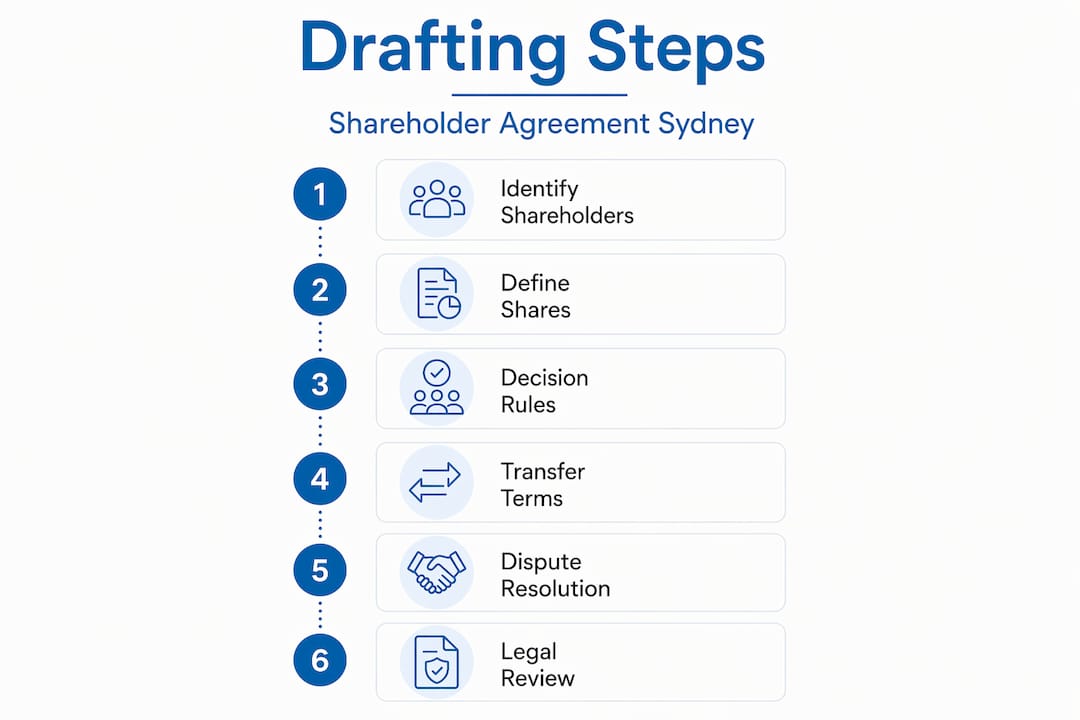
Step 1: Identify all shareholders and their roles
Begin by listing every person or entity that holds or will hold shares. Clarify whether each shareholder is also a director, employee, or passive investor. This determines which governance rights apply to each party.
Step 2: Define share classes and ownership percentages
Decide whether your company will have ordinary shares only, or whether you need preference shares, employee shares, or founder shares with special voting rights. Document the exact percentage each shareholder holds and how dilution will be managed if new shares are issued.
Step 3: Establish decision-making rules
Not every decision should require unanimous shareholder approval. Define which matters require a simple majority, a special majority, or unanimity. Reserved matters, those decisions too significant to leave to the board alone, must be explicitly listed.
Step 4: Draft share transfer and exit provisions
This is often the most contested area. Your agreement should specify pre-emption rights so that shareholders must first offer shares to existing owners before selling externally. Include drag-along and tag-along clauses to manage acquisition scenarios. Also address what happens when a shareholder dies, becomes bankrupt, or is no longer employed by the business.

Step 5: Include founder vesting and leaver provisions
Vesting schedules protect the business when a founder leaves early. A good leaver clause may allow departing shareholders to retain vested shares, while a bad leaver clause (such as for misconduct) may require shares to be sold back at a discounted price. These provisions need precise drafting to be enforceable.
Step 6: Set out dispute resolution mechanisms
The essential dispute resolution clauses in an Australian shareholders agreement address both deadlock situations and interpersonal conflicts. The table below compares common approaches:
| Approach | How it works | Best suited for |
|---|---|---|
| Mediation | Neutral third party facilitates dialogue | Early-stage or relationship-focused disputes |
| Expert determination | Specialist makes binding decision on technical issues | Financial or valuation disputes |
| Arbitration | Private binding decision outside court | Complex commercial disputes |
| Russian roulette clause | One party sets a price; the other buys or sells at that price | Deadlocked 50/50 partnerships |
| Shoot-out clause | Both parties submit sealed bids; highest bidder buys | Competitive exit scenarios |
Step 7: Review against the company constitution
Your shareholder agreement must be read together with your company constitution to avoid inconsistency. Where the two conflict, the outcome depends on whether the agreement is expressed to override the constitution, which requires careful legal drafting.
Step 8: Obtain legal review and execution
Before signing, have a qualified commercial lawyer review the complete document. This is not a step to skip. You should also conduct legal checks for commercial property if your business owns or intends to lease commercial premises, as those obligations may also need to be reflected in your governance framework.
Pro Tip: Always have each shareholder sign the agreement in the presence of an independent witness. For documents that will be used internationally or in cross-border transactions, consider having them certified by a notary for added legal weight.
Ensuring compliance and enforceability in Sydney
With your draft prepared, you need to ensure it is legally compliant and will stand up to scrutiny if a dispute arises. A shareholder agreement that looks comprehensive on paper can still fail in court if it contains provisions that breach statutory obligations or contradict other governance documents.
The critical standard for compliance is clear. For enforceability, ensure any commercial provisions you draft do not require breaches of statutory duties and that the governance architecture, meaning the constitution, shareholders agreement, and board processes, is internally consistent.
A shareholder agreement that conflicts with the company constitution or requires directors to breach their statutory duties under the Corporations Act 2001 (Cth) will not be enforced by Australian courts. Internal consistency across all governance documents is not optional. It is essential.
Compliance checklist for NSW shareholder agreements:
- The agreement must not require directors to act in breach of their duties under the Corporations Act 2001 (Cth), including the duty to act in good faith and in the best interests of the company
- Provisions dealing with share transfers must align with any restrictions in the constitution and comply with ASIC notification requirements
- Confidentiality clauses must not prevent disclosure required by law
- Any restraint of trade provisions must be reasonable in scope and duration to be enforceable under NSW law
- Financial assistance provisions must comply with Part 2J.3 of the Corporations Act 2001 (Cth) if the company is assisting someone to acquire its own shares
- The agreement should specify governing law as New South Wales to avoid jurisdictional uncertainty
It is also worth considering what happens when shareholders disagree about property co-owned by the business. Understanding co-ownership disputes can help you draft stronger provisions for business assets held jointly, particularly for companies that own commercial real estate alongside their operating business.
Regularly review and update your shareholder agreement as the business grows. A document drafted for a two-person startup will not be adequate for a seven-shareholder company operating across multiple states.
Common mistakes and how to avoid disputes
Ensuring enforceability is critical, but avoiding costly mistakes and disputes from the outset is equally important. Many shareholder disputes in Sydney are not caused by deliberate bad faith but by agreements that were vague, incomplete, or simply not understood by all parties when signed.
Common drafting mistakes to avoid:
- Failing to define “deadlock” clearly, leaving the business unable to make decisions when shareholders are evenly split
- Omitting leaver provisions, which means departing shareholders may retain full equity regardless of the circumstances of their departure
- Using generic online templates without adapting them to the company’s specific structure, industry, or risk profile
- Neglecting to address intellectual property ownership, particularly important for technology companies or businesses built on proprietary processes
- Ignoring minority shareholder protections, which can expose the company to oppression claims under the Corporations Act 2001 (Cth)
- Not reviewing the agreement after major changes, such as new investment rounds, shareholder exits, or significant shifts in business direction
- Omitting a proper dispute escalation process, which forces shareholders straight into litigation without any intermediate steps
The deadlock and dispute resolution processes that well-drafted Australian shareholder agreements include are not there by accident. They reflect hard lessons learned from real disputes. Without these provisions, even a minor disagreement can escalate into a costly court proceeding.
If a dispute does escalate, knowing your options matters. Civil dispute resolution services can assist when shareholder conflicts reach an impasse and formal legal intervention is required.
Pro Tip: Consider including an annual review clause in your agreement, requiring all shareholders to sit down each year and confirm the agreement still reflects the business’s current circumstances. This simple step can prevent minor misunderstandings from becoming significant disputes.
Lessons from real Sydney businesses: why a generic template rarely works
We have worked with many Sydney business owners who began their commercial journey with a downloaded template, confident it covered everything they needed. In our experience, those templates almost always fall short when the business is tested by real-world pressure.
Generic agreements do not account for the specific dynamics of your industry, the size and nature of your shareholder group, or the personal and financial circumstances of individual shareholders. A standard template designed for a technology startup, for example, will likely be poorly suited to a professional services firm or a construction company operating under fixed-price contracts.
One of the most instructive patterns we observe is the 50/50 shareholder arrangement with no deadlock mechanism. Two equal partners, both directors, both with veto power, and no agreed process for resolving gridlock. When the relationship sours, the company is effectively paralysed. Neither party can force the other to act, and the business suffers while legal costs mount. A properly drafted agreement would have included a mechanism such as mediation, an independent chairman’s casting vote, or a structured buyout process to break that deadlock.
We also see frequent problems with leaver provisions that were either absent or so broadly written that they were unenforceable. A clause that simply states “a departing shareholder must sell their shares at fair market value” sounds reasonable, but who determines fair market value, using what methodology, and within what timeframe? Without precise drafting, that single question can take months and thousands of dollars to resolve.
The lesson is straightforward. Your shareholder agreement should be drafted by a lawyer who understands your business and the specific legal environment in New South Wales. It should reflect your actual ownership structure, your industry’s particular risks, and the realistic scenarios your company might face over the next five to ten years. Reviewing co-ownership dispute case studies can give you a clearer picture of how quickly unresolved tensions can escalate when governance documents are inadequate.
Bespoke drafting is not a luxury. For most businesses, it is the most cost-effective legal investment you will ever make.
Need expert help drafting your shareholder agreement?
If you are ready to protect your business with a properly drafted shareholder agreement, or if you need an existing agreement reviewed and updated, GKE Lawyers can help. Our commercial law team works with business owners across Sydney and throughout New South Wales to draft clear, enforceable agreements that reflect your specific needs and comply with all relevant legislation.

We also assist with related legal matters, including property disputes involving business assets, conveyancing through our property lawyers in Sydney, and a full range of commercial and litigation services. Whether you are starting a new business or restructuring an existing one, our team provides Sydney legal guidance that is practical, personal, and focused on protecting your interests. Contact us today to book a consultation.
Frequently asked questions
What clauses should my Sydney shareholder agreement include?
Your agreement should cover share capital and decision-making, share transfer rules including pre-emption and drag-along rights, dispute resolution processes, founder vesting, and financial and dividend policies tailored to NSW regulations.
Is a shareholder agreement mandatory for private companies in NSW?
No, it is not legally required, but it is strongly recommended to clearly define shareholder rights and prevent costly disputes from arising as the business grows and circumstances change.
How do I ensure my shareholder agreement is enforceable in NSW?
For enforceability, ensure the agreement aligns with your company constitution, is internally consistent across all governance documents, and does not require directors to breach their statutory duties under Australian law.
Can business owners in Sydney resolve shareholder disputes without litigation?
Yes, many agreements include mediation, expert determination, or other deadlock resolution processes that allow disputes to be resolved privately, which is typically faster, less expensive, and less damaging to business relationships than going to court.