
Categories
Uncategorized

How to protect your rights in NSW property settlement

Separating from a partner is one of the most stressful experiences you can face, and the legal process of dividing property and assets adds a significant layer of complexity and uncertainty. Many people in New South Wales make costly mistakes during this period, simply because they do not understand the rules, the deadlines, or the difference between a handshake agreement and a legally binding arrangement. This guide walks you through every critical stage of property settlement after separation in NSW, from identifying your relationship type and compiling your financial picture, to choosing the right legal pathway and avoiding the pitfalls that derail even the most amicable splits.


Table of Contents

Key Takeaways

Point Details
Know your time limits Missing the property settlement deadline could forfeit your rights, so check which rules apply to your situation.
Documentation is vital Start by organising all your financial information to make negotiation and resolution smoother.
Formalise your agreement Use a binding financial agreement or consent orders if you want your property settlement to be legally enforceable.
Explore all settlement methods Agreement and mediation can avoid lengthy court processes when you act early and cooperatively.

What to do first: understanding property settlement basics in NSW

Property settlement is the legal process of dividing assets, debts, and financial resources between two people after the end of a relationship. In NSW, this process is governed by both federal legislation for married couples and state legislation for de facto couples, which means the rules, timelines, and available remedies can differ depending on your circumstances.

Understanding family law basics before you begin negotiating is essential. Married couples are governed by the Family Law Act 1975 (Cth), while de facto couples in NSW are governed by the Property (Relationships) Act 1984 (NSW) for state-based matters, though federal de facto provisions also apply in many situations. Knowing which legislation applies to you determines which court has jurisdiction, what deadlines you face, and what evidence matters most.

One of the first and most important things you need to establish is your separation date. This is the date on which the relationship effectively ended, and it has direct legal consequences for calculating application deadlines. Courts look at factors such as living arrangements, communication, financial separation, and social conduct when determining this date. Disputes about the separation date are common and can affect your rights significantly, so it is worth getting clarity on this early.

Before any negotiations begin, compile a thorough inventory of all assets and debts. This includes:

  • Real property (family home, investment properties, land)
  • Bank accounts, savings, and term deposits
  • Superannuation balances for both parties
  • Vehicles, boats, and other personal property
  • Shares, managed funds, and business interests
  • Joint and individual debts, including mortgages, personal loans, and credit cards
  • Inheritances or gifts received during the relationship

In NSW, you must start property settlement proceedings within strict time limits that depend on whether you were married or in a de facto relationship. Missing these windows can be extremely costly, and the courts are not always sympathetic to late applicants.

Relationship type Governing legislation Key deadline
Married couple Family Law Act 1975 (Cth) 12 months after divorce is finalised
De facto couple (NSW) Property (Relationships) Act 1984 (NSW) 2 years after separation

Pro Tip: Start gathering financial documents, bank statements, mortgage paperwork, and superannuation records as soon as possible after separation. The earlier you have a complete picture, the less stressful the negotiation process will be, and the less likely you are to overlook an asset or undervalue your entitlements.

Understanding family law in Sydney and how it applies to your specific situation is a foundational step that can protect you from making decisions you will regret later.
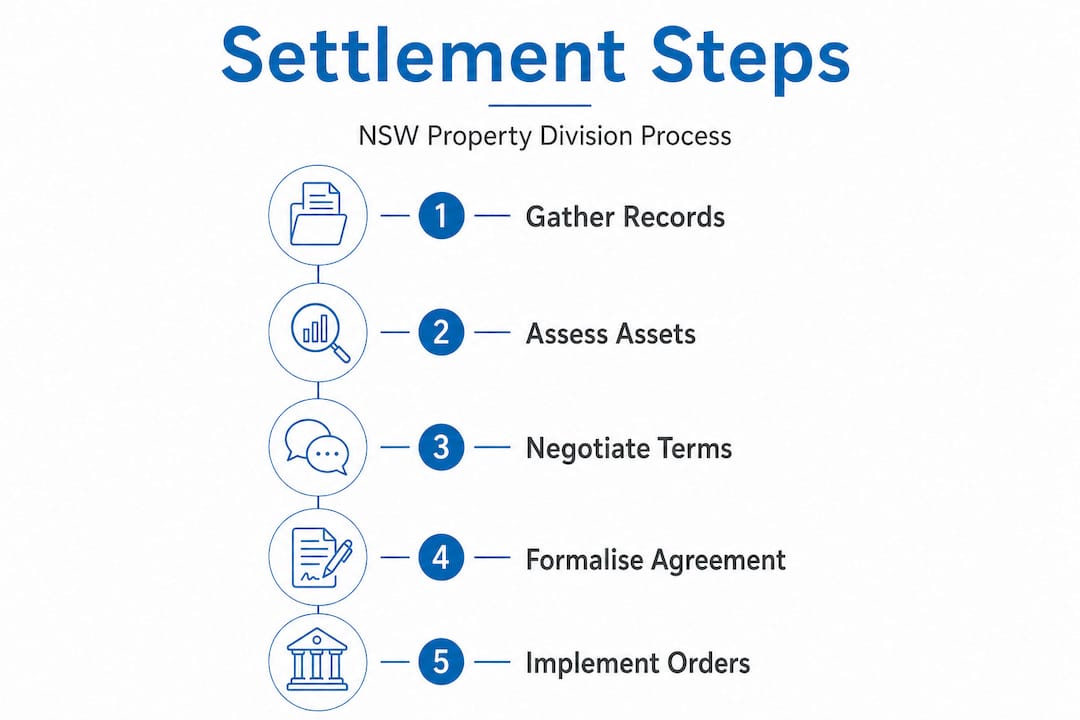
Infographic of NSW property settlement process steps


Key requirements and timelines: what you must know

Time limits in property settlement law are not soft guidelines. They are strict legal requirements, and missing them can mean you lose the right to make a claim altogether. Here is a clear breakdown of the major timelines you need to be aware of.

For married couples:

  1. You must be separated for 12 months before you can apply for divorce.
  2. Once the divorce order is made, you have exactly 12 months to commence property settlement proceedings.
  3. If you miss this window, you must apply to the court for “leave” to proceed out of time.

For de facto couples:

  1. The relationship must have broken down before the clock starts.
  2. NSW de facto law provides a 2-year application window after the relationship ceases, with limited ability to get leave after that time passes.
  3. Establishing the exact date of separation becomes critically important.
Factor Married couples De facto couples
Deadline to apply 12 months after divorce 2 years after separation
Governing court Federal Circuit and Family Court NSW courts (or federal, depending on the matter)
Out-of-time applications Leave required under Family Law Act Leave required, hardship test applies
Super splitting available Yes Yes, under federal provisions
Key documents needed Marriage certificate, financial disclosure Evidence of de facto relationship, separation date

Critical warning: If you allow either deadline to pass without formalising your settlement or commencing proceedings, you may permanently lose the ability to make a claim. Even if both parties are on good terms, the absence of a formal legal order means either party could later dispute what was agreed. Do not rely on goodwill alone.

The concept of “leave” to apply out of time is important to understand. If you have missed the deadline, you can ask the court for permission to proceed, but this is not automatic. Late de facto applications may be allowed only where hardship considerations favour the late applicant. The court will examine factors such as whether a child would suffer hardship, whether the applicant would be left without adequate support, and whether the other party would be prejudiced by a late claim.

Getting property dispute advice from a qualified lawyer well before any deadline approaches is strongly recommended. Acting early gives you options. Waiting until the deadline passes removes them.

Pro Tip: Set a calendar reminder for your relevant deadline the moment you separate. Write it down, tell your lawyer, and treat it as a hard stop. The difference between lodging one day inside and one day outside the window can determine whether you have any legal recourse at all.


Reaching an agreement with your former partner is genuinely a positive outcome, but it only protects you if that agreement is formalised correctly. Many people in NSW make the mistake of assuming that a verbal agreement, a written email exchange, or even a signed document prepared without legal input will be enough to protect them. This is rarely the case.

The main legal pathways to settle property after separation are:

  1. Informal agreement — A verbal or written understanding between parties. Not legally binding and unenforceable in most circumstances.
  2. Mediation — A structured negotiation facilitated by a neutral third party. Can lead to a binding outcome if documented properly, but the mediation itself does not create a legally enforceable order.
  3. Binding financial agreement (BFA) — A private contract between the parties that sets out how assets and debts will be divided. Must meet strict legal requirements, including independent legal advice for both parties, to be valid.
  4. Consent orders — An agreement lodged with the court and approved by a registrar or judge. Once approved, it has the same force as a court order.
  5. Court order — Issued by a judge following a contested hearing. Used when parties cannot agree. The most expensive and time-consuming option.

If you want asset transfers or super splitting to be legally effective, you generally need consent orders or a binding financial agreement, not just an informal arrangement. Banks will not transfer a mortgage or update title records based on a handshake. The Titles Registry requires formal legal documentation. Superannuation funds have their own compliance requirements before they will action a split.

Informal agreements can leave you exposed in ways that only become apparent years later, such as when one party seeks to revisit the division, when a bank requires proof of legal entitlement, or when a new partner or creditor enters the picture.

Solicitor reviewing property agreement paperwork

When considering property transfers after separation, it is critical to understand that only a formal legal order or BFA will give you the certainty and protection you need.

Pro Tip: Never sign any document, whether labelled as a “settlement deed,” “agreement,” or “arrangement,” without having a qualified lawyer review it first. What seems straightforward in plain language can have significant legal implications, particularly around stamp duty exemptions, future financial claims, and superannuation entitlements.


Settlement methods: agreement, mediation, or court?

Choosing the right method to resolve your property settlement is one of the most consequential decisions you will make throughout this process. The approach that suits you depends on the level of conflict between parties, the complexity of your asset pool, and how quickly you need a resolution.

Here is a clear breakdown of the three main approaches:

  • Negotiated agreement: Best suited when both parties are cooperative, have a clear understanding of their assets, and are willing to compromise. This approach is the fastest and least expensive. It works best when formalised through consent orders to ensure enforceability.
  • Mediation: Well suited when there is one or more disputed items but both parties are broadly willing to resolve matters without a judge’s intervention. A skilled mediator can help parties find common ground efficiently. You can negotiate property settlement directly, but if agreement is not reached, mediation or court may be necessary.
  • Court proceedings: Reserved for situations where there is an irretrievable breakdown in communication, allegations of asset concealment, significant power imbalances, or complex financial structures that require judicial determination. Court is the most expensive, time-consuming, and emotionally draining option.

Understanding mediation options in NSW can help you determine whether this step is right for your situation before committing to litigation.

When preparing for mediation, you should gather all financial documents, prepare a list of your priorities and non-negotiables, and attend with a clear understanding of your legal entitlements. When preparing for court, you need to engage a solicitor, comply with disclosure requirements, and be ready for a process that can take months or years.

Before escalating any dispute, consider using dispute resolution methods that can achieve a fair outcome without the financial and emotional cost of litigation. If you are unsure which path suits your circumstances, speaking with a lawyer who handles property disputes in Sydney is the most reliable first step.


A lawyer’s perspective: common pitfalls in NSW property settlements

After working through a wide range of property settlements in NSW, we have seen certain mistakes appear repeatedly. Understanding these pitfalls is often what separates a clean, protected outcome from one that causes problems for years after the relationship ends.

The separation date dispute is more common than people expect. Many clients come to us believing their separation date is obvious, only to find that the other party disputes it. This matters because the separation date determines which assets are included in the pool and when the legal clock starts ticking on deadlines. Documenting your separation clearly and early is not optional.

Informal agreements create a false sense of security. We have seen clients accept a split of the family home, hand over keys, and genuinely believe the matter is resolved, only to face a claim from their former partner years later. Without consent orders or a BFA, no division of property is final. Banks, superannuation funds, and the courts do not recognise informal arrangements as binding.

Delaying paperwork is one of the most preventable risks. People frequently put off gathering financial records, assuming they can do it later. By the time a deadline approaches, bank records are harder to access, valuations become contentious, and stress levels are high. Starting the paperwork process immediately after separation is always the right move.

Rushing to court can backfire. Some clients arrive convinced that court is the only option. In practice, many of these matters are resolved through out-of-court solutions that cost a fraction of litigation and produce equally binding results. Court should be a last resort, not a first response.

Even amicable separations need professional documentation. A friendly split today can become a disputed one tomorrow if circumstances change, such as one party remarrying, experiencing financial difficulty, or simply having a change of heart. The only way to truly protect yourself is through a legally formalised agreement.


Get expert help with your property settlement in NSW

Property settlement in NSW is one of the most legally complex processes a person can face outside of a courtroom, and the stakes are high. Whether you are trying to protect your share of the family home, secure a fair division of superannuation, or simply understand your rights and obligations, having the right legal support makes a measurable difference to outcomes.

https://gkelawyers.com.au

At GKE Lawyers, our property lawyers in Sydney work closely with clients navigating separation and asset division across NSW. We help you understand your entitlements, meet critical deadlines, and formalise agreements that are legally binding and enforceable. Our property dispute lawyers are experienced in both negotiated settlements and contested proceedings, giving you confident representation at every stage. If you are ready to take the next step, contact us to book a consultation and get clarity on your situation today.


Frequently asked questions

Can you make a legally binding property settlement without going to court in NSW?

Yes, you can formalise your settlement through consent orders or a binding financial agreement, both of which are legally enforceable without requiring a contested court hearing.

What happens if property settlement is not done within the time limit?

You may lose the automatic right to apply, but courts can sometimes allow late applications if you can demonstrate hardship. Late de facto applications may be permitted only where hardship considerations favour the applicant.

Is mediation compulsory before applying to court for property settlement in NSW?

Mediation is strongly encouraged and widely used before court, but it is not strictly compulsory in all circumstances, particularly if urgent or complex issues exist. Negotiation and mediation are generally recommended as first steps.

Consent orders are submitted to the court and approved by a judicial officer, making them enforceable as a court order. Binding financial agreements are private contracts that do not require court approval but must meet strict legal requirements, including independent legal advice for both parties, to be valid.

Categories
Uncategorized

Estate planning in NSW: Protect your family’s future

Estate planning is far more than writing a Will. According to the NSW Government, estate planning involves putting legal documents in place to direct what happens to your estate when you die and to manage important decisions if you lose capacity. For NSW residents, this means considering everything from asset distribution and guardianship appointments to powers of attorney and trust structures. Getting these elements right requires local legal knowledge, because NSW laws and requirements shape every document in your plan.

Table of Contents

Key Takeaways

Point Details
Estate planning is multi-faceted It covers asset distribution, trust management, incapacity planning, and key legal roles.
A valid Will is essential Having a properly executed Will guides asset distribution and avoids complex court processes.
Choose your representatives wisely Executors and trustees should be reliable and capable of carrying out your intentions.
Incapacity planning matters Assigning an Enduring Power of Attorney and guardian protects you and your family if you lose capacity.
Professional help makes a difference Legal advice and secure document storage strengthen compliance and peace of mind.

Understanding estate planning in New South Wales

Estate planning is a structured legal process that covers a wider range of decisions than most people realise. Estate planning in NSW involves putting legal documents in place to direct what happens to your estate when you die and to manage important decisions if you lose capacity. That single sentence carries enormous weight, because it confirms that your plan must work in two distinct scenarios: after your death, and while you are still alive but unable to make decisions for yourself.

The core documents in a NSW estate plan typically include:

  • Will: Directs the distribution of your estate after death and appoints an executor
  • Enduring Power of Attorney: Authorises someone to make legal and financial decisions on your behalf
  • Appointment of Enduring Guardian: Authorises someone to make health, lifestyle, and accommodation decisions if you lose capacity
  • Testamentary trust: A structure created within your Will that activates after death to manage assets for beneficiaries

Critically, estate planning is broader than just a Will because incapacity planning and the correct choice of roles affect family protection and implementation in ways that asset distribution alone cannot address. Many NSW families discover this the hard way, when an unforeseen illness or accident occurs and no incapacity documents are in place. Estate planning advice from a qualified solicitor can help you avoid these gaps before they become crises.

Key estate planning documents and their function:

Document When it applies Primary function
Will After death Asset distribution and executor appointment
Enduring Power of Attorney During incapacity Legal and financial decisions
Enduring Guardian During incapacity Health and lifestyle decisions
Testamentary trust After death (via Will) Asset management for beneficiaries

Pro Tip: Do not treat estate planning as a one-time event. Review your plan every three to five years or whenever a major life event occurs, such as marriage, divorce, the birth of a child, or acquiring significant assets.

The role of a Will in estate planning

A Will sits at the centre of any sound estate plan. A Will states your instructions for distributing your estate after death and appoints an executor to administer the estate. That executor has the legal responsibility to locate your assets, pay any outstanding debts, and distribute what remains to your nominated beneficiaries according to your stated wishes.

A valid Will in NSW typically covers:

  • Beneficiaries: The people or organisations who receive your assets
  • Executor: The person responsible for carrying out your instructions
  • Guardianship: Who cares for minor children if both parents pass away
  • Specific bequests: Particular items, sums of money, or property you wish to leave to named individuals
  • Residuary estate: What happens to everything not specifically mentioned

“Without a valid Will, your estate may not be distributed the way you intended, and the administration process becomes significantly more complex and stressful for your family.”

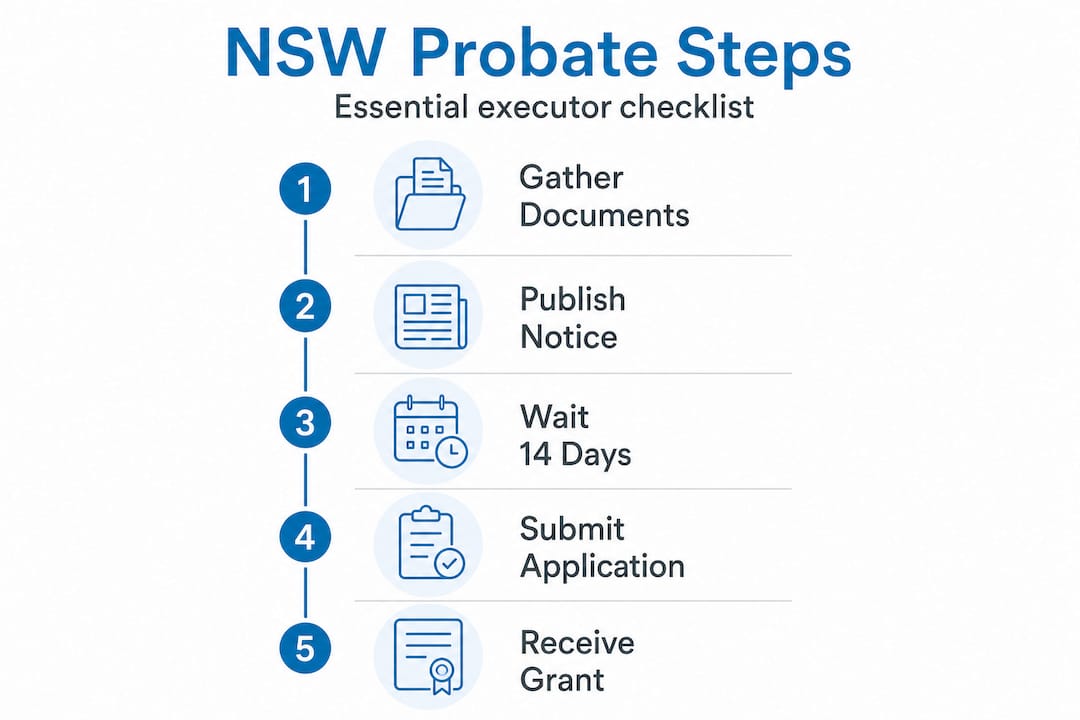
When a person dies with a valid Will, the executor typically applies for a grant of probate from the Supreme Court of NSW. Probate is the court’s formal recognition that the Will is valid and that the executor has authority to act. When a person dies without a valid Will (known as dying intestate), administration of the estate changes and the family must apply for letters of administration, a separate court process where the court appoints an administrator.

Situation Court process Who applies Outcome
Valid Will exists Grant of probate Named executor Estate distributed per Will
No valid Will Letters of administration Next of kin Estate distributed per intestacy laws

The intestacy rules in NSW follow a set statutory formula, which may not reflect your personal wishes or family circumstances. For example, a long-term de facto partner might not receive what you intended, or assets could be divided in ways that create financial hardship. Getting Will preparation in Sydney right from the start avoids these complications entirely.

Understanding the probate process in NSW is also important for executors, as the timeframes, required documents, and court fees all need to be managed correctly after a loved one passes.

Trusts and testamentary trusts explained

While a Will answers many questions about what happens to your estate, trusts provide additional flexibility and protection, particularly for families with young children, blended family arrangements, or significant assets.

Trusts in NSW involve one person holding property on behalf of, and for the benefit of, another, with a trustee managing trust assets according to the trust deed or Will. The key benefit is control: assets are not handed over outright but managed according to specific terms you set.

Here are the main reasons NSW families use trusts in estate planning:

  1. Protecting minor beneficiaries: Children cannot legally manage significant assets. A trust ensures their inheritance is managed responsibly until they reach a suitable age, often 18, 21, or 25 depending on your instructions.
  2. Providing for vulnerable beneficiaries: Adults with disabilities or mental health conditions benefit from managed distributions rather than lump sums that could be misused or affect their eligibility for government support payments.
  3. Tax efficiency: Testamentary trusts can offer income-splitting benefits for adult beneficiaries, which may reduce the overall tax burden on the estate’s earnings over time.
  4. Protecting assets from relationship breakdown: If a beneficiary goes through a divorce, assets held in trust may be better protected than those transferred outright.
  5. Managing complex family structures: Blended families with children from multiple relationships often use trusts to ensure fair distribution across all family members.

Testamentary trusts are created within a Will and come into effect only after the person dies. This is an important distinction: they have no legal effect during your lifetime and do not require any separate ongoing management before your death. Once the Will is executed and the estate is administered, the trustee steps in to manage the assets according to your instructions.

Trust type When it activates Managed by Primary use
Testamentary trust After death (via Will) Appointed trustee Protecting beneficiaries long-term
Inter vivos trust During lifetime Appointed trustee Asset management now and after death
Superannuation trust After death (via binding nomination) Fund trustee Directing super death benefits

Pro Tip: If you have children under 18 or a beneficiary with a disability, discuss a testamentary trust with your solicitor. It can make a significant difference to how well their inheritance is managed and preserved over time.

If you are concerned about disputes or the validity of your estate arrangements, understanding the options around contesting a Will in NSW is also worth exploring with your legal adviser.

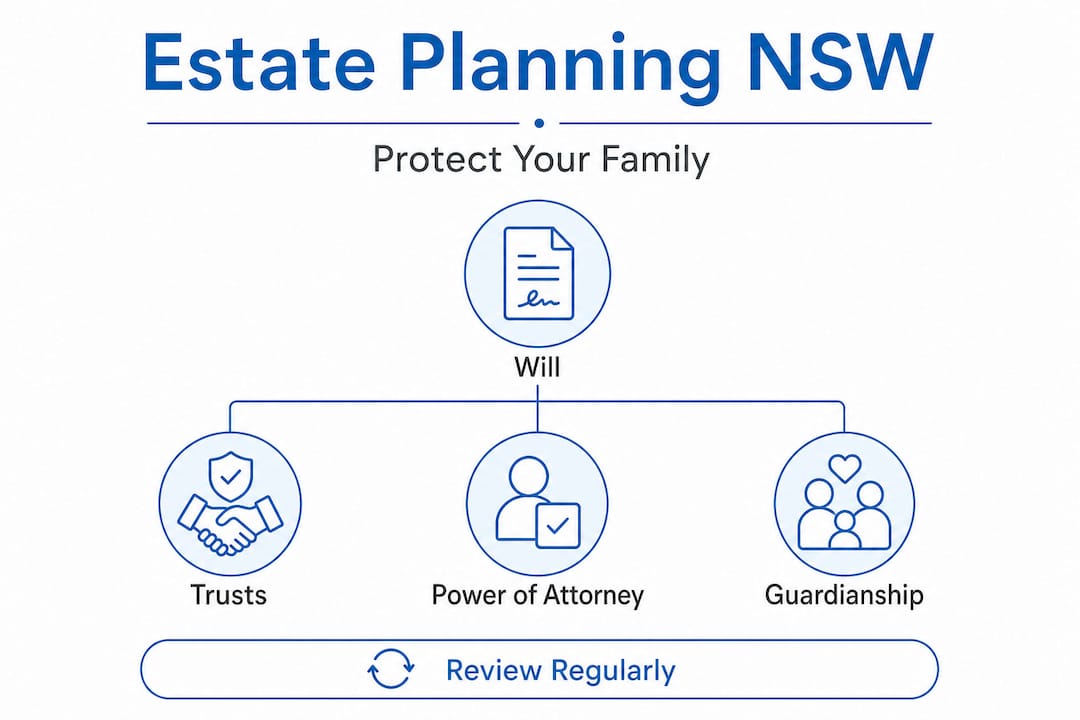
Hierarchy infographic of NSW estate planning essentials

Incapacity planning: Powers of attorney and guardianship

Many NSW residents focus heavily on what happens after they die, but preparing for incapacity during your lifetime is equally important. Incapacity can result from a sudden accident, a progressive illness, or age-related cognitive decline. Without the right documents in place, your family may face an urgent and costly legal process to gain authority to manage your affairs.

Woman signs power of attorney document at home

An Enduring Power of Attorney authorises someone to make legal and financial decisions when you are unable to. Your chosen attorney can manage your bank accounts, pay bills, manage investments, and deal with property transactions on your behalf. The word “enduring” is critical here: it means the power continues even if you lose mental capacity, unlike a general power of attorney, which automatically ends at that point.

An enduring guardian is appointed to make accommodation, healthcare, lifestyle, and medical decisions if you become unable to make your own decisions. This is the person who can decide where you live, what medical treatment you receive, and what support services you access. These are deeply personal decisions, and you want someone who genuinely understands your values and wishes.

Key considerations when appointing these roles:

  • Choose someone you trust completely. They will have real authority over significant aspects of your life.
  • Consider practical capacity. A person who is unorganised, lives overseas, or has competing personal interests may not be suitable, regardless of your relationship with them.
  • Appoint a substitute. If your primary attorney or guardian is unable or unwilling to act, a named substitute ensures there is no gap in authority.
  • Review your appointments regularly. Life circumstances change, and the person you appoint today may not be the right person in ten years.

Pro Tip: Your attorney and guardian do not need to be the same person. In fact, separating financial and personal decisions between two trusted individuals can create a useful system of checks and provide greater family confidence in the process.

Working with estate administration support professionals ensures your incapacity documents are drafted correctly and legally valid in NSW.

Choosing executors, trustees, and storage solutions

Selecting the right executor and trustee is one of the most consequential decisions in your entire estate plan. It is not simply a matter of choosing the most senior family member or your closest friend. These roles carry real legal responsibilities, and the person you choose must be able to manage them effectively.

What a good executor or trustee looks like:

  • Organised and reliable, capable of managing paperwork and meeting legal deadlines
  • Financially literate enough to understand account management and distributions
  • Emotionally resilient, as they may need to make difficult decisions during a period of grief
  • Free from conflicts of interest with beneficiaries
  • Willing and available to act, which takes more time than most people realise

Trustee honesty and capacity are essential qualities in asset management. An executor who lacks organisational skills or becomes overwhelmed can delay the administration of your estate by months or even years.

Common document storage and management options in NSW:

Storage option Benefits Considerations
With your solicitor Secure, professional, easily retrieved Ongoing storage fee may apply
NSW Trustee and Guardian Government-backed, integrated with service Fees apply for preparation and storage
Home safe Accessible Risk of loss, damage, or being overlooked
Safety deposit box Secure Access may be difficult for executor after death

NSW Trustee and Guardian provides estate planning services including preparing Wills, Powers of Attorney, and Appointment of Enduring Guardian, and can also store these documents securely. This is a practical option for many NSW residents, particularly those who want a government-backed service with integrated document management.

Seeking probate application advice early also helps your executor understand what will be required of them when the time comes, reducing stress and uncertainty for your family.

What most people in NSW miss about estate planning

After working with NSW families on estate planning matters, we have observed a consistent pattern: most people believe that signing a Will is enough. They draft it, file it away, and consider the task complete. This approach leaves significant gaps that can have serious consequences for the people they care most about.

Estate planning is broader than just a Will because incapacity planning and the correct choice of roles affect family protection and implementation just as profoundly as the distribution of assets. A perfectly drafted Will becomes far less effective if the executor lacks the skills to carry it out, or if no enduring guardian has been appointed and a family member must urgently apply to the NSW Civil and Administrative Tribunal for decision-making authority during a health crisis.

The choice of executor and trustee deserves the same careful thought as asset distribution. We have seen estates where the named executor was well-intentioned but completely unprepared for the administrative and emotional demands of the role. Delays, errors, and family tension followed. Choosing the right person, and having an honest conversation with them beforehand, changes real outcomes.

Incapacity planning is also frequently postponed because people associate it with old age. In reality, incapacity can occur at any life stage. Reviewing your estate planning detail regularly and ensuring all documents are current is one of the most practical things any NSW resident can do for their family’s protection.

Get help with estate planning in NSW

Understanding estate planning is the first step. Acting on it is what protects your family.

https://gkelawyers.com.au

At GKE Lawyers, our estate planning solicitors help NSW residents prepare Wills, testamentary trusts, Powers of Attorney, and Appointment of Enduring Guardian documents that are legally sound and tailored to your specific circumstances. We take the time to understand your family structure, your assets, and your wishes so that every document works together as a coherent plan. Whether you are starting your estate plan for the first time or reviewing documents that have not been updated in years, our team is ready to assist. Contact GKE Lawyers today to book a consultation and take the next practical step towards protecting the people who matter most to you.

Frequently asked questions

What if I die without a Will in NSW?

If you die without a valid Will, your estate will be administered through a court process called letters of administration, and assets are distributed according to the NSW intestacy rules, which may not reflect your personal wishes. Administration changes significantly without a valid Will, and the process is more burdensome for your family.

What is an Enduring Power of Attorney?

An Enduring Power of Attorney authorises a person you choose to make legal and financial decisions on your behalf when you are no longer able to do so yourself. Unlike a general power of attorney, it continues to operate even after you lose mental capacity.

How do trusts fit into estate planning?

Trusts allow assets to be held and managed by a trustee for the benefit of your chosen beneficiaries, providing protection and control over how wealth is distributed. Testamentary trusts are created within a Will and only come into effect after the person dies.

Who should I choose as executor or trustee?

Choose someone who is honest, organised, and capable of managing legal and financial responsibilities, as trustee honesty and capacity are essential to effective asset management. Speak with your chosen person beforehand to confirm they are willing and prepared to take on the role.

Can professionals help with estate planning in NSW?

Yes. Legal solicitors and NSW Trustee and Guardian both offer estate planning services including Will preparation, Powers of Attorney, Enduring Guardian appointments, and secure document storage across New South Wales.

Categories
Uncategorized

Family law in NSW: Key rights, rules and processes

Many people assume family law is simply about divorce. In reality, family law in NSW is primarily governed by the federal Family Law Act 1975 (Cth), which applies uniformly across Australia and covers a much broader range of issues, including parenting arrangements, property settlements, de facto relationships, financial disclosure obligations, and even what happens to the family pet. Whether you are considering separation, dealing with a custody dispute, or trying to understand your rights after a long-term relationship ends, this guide explains the key elements of family law in NSW, recent major reforms, and the practical steps you can take to protect yourself and your family.

Table of Contents

Key Takeaways

Point Details
Broad coverage Family law in NSW covers divorce, children, property, and relationships beyond just marriage.
Major 2025 changes Recent reforms affect how courts handle family violence, economic abuse, and pets in settlements.
Focus on children Parenting decisions always prioritise the child’s best interests and safety after 2024 amendments.
Dispute resolution first Most family law issues require mediation before court is considered.
Expert advice matters Unique situations need professional legal guidance to get the right result under NSW law.

How family law works in NSW

Family law in NSW operates under a federal framework, meaning the same laws apply whether you live in Sydney, regional NSW, or any other state. This is an important distinction: NSW does not have its own separate family law system. Instead, the Family Law Act 1975 (Cth) sets out the rules for divorce, parenting arrangements, property division, and more, with matters heard in the Federal Circuit and Family Court of Australia (FCFCOA).

As a starting point for anyone seeking an introduction to family law, it helps to understand exactly which situations the Act covers:

  • Divorce and separation for married couples
  • Parenting arrangements (previously called “custody”) for children of both married and de facto couples
  • Property settlement and superannuation splitting for married and de facto couples
  • De facto relationships (including same-sex couples) that have broken down
  • Binding Financial Agreements as an alternative to court-ordered settlements
  • Family violence, including economic abuse and dowry abuse, and their effect on outcomes

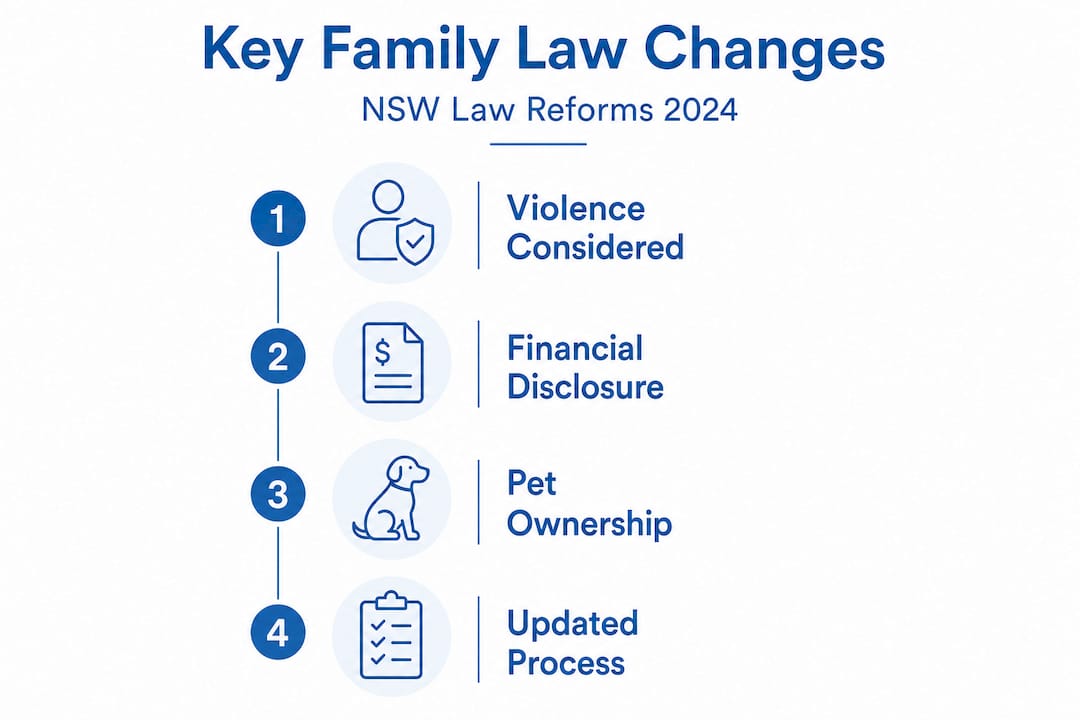
Recent legislative changes have made the framework even broader. From June 2025, the Family Law Amendment Act 2024 introduced significant updates: courts must now consider the impact of family violence, including economic abuse and dowry abuse, when determining property settlements; immediate full financial disclosure between parties is mandatory from the outset; and there are new provisions around pet ownership following separation. These changes apply to both new and existing cases, unless a final hearing has already started.

Who is covered and common scenarios

Situation Who is covered Key issue
Married couple separating Both spouses Divorce, property, parenting
De facto couple separating Both partners (2+ years or child involved) Property, parenting (no divorce needed)
Dispute over children Either parent or carer Parenting arrangements, safety
Financial disagreement Married or de facto Property settlement, disclosure
Family violence situation Victim and dependants Protective orders, adjusted settlements

Understanding which category your situation falls into is the first practical step. Each category involves different processes, timelines, and legal requirements.

Divorce and separation: Key processes in NSW

Man reviewing divorce documents at kitchen table

Once you understand what family law covers, the next concern for many people is how divorce and separation actually work. In NSW, divorce is a no-fault process, which means neither party needs to prove wrongdoing. The only ground for divorce is irretrievable breakdown of the marriage, evidenced by 12 months of separation. At least one party must have an Australian connection, either by being an Australian citizen, ordinarily resident in Australia, or present in Australia on the application date.

Here is a step-by-step overview of the divorce process:

  1. Confirm 12 months of separation. This period can include time spent separated while living under the same roof, but additional evidence will be required.
  2. Lodge an application. Applications are filed with the FCFCOA, either as a sole application or jointly with your former spouse.
  3. Serve the application. If filing alone, the other party must be formally served with the divorce application.
  4. Attend a hearing (if required). Hearings are typically brief; you may only need to attend if children under 18 are involved.
  5. Receive the divorce order. If granted, the divorce becomes final one month and one day after the order is made.

It is important to understand that divorce and property settlement are two separate legal processes. A divorce order does not resolve financial matters. Property settlement must be initiated within 12 months of the divorce becoming final, or you may lose the right to apply.

Separation under one roof

Many couples in NSW continue to live in the same home for financial or practical reasons even after the relationship ends. This is known as “separation under one roof” and it is legally recognised, but it does require additional evidence. Courts will look for proof that you and your former partner genuinely led separate lives within the shared home.

“Separation under one roof” requires affidavits from the separating parties and, ideally, a supporting statement from a third party such as a friend, family member, or counsellor who can confirm the living arrangement and the nature of the separation.

Pro Tip: If you are in this situation, start documenting the separation clearly and early. Keep records of separate finances, separate social activities, and any communications that clearly reflect the relationship has ended. A well-prepared affidavit can make the difference between a straightforward application and a contested hearing.

Parenting arrangements and child-focused decisions

After separation, decisions about children are often the most emotionally charged part of the process. The term “custody” is no longer used in Australian family law. Instead, the focus is on parenting arrangements that serve the child’s best interests.

The best interests of the child remain the paramount consideration in all parenting decisions. Following the 2024 amendments, there is no longer a presumption of equal shared parental responsibility or equal time. This is a significant shift. Courts now start from a neutral position and assess each case individually, prioritising safety above all else.

What courts consider when making parenting decisions

Factor Why it matters
Safety from family violence or abuse Highest priority; overrides time arrangements
The child’s own views Considered in proportion to the child’s age and maturity
The child’s relationship with each parent Supports continuity and emotional wellbeing
Each parent’s capacity to meet the child’s needs Practical ability to provide care, stability, schooling
Impact of change on the child Courts minimise disruption where possible
Cultural and Aboriginal or Torres Strait Islander identity Recognised and preserved where relevant

Before applying to the court for parenting orders, parties are generally required to attempt Family Dispute Resolution (FDR), a structured mediation process designed to help parents reach agreement without litigation. There are important exemptions, however. If there is a history of family violence, child abuse, or urgent safety concerns, you are not required to attend FDR before going to court.

  • FDR is conducted by accredited practitioners, often through services such as Relationships Australia or Legal Aid NSW.
  • If agreement is reached in FDR, the parties can formalise this through consent orders, which are legally binding.
  • If FDR fails, the practitioner issues a certificate allowing you to apply to court.

Pro Tip: One of the most common mistakes parents make during negotiations is confusing their own needs with the child’s. Courts are not interested in what is fair to you as a parent; they are focused entirely on what is best for your child. Keeping this distinction clear in all communications and documentation will strengthen your position.

Property settlement, family violence and pets: Recent changes explained

Property matters after separation are more complex than most people expect. The process involves identifying the total asset pool (including superannuation), assessing each party’s financial and non-financial contributions, and then considering future needs before arriving at a fair division.

Key elements of property settlement in NSW include:

  • Identifying the property pool: All assets, liabilities, and superannuation interests of both parties are included, regardless of whose name they are in.
  • Assessing contributions: Both financial contributions (income, property brought into the relationship) and non-financial contributions (homemaking, parenting) are recognised.
  • Future needs adjustment: The court considers factors such as age, health, earning capacity, and primary care of children.
  • Superannuation splitting: Super is treated as property and can be split between parties by agreement or court order.
  • Binding Financial Agreements (BFAs): Couples can opt for a private agreement rather than a court-determined settlement, but these must be drafted carefully to be enforceable.

The Family Law Amendment Act 2024 brought three major changes to property matters that every NSW resident should understand.

Family violence and economic abuse. Courts must now actively consider the effect of family violence, including economic abuse (such as controlling finances, restricting employment, forcing debt) and dowry abuse, when assessing property settlements. This means that if you experienced financial control during the relationship, it can directly affect the outcome of your settlement. This is a genuinely transformative change for many victims.

Infographic summarizing major NSW family law changes

Mandatory immediate financial disclosure. From the outset of any property dispute, both parties are required to fully and immediately disclose all financial information. Non-disclosure is treated seriously by courts and can result in adverse findings. This obligation begins before formal proceedings, not only after they commence.

Pet ownership. Previously, pets were treated as chattels (personal property assessed by monetary value). Under the new laws, courts must consider pet ownership more thoughtfully, looking at who purchased the pet, who has primarily cared for it, and what living arrangements exist. This reflects the reality that pets are members of the family, not simply possessions.

Pro Tip: If you believe economic abuse has affected your financial position during the relationship, document every instance you can recall and gather any available evidence, including bank records, communications, or witness accounts. These details can substantially shift the outcome of a property settlement under the 2024 reforms.

Resolving disputes and next steps

No matter the issue, resolving disputes in family law usually follows a structured path. Dispute resolution is encouraged, and in many cases required, before a matter proceeds to court. This is because litigation is expensive, time-consuming, and emotionally taxing for everyone involved, especially children.

The main resolution pathways available in NSW include:

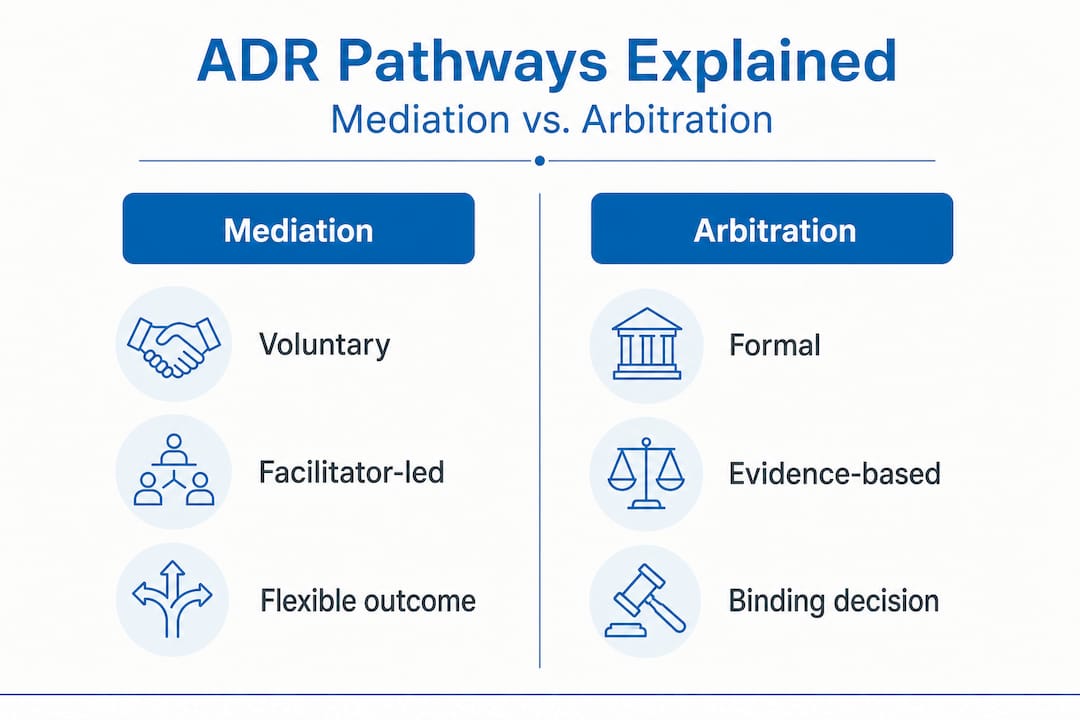
  • Mediation: A neutral third party helps both parties negotiate an agreement outside of court.
  • Family Dispute Resolution (FDR): Specifically for parenting matters; required before court in most cases.
  • Collaborative law: Both parties and their lawyers commit to resolving matters without court proceedings.
  • Consent orders: Once an agreement is reached, it can be formalised as a court order without a contested hearing.

If agreement cannot be reached, here is what to do:

  1. Obtain a certificate from your FDR practitioner confirming that resolution was attempted but failed.
  2. File an application in the FCFCOA for parenting or property orders.
  3. Participate in any court-ordered mediation or case management steps.
  4. Attend the final hearing, where a judge will make binding orders.

Family violence situations are treated as exemptions to the requirement to attempt FDR. If there is risk to your safety or the safety of your children, you can go directly to court and also apply for protection orders through the NSW Local Court.

A fresh perspective on family law in NSW

Having worked with many families navigating these issues, we have noticed something consistent: the legal framework matters, but the practical realities of each person’s situation often shape outcomes just as much as the law itself.

Many people underestimate how much preparation and organisation can affect the result. The introduction of mandatory financial disclosure and the recognition of economic abuse are not just technical legal reforms. They are a reflection of what practitioners have long observed: that financial control and manipulation are frequently central to family breakdown, yet they were historically hard to address within the legal system.

The same is true for some of the edge-case issues that have moved into mainstream family law. Separation under one roof, binding financial agreements, and now pet ownership are all areas where getting the details right early matters enormously. A poorly drafted agreement or an undocumented separation can unravel a case that seemed straightforward.

Our honest advice is this: do not wait until things become adversarial before seeking legal guidance. The earlier you get clear, tailored advice about your specific situation, the better placed you are to protect your rights and reach an outcome that actually works for your family. The system is rules-based, but it is also deeply nuanced, and no two situations are the same.

How expert family lawyers can help

Navigating family law in NSW, especially after the significant 2024 reforms, requires more than a general understanding of the rules. It requires advice that is specific to your circumstances.

https://gkelawyers.com.au

At GKE Lawyers, our family law solicitors work with clients across Sydney and NSW to provide clear, practical guidance on divorce, parenting arrangements, property settlements, and financial agreements. Whether you are dealing with economic abuse, complex asset structures, or a parenting dispute, we are here to help you understand your options and move forward with confidence. Contact our team today for a confidential consultation and find out how we can support you through every step of the process.

Frequently asked questions

Do I have to go to court for all family law issues in NSW?

No, many family law matters are resolved through mediation or consent orders without court involvement; court proceedings are considered a last resort after other resolution pathways have been exhausted.

What is considered economic abuse in family law?

Economic abuse includes restricting access to finances, controlling spending, or dowry abuse, and under 2024 reforms courts must now consider its impact directly when determining property settlements.

Is there a difference between custody and parenting arrangements?

Yes, Australian courts now use “parenting arrangements” rather than “custody,” with the child’s best interests as the paramount and only focus, rather than any presumption about parental rights.

How are pets treated in family law disputes?

Since the 2024 amendments took effect in June 2025, pets are treated as owned property with courts considering who purchased and primarily cared for the animal, rather than simply assigning them a monetary value as chattels.

Do I need an affidavit if we separated under one roof?

Yes, if you and your former partner were still living together during the 12 months of separation, you will need supporting affidavits and ideally a third-party statement to confirm the genuine end of the relationship.

Categories
Uncategorized

Choose the right property dispute resolution in NSW

Property disputes in NSW can shift from a minor disagreement to a serious legal matter faster than most homeowners expect. Whether you are dealing with a difficult neighbour, a strata committee conflict, or a landlord who refuses to return a bond, the confusion about where to turn and what steps to take can feel overwhelming. NSW law offers several distinct pathways, each with its own rules, timeframes, and consequences. This guide walks you through each option clearly, so you can make a confident, informed decision and avoid costly mistakes along the way.

Table of Contents

Key Takeaways

Point Details
Direct talk first Informal discussion and clear communication can often resolve issues before escalation.
Mediation is key NSW offers free, structured mediation that resolves many disputes quickly and at minimal cost.
Know formal deadlines Time frames for Tribunal applications (often 28 days) are strict and must be followed.
Choose the right forum Matching your dispute to the correct service or legal process saves time and money.
Expert help adds value Legal advice and preparation boost your odds of settlement without lengthy court battles.

How to assess your property dispute

Now that you know what’s at stake, the first step is to assess the nature and urgency of your dispute before taking any action. Not every property conflict follows the same path, and choosing the wrong forum early can limit your options later or cause unnecessary delays.

Most property disputes in NSW fall into one of these broad categories:

  • Neighbour disputes: Noise, boundary encroachments, overhanging trees, or access issues
  • Strata and community scheme disputes: Disagreements with owners corporations, by-law breaches, or common property maintenance
  • Tenancy disputes: Bond refunds, rent increases, repairs, or unlawful eviction
  • Residential property disputes: Contract issues, easements, or encumbrances affecting title

Identifying which category your dispute belongs to is critical because it determines which service or forum applies. For example, NCAT’s case types confirm that if your dispute falls within the ‘housing and property’ category, covering renting, strata, and other residential property matters, NCAT processes and associated mediation pathways are likely directly relevant. If your dispute sits outside these categories, the availability of NSW Fair Trading mediation may vary depending on the governing legislation and scheme type.

Timing also matters. Some disputes have strict statutory deadlines, and acting too slowly can mean losing your right to apply to a Tribunal altogether. Ask yourself these questions before proceeding:

  • Is this a renting or strata-related issue?
  • Am I part of a community, neighbourhood, or strata scheme?
  • Is there a time-sensitive element, such as an imminent eviction or settlement date?
  • Have I already attempted any informal resolution?

Understanding the resolution pathways in NSW available to you is far easier once you have clearly defined what type of dispute you are dealing with.

Pro Tip: Gather all relevant documentation now, regardless of which pathway you choose. This includes lease agreements, strata by-laws, correspondence, photographs, receipts, and any written notices. Strong documentation is your most valuable asset at every stage of the process.

Direct negotiation: why ‘talk first’ often works

After clarifying your dispute, the next logical step is a direct approach. It sounds simple, but many people skip this step out of frustration or anxiety, and that can be a costly mistake.

NSW’s strata guidance outlines a step process that begins with direct communication before escalating to mediation or formal proceedings. This approach is consistent across most property dispute types in NSW. Speaking directly with the other party gives both sides a chance to resolve the matter quickly, without the time and expense of formal proceedings.

Here is a structured way to approach a direct negotiation:

  1. Identify the issue clearly. Write down exactly what the problem is, what outcome you want, and what evidence supports your position.
  2. Prepare your evidence. Gather documents, photographs, written communications, and any relevant lease or by-law provisions before the conversation.
  3. Schedule a neutral meeting. Choose a time and place where both parties can speak calmly and without distraction. Avoid confrontational settings.
  4. Discuss and keep detailed notes. During the meeting, stay factual and focused. After the meeting, write up a summary of what was discussed and any agreements reached.
  5. Follow up in writing. Send a brief email or letter summarising the outcome. This creates a record that may be useful if the dispute escalates.

“The simplest approach often saves weeks of legal costs and delays.”

Direct negotiation works particularly well when both parties have an ongoing relationship, such as neighbours or landlords and tenants, and when the issue is relatively straightforward. It preserves the relationship, costs nothing, and can be completed in days rather than weeks.

Pro Tip: Document every attempt at direct resolution, including dates, what was said, and who was present. If the matter later goes to mediation or Tribunal, this record demonstrates good faith and can strengthen your position. Reviewing initial dispute resolution steps with a legal professional before approaching the other party can also help you frame your position effectively.

Mediation: fast, free, and often effective

When talking isn’t enough, NSW’s structured mediation is often the crucial next step. Mediation sits between informal negotiation and formal Tribunal proceedings, and for many disputes, it is the most efficient path to resolution.

NSW’s guidance describes mediation as an informal negotiation process facilitated by a neutral mediator. The mediator does not make a decision or impose an outcome. Instead, they help both parties clarify their concerns, explore options, and work toward a mutually acceptable agreement. For community and neighbourhood schemes, mediation through NSW Fair Trading is identified as a key mechanism to avoid the cost and formality of Tribunal proceedings. If mediation does not resolve the dispute, the matter can then proceed to NCAT.

NCAT mediation guidance confirms that NCAT also uses mediation as a confidential, structured process. The mediator facilitates settlement discussions, but does not determine the outcome. If mediation at NCAT fails, the case proceeds to a Tribunal Member for a formal decision.

Key benefits of mediation include:

  • Cost: NSW Fair Trading mediation is free for eligible disputes
  • Speed: Sessions are typically arranged within weeks, not months
  • Confidentiality: What is discussed in mediation cannot generally be used in later proceedings
  • Control: Both parties retain control over the outcome, unlike a Tribunal decision
  • Flexibility: Agreements can be creative and tailored to the specific situation

When considering property mediation in NSW, preparation is everything. Here is a practical overview of what to expect:

Element Detail
What to bring Evidence, relevant documents, a clear summary of your position and desired outcome
Typical timeframe A few weeks from application to session; session itself usually lasts 2 to 4 hours
Who attends Both parties; legal representatives may attend in some cases
Possible outcomes Written agreement, partial agreement, or no agreement (matter proceeds to Tribunal)
Cost Free via NSW Fair Trading for eligible disputes; NCAT mediation fees may apply

Mediation is particularly effective for strata and tenancy disputes where both parties have ongoing obligations to each other. It is less suited to situations involving urgent orders, such as an imminent unlawful eviction, where a Tribunal application may be more appropriate.

Property mediation session in glass-walled room

NCAT tribunal and court: formal pathways explained

If mediation fails or is unavailable, the next stop is a formal forum. NCAT’s case types page explicitly states that ‘Housing and property’ includes applications about renting, strata, and other residential property disputes, making NCAT the central forum for most NSW property matters that require a binding decision.

Understanding how these formal pathways compare is essential for planning your next move.

Feature Mediation NCAT Court
Cost Free or low cost Moderate filing fees Significant legal costs
Timeframe Weeks Weeks to months Months to years
Outcome Agreement (not binding unless formalised) Binding orders Binding judgment
User-friendliness High Moderate Low
Legal representation Optional Limited in some divisions Common and often necessary
Best for Straightforward disputes Most property disputes Complex or high-value matters

A Law Foundation of NSW analysis of 39,707 NCAT tenancy applications in 2024 found that a substantial share of matters were finalised quickly, with over 66% of tenancy disputes resolved within four weeks. This makes NCAT a genuinely efficient option for most residential tenancy matters.

However, there are important risks and limitations to understand before lodging a formal application:

  • Strict time limits apply. As noted in NCAT’s tenancy and social housing fact sheet, if no specific time limit is stated in the relevant legislation, applications must generally be lodged within 28 days. Missing this window can mean losing your right to apply entirely.
  • Costs orders are possible. While NCAT is generally less expensive than court, a Tribunal Member can order one party to pay the other’s costs in certain circumstances.
  • Preparation is essential. Consent orders and early settlements are common at NCAT, but only when both parties arrive well prepared with clear evidence and realistic expectations.
  • Court is sometimes necessary. For complex property disputes involving significant sums, title issues, or matters requiring injunctive relief, the Supreme Court or District Court may be the appropriate forum.

When assessing formal property dispute resolution, it is worth speaking with a property lawyer before lodging any application to ensure you are using the right forum and meeting all procedural requirements.

What most guides miss about choosing the right pathway

Most articles about property dispute resolution focus on the mechanics: what each pathway is, how to apply, and what to expect. That information is useful, but it misses a crucial strategic layer that we see play out regularly for homeowners and investors in NSW.

The most common mistake is not choosing the wrong pathway. It is making the first move without understanding how that move affects every step that follows. For example, if you skip compulsory mediation in a strata dispute and go straight to NCAT, your application may be dismissed on procedural grounds. You then have to start again, having lost time and potentially missed a statutory deadline.

Documentation is the other area where people consistently underestimate the stakes. At GKE Lawyers, we see clients arrive at formal proceedings with strong cases that are weakened by incomplete records. A text message thread that was not saved, a phone call that was not followed up in writing, or a repair request that was verbal rather than documented. These gaps matter enormously when a Tribunal Member is weighing competing accounts of events.

There is also a persistent myth that court is always the worst outcome. In reality, for complex disputes involving significant property values, unclear title issues, or matters where a precedent-setting decision is needed, court may be the most appropriate and ultimately most efficient choice. A Tribunal cannot make certain orders that a court can, and attempting to resolve a genuinely complex matter through mediation or NCAT can sometimes delay an inevitable court application by months.

Pro Tip: Before taking any formal step, check whether mediation is compulsory for your type of dispute. NSW has different requirements for strata, community scheme, and tenancy disputes. Skipping a compulsory step is not just inefficient, it can invalidate your application entirely. Reviewing NSW legal dispute insights with an experienced property lawyer before you act is one of the most cost-effective decisions you can make.

The final point worth making is about consent-based outcomes. When both parties arrive at mediation or NCAT well prepared, with realistic expectations and a genuine willingness to resolve the matter, consent orders are faster than any contested hearing. The preparation you invest before the process begins directly determines how quickly and favourably it ends.

Expert help can make all the difference

Navigating property disputes in NSW involves strict deadlines, procedural rules, and strategic decisions that can significantly affect your outcome. Getting the process right from the start matters.

https://gkelawyers.com.au

At GKE Lawyers, our property dispute team helps homeowners and investors across Sydney and NSW understand their rights, meet critical deadlines, and choose the most effective resolution pathway for their specific situation. Whether you need support preparing for mediation, representation at NCAT, or advice on whether a court application is appropriate, we provide clear, practical guidance tailored to your circumstances. Do not wait until a deadline has passed or a procedural error has limited your options. Speak to property dispute lawyers at GKE Lawyers today and get the clarity you need to move forward with confidence.

Frequently asked questions

What is the first step if I have a property dispute in NSW?

Start by trying to resolve the dispute directly with the other party. As NSW’s strata guidance outlines, direct communication is the recommended first step before formal pathways like mediation or Tribunal are considered.

How long does NCAT typically take to resolve property disputes?

Most tenancy matters are finalised within four weeks, and a significant proportion within six weeks. The Law Foundation of NSW analysis of 39,707 NCAT tenancy applications in 2024 confirmed that a substantial share of matters were resolved quickly, often by consent.

Is mediation always required before going to NCAT?

For many strata disputes, mediation is compulsory before lodging with NCAT, but some dispute types can proceed directly to Tribunal. NSW’s strata disputes page notes that while mediation is compulsory for most strata matters, certain disputes bypass this requirement.

Are there time limits for filing with NCAT?

Yes. NCAT’s tenancy and social housing fact sheet confirms that if no specific time limit is stated in the relevant legislation, applications must generally be lodged within 28 days of the relevant event.

What if mediation does not resolve my property dispute?

If mediation fails, you can apply to NCAT or the courts for a formal determination. NSW’s guidance confirms that unresolved mediation matters can proceed to NCAT for a binding decision.

Categories
Uncategorized

Understanding co-ownership disputes and your legal rights

Co-ownership of property in New South Wales can work smoothly for years until it doesn’t. Many co-owners assume that disputes only arise from dramatic fallouts or major financial betrayals. The reality is far more ordinary and, in many ways, more unsettling. A difference of opinion about whether to rent or sell, a disagreement over who pays for urgent repairs, or simply diverging life plans can be enough to trigger a legal conflict that becomes costly and time-consuming. Understanding your rights from the outset is the most effective way to protect yourself and your investment.

Table of Contents

Key Takeaways

Point Details
Co-ownership disputes defined A co-ownership dispute arises when property co-owners cannot agree on key issues like maintenance, use, or sale.
Arrangements impact risks Your co-ownership structure (e.g., joint tenancy or tenancy in common) affects the types of disputes and solutions available.
Legal options are available NSW law provides structured ways to resolve disputes, including court orders for sale or partition when needed.
Prevention is best Early expert legal advice and thorough agreements are the most effective way to prevent serious disputes.

What is a co-ownership dispute?

Co-ownership in New South Wales refers to any arrangement where two or more people hold legal title to the same property. This includes family members who inherit property together, business partners who purchase commercial premises jointly, and friends or couples who buy residential property as an investment. It is a common and practical arrangement, but it comes with shared rights and shared responsibilities that do not always align neatly over time.

Co-ownership disputes typically occur when two or more parties with shared ownership of a property disagree on rights, responsibilities, or future use. These disagreements can arise gradually, often without any single dramatic event. A co-owner who wants to sell while the other wants to hold, one party failing to contribute to mortgage repayments, or conflicting views on renovation decisions are all common starting points.

Common triggers for co-ownership disputes include:

  • Disagreements about selling the property, including timing, price expectations, and choice of agent
  • Unequal financial contributions to mortgage repayments, council rates, or maintenance costs
  • Disputes over the use of the property, such as whether to lease it out or occupy it personally
  • Differences in long-term plans, where one owner’s circumstances change significantly
  • Poor communication and the absence of any formal co-ownership agreement

“A co-ownership arrangement without a written agreement is an arrangement built on assumptions. Assumptions are exactly where legal disputes begin.”

Clarity in your co-ownership arrangement is not just a legal formality. It is a practical safeguard. A detailed, legally binding agreement that outlines each party’s rights, obligations, and exit strategy dramatically reduces the risk of disputes escalating to a point where court intervention becomes necessary. Seeking legal guidance for co-ownership before any conflict arises is always preferable to addressing it after the fact.

Types of co-ownership arrangements and typical dispute causes

Once you understand what constitutes a co-ownership dispute, it is important to recognise that the nature of your property arrangement can influence the risks you face. In NSW, there are two primary forms of co-ownership, each carrying distinct legal implications.

Different kinds of co-ownership, such as joint tenancy and tenancy in common, have distinct legal implications that directly affect how disputes are handled and resolved.

Legal advisor explaining co-ownership arrangements

Feature Joint tenancy Tenancy in common
Ownership shares Equal shares Can be unequal shares
Right of survivorship Yes, automatically transfers to surviving co-owner No, share passes through the deceased’s estate
Ability to sell your share Requires agreement or severance Can sell your share independently
Common in Married couples, domestic partners Business partners, investors, unrelated parties
Risk of dispute Lower initially, higher if relationship breaks down Higher due to flexible structure

Understanding joint tenancy versus tenancy in common is an essential starting point when evaluating your co-ownership risk. Joint tenants hold equal shares and are legally treated as a single entity in some respects, which can simplify decisions but also create friction when one party wants to exit. Tenants in common can hold unequal shares, can sell or transfer their interest without the other owner’s consent, and do not benefit from the right of survivorship.

Typical sources of conflict in both arrangements include:

  • One co-owner wanting to sell and the other refusing, which can stall the property indefinitely
  • Disputes about rental income distribution where the property is leased to a third party
  • Disagreements about capital improvements and whether costs should be shared proportionally
  • Breakdown of the personal relationship between co-owners, particularly in family law contexts
  • One co-owner becoming insolvent and a trustee in bankruptcy seeking to realise the property

Pro Tip: If you are entering into a co-ownership arrangement as tenants in common, always specify the ownership percentages and contribution obligations in a formal co-ownership agreement drafted by a solicitor. This single step can prevent years of costly litigation.

Knowing which legal avenues are available in New South Wales can help you better plan your next step if conflicts arise. The good news is that NSW law provides several structured options for resolving these disputes, ranging from informal negotiation through to formal court proceedings.

Infographic showing steps to resolve co-ownership dispute

NSW law provides statutory methods for resolving disputes, including applications to the Supreme Court for sale or partition of the property where co-owners cannot reach an agreement voluntarily.

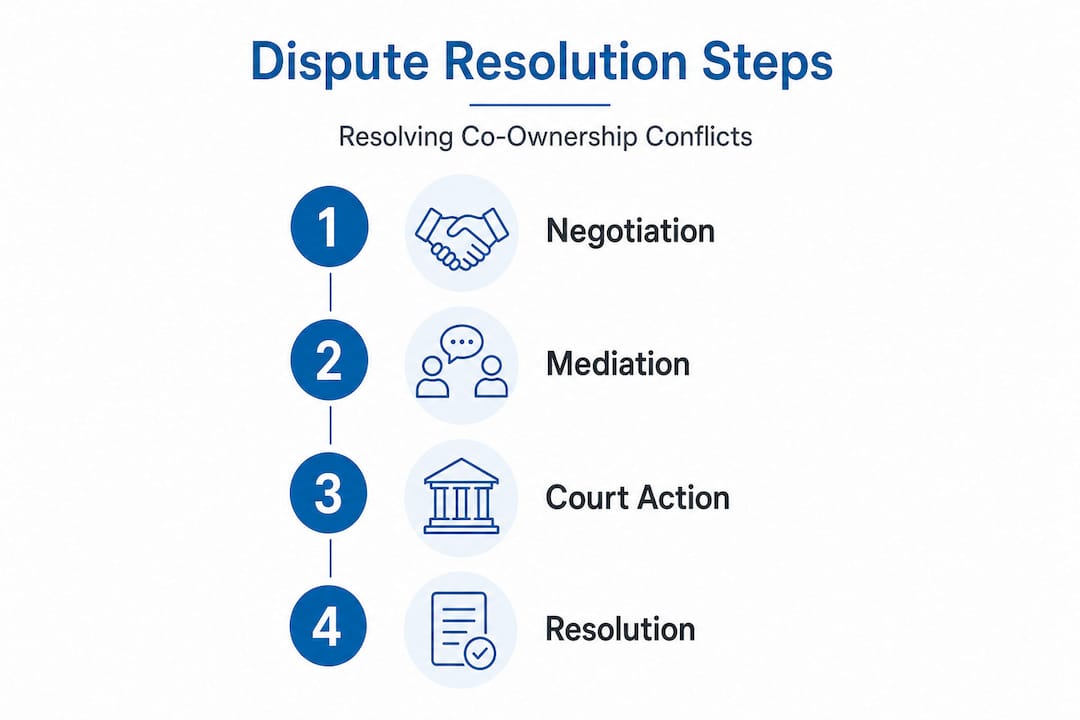
The three primary resolution pathways are:

  1. Negotiation: Direct discussion between co-owners, often assisted by legal representatives, to reach a mutually acceptable outcome. This is the fastest and least expensive option and should always be attempted first.
  2. Mediation: A neutral third-party mediator facilitates structured discussions between the parties. Mediation is confidential, flexible, and significantly less costly than litigation. In NSW, community mediation services and private commercial mediators are both available.
  3. Litigation: Where negotiation and mediation fail, either party may apply to the NSW Supreme Court. The court has broad powers under the Conveyancing Act 1919 (NSW) to order the sale or partition of a co-owned property.
Resolution method Estimated timeframe Approximate cost range Outcome control
Negotiation Days to weeks Low High
Mediation Weeks to months Moderate Moderate
Supreme Court application Months to years High Low

When the Supreme Court becomes involved, it can order a partition of the property (dividing it physically between co-owners where practicable) or a sale of the property with proceeds divided according to each co-owner’s interest. Courts generally consider partition only when it is physically feasible and equitable. For most residential properties, a court-ordered sale is the more common outcome.

You should consult expert property dispute guidance as early as possible if a dispute is developing. Understanding the full scope of your legal options before emotions and costs escalate is critical. Delay often results in more entrenched positions and higher legal fees for all parties.

It is also worth noting that costs orders in Supreme Court proceedings are entirely at the court’s discretion. There is no guarantee that the winning party will recover all or any of their legal costs, which is another strong reason to explore negotiated or mediated outcomes wherever possible.

Practical steps to prevent and resolve co-ownership disputes

Understanding the legal routes is important, but many disputes can be prevented, or efficiently resolved, by taking some proactive steps before the situation deteriorates. Prevention is almost always cheaper and less stressful than litigation.

  1. Draft a formal co-ownership agreement before settlement. This document should clearly specify each party’s ownership share, their financial obligations, how decisions about the property will be made, and the process for exiting the arrangement. It should also address what happens if one party defaults on their obligations.

  2. Maintain transparent financial records. Keep accurate documentation of all contributions to mortgage repayments, maintenance, insurance, and council rates. Disputes over financial contributions are much harder to resolve without clear records.

  3. Communicate in writing. Even between close friends or family members, important decisions about the property should be confirmed in writing, whether by email or formal letter. This creates a contemporaneous record that can be relied upon if a dispute later arises.

  4. Review your agreement periodically. Life circumstances change. A co-ownership agreement that was suitable five years ago may not reflect the current situation. Schedule a review whenever there is a significant change, such as a relationship breakdown, change in financial circumstances, or market shift.

  5. Seek mediation early. If disagreements begin to surface, do not wait for them to escalate. Engaging a professional mediator while both parties are still willing to communicate can resolve issues in a fraction of the time and cost of litigation.

  6. Consult a property lawyer at the first sign of serious conflict. Seeking legal help early gives you a clear picture of your rights and options before the dispute becomes entrenched.

Professional legal advice can clarify the rights and responsibilities in co-ownership situations and reduce the risk of escalation. This is not merely a caution but a practical recommendation. A solicitor can review your existing arrangements, identify vulnerabilities, and propose practical solutions that protect your interests without unnecessarily antagonising the other party.

Pro Tip: The most overlooked clause in co-ownership agreements is the exit mechanism. Always specify what happens when one co-owner wants to sell or exit the arrangement, including a right of first refusal for the remaining co-owner and a valuation process. Omitting this clause is one of the most common causes of expensive disputes.

Why most co-owners underestimate the complexity of disputes

After years of advising clients on property matters across New South Wales, we have observed a consistent pattern. Most co-owners who come to us in the middle of a dispute share one thing in common: they genuinely did not expect it to happen. This is not naivety. It is a reflection of how co-ownership disputes actually develop.

People enter co-ownership arrangements during a period of goodwill and mutual trust. The legal structure feels like a formality, not a safeguard. A written agreement seems almost insulting when you are buying property with someone you love or trust completely. This is precisely why disputes so often come as a shock.

The complexity deepens because co-ownership disputes rarely exist in isolation. Emotional ties to the property, personal relationships between the parties, fluctuating market values, and the financial interdependence of the co-owners all add layers that purely legal frameworks do not fully address. A court can order a sale, but it cannot resolve the grief or resentment that led to the dispute. These factors often cause parties to make decisions that are not in their best financial interest.

We also see that many co-owners hold a common myth: that the person who contributes more financially has more say in decisions. Under a joint tenancy, this is not the case at all. Equal ownership means equal rights, regardless of who has paid more over the years. Under a tenancy in common, the percentage of ownership determines legal rights, not the history of contributions.

Our view, grounded in property law expertise developed across hundreds of property matters, is that the single most effective investment any co-owner can make is a well-drafted co-ownership agreement prepared before any conflict arises. The cost is modest. The protection it provides is substantial. No amount of goodwill replaces a clear, legally binding document that both parties have had the chance to understand and negotiate.

Co-ownership disputes can move quickly from minor tension to serious legal conflict. When that happens, having the right legal team beside you makes a measurable difference to both the outcome and the experience.

https://gkelawyers.com.au

At GKE Lawyers, we have extensive experience advising property co-owners across Sydney and throughout New South Wales. Whether you are at the earliest stages of a disagreement or facing Supreme Court proceedings, we can help you understand your rights, explore your options, and pursue a resolution that protects your interests. To speak with a property lawyer about your co-ownership situation, contact our team today. We offer clear, practical advice tailored to your specific circumstances, so you can make informed decisions with confidence.

Frequently asked questions

What are the main causes of co-ownership disputes in NSW?

Disagreements typically arise from differences in opinions about usage, investment, and rights, with the most common triggers being disputes over selling the property, unequal financial contributions, and conflicting plans for the property’s future.

Can one co-owner force the sale of the property in NSW?

NSW law allows for court applications for sale or partition where co-owners cannot agree, meaning yes, one co-owner can apply to the Supreme Court to seek a court-ordered sale in appropriate circumstances.

How can co-ownership disputes be prevented?

Legal advice and robust agreements help reduce the risk of dispute escalation, and most conflicts can be avoided through clearly drafted co-ownership agreements, consistent communication, and early mediation when tensions first appear.

What is the first step if a dispute arises?

It is advised to attempt negotiation or mediation prior to litigation, as these approaches preserve relationships, cost significantly less, and often result in outcomes that both parties find more acceptable than those imposed by a court.

Categories
Uncategorized

Resolving disputes in NSW without going to court

Most people assume that when a legal dispute arises, court is the inevitable destination. That assumption is wrong. 94% of workers compensation disputes in NSW are resolved without a formal court determination, and that pattern holds across family law, commercial disagreements, and civil claims throughout the state. Alternative dispute resolution (ADR) is not a workaround or a compromise. It is the primary mechanism through which most disputes in NSW are actually settled, and understanding how it works gives you a genuine strategic advantage before you spend a dollar on litigation.

Table of Contents

Key Takeaways

Point Details
ADR solves most disputes In NSW, the majority of civil disputes—including personal injury and workers’ compensation—are resolved through ADR, not in court.
Different ADR approaches Mediation focuses on negotiated agreement, while arbitration provides a binding decision by a neutral third party.
ADR can be mandatory Courts in NSW may require parties to use ADR before progressing to a formal hearing.
Mediation preserves control Parties always have the final say in mediation—it’s never forced.
Get experienced support Legal advice is vital to choosing the right ADR process and ensuring your rights are protected.

What is alternative dispute resolution?

ADR is a collective term for structured processes that resolve disputes outside the traditional court system. It includes mediation, arbitration, conciliation, and negotiation, but it does not include the formal adversarial hearing before a judge that most people picture when they think of “going to court.”

The NSW legal system actively encourages ADR. The Civil Procedure Act 2005 sets out the objective of achieving a “just, quick and cheap resolution” of civil disputes, and ADR is central to that objective. Courts in NSW are not merely tolerant of ADR. They are required to actively promote it, and in many cases they will direct parties to attempt it before allowing a matter to proceed to a full hearing.

ADR applies across a wide range of dispute types. Family law matters, including property settlements and parenting arrangements, are among the most common. Commercial disputes involving contract breaches, partnership disagreements, and business debts are also frequently resolved through ADR. Personal injury claims, employment conflicts, and neighbourhood disputes all fall within its reach.

The core benefits of ADR, compared to full litigation, include:

  • Speed: Most ADR processes resolve in weeks or months, not years

  • Cost: Legal fees and preparation costs are significantly lower than a full trial

  • Confidentiality: Proceedings and outcomes are generally private, unlike court judgments which are public

  • Flexibility: Parties can agree on processes, timelines, and outcomes that a court could not legally impose

  • Preservation of relationships: ADR encourages dialogue, which matters when ongoing business or family relationships are involved

“ADR refers to processes that resolve disputes outside the traditional court system, encouraged in NSW for a ‘just, quick and cheap resolution.’” — Judicial Commission of NSW

Understanding these principles helps you approach any dispute with a clearer sense of what is actually available to you and what the legal system expects you to consider before filing a claim.

ADR pathways in New South Wales

NSW offers several structured pathways for ADR, and knowing which one applies to your situation is the first practical step. The main types are mediation, arbitration, conciliation, and negotiation. Each operates differently, involves different levels of formality, and produces different kinds of outcomes.

Mediation is the most widely used form of ADR. A neutral third party, the mediator, facilitates discussion between the disputing parties. The mediator does not decide who is right. Their role is to help both sides communicate clearly, identify their real interests, and work toward a mutually acceptable agreement.

Arbitration is more formal. An arbitrator hears evidence and submissions from both sides, then makes a decision. Depending on the agreement between the parties, that decision can be binding, meaning it has the same force as a court order.

Conciliation is similar to mediation but the conciliator plays a more active role, often suggesting possible outcomes and guiding parties toward resolution. It is commonly used in employment and consumer disputes.

Negotiation is the most informal option. Parties, usually through their lawyers, communicate directly to reach a settlement without any third-party involvement.

How a dispute enters the ADR process varies. You may agree voluntarily with the other party to attempt mediation before taking any formal steps. Your contract may contain a clause requiring arbitration before litigation. Or a court may direct you to ADR after proceedings have already commenced.

Court-ordered mediation under Part 4 and court-referred arbitration under Part 5 of the Civil Procedure Act 2005 are the two main statutory mechanisms. Under Part 4, the court can order parties to attend mediation at any stage of proceedings. Under Part 5, the court can refer specific questions or the entire dispute to an arbitrator.

Courts in NSW may order or refer parties to ADR in the following circumstances:

  • When the matter involves a factual dispute that could be resolved without judicial determination

  • When the parties have not yet attempted any form of negotiation or mediation

  • When the complexity of the matter makes early resolution more cost-effective

  • When a statutory scheme (such as the Personal Injury Commission) mandates ADR before formal determination

  • When the court determines that the relationship between parties warrants a less adversarial process

Pro Tip: If you want maximum control over the final outcome, start with mediation. You retain the right to reject any proposed agreement, and nothing is binding unless you sign it.

In family law, mediation through a registered Family Dispute Resolution practitioner is generally required before applying to the Federal Circuit and Family Court of Australia for parenting orders. This is a statutory requirement, not optional, and it reflects how seriously NSW and federal law take ADR as the preferred first step.

Mediation and arbitration: Key differences explained

Mediation and arbitration are the two most commonly used ADR methods in NSW, but they operate very differently. Understanding those differences helps you choose the right process for your specific dispute.

Mediation is a structured negotiation where a neutral facilitator helps the parties reach their own agreement. The mediator has no authority to impose a decision. If you cannot agree, you leave mediation without a resolution and may need to pursue other options.

Neutral facilitator overseeing mediation process

Arbitration is more formal and involves the presentation of evidence and legal submissions. The arbitrator listens to both sides and then makes a decision, which is typically binding if the parties agreed to binding arbitration at the outset.

Feature Mediation Arbitration
Decision-maker The parties themselves The arbitrator
Outcome Voluntary agreement Binding or non-binding award
Formality Low to moderate Moderate to high
Evidence rules Flexible More structured
Confidentiality Generally yes Generally yes
Cost Lower Higher than mediation
Speed Usually faster Slower than mediation
Best for Preserving relationships, flexible outcomes Finality, complex factual disputes

When deciding which process suits your situation, consider the following:

  1. Do you need a binding decision? If the other party is unlikely to honour a voluntary agreement, arbitration provides an enforceable outcome without going to court.

  2. Is the relationship ongoing? If you need to continue working with or co-parenting with the other party, mediation’s collaborative approach is far less damaging.

  3. How complex is the evidence? Arbitration is better suited to disputes involving technical evidence, expert witnesses, or detailed financial records.

  4. What is your risk tolerance? In mediation, you control the outcome. In arbitration, you hand that control to a third party. That is a significant difference if the stakes are high.

  5. What does your contract say? Many commercial agreements specify arbitration as the required dispute resolution method. Check your contract before deciding.

The choice between these two processes is not simply about cost or formality. It is about who you want making the final call, and whether you can live with an outcome you did not choose.

Does ADR work? Results and real-world impact

Infographic showing mediation versus arbitration comparison

The evidence that ADR works in NSW is not theoretical. It is documented in published data from the institutions that administer it.

The Personal Injury Commission, which handles workers compensation and motor accident disputes in NSW, reported that 94% of disputes were resolved without a formal determination in its 2024-25 Annual Review. That means the overwhelming majority of people who entered the Commission’s processes reached an outcome through conciliation, mediation, or negotiated settlement rather than a formal hearing.

“The vast majority of disputes before the Personal Injury Commission are resolved through alternative processes, reflecting the effectiveness of structured ADR in reducing the burden on formal legal proceedings.” — Personal Injury Commission Annual Review 2024-25

This outcome is not unique to personal injury matters. Across family law, commercial disputes, and civil claims, ADR consistently resolves the majority of matters before they reach a courtroom.

Dispute type ADR mechanism Typical resolution rate
Workers compensation (NSW) Conciliation/mediation ~94% resolved without determination
Family law parenting disputes Family Dispute Resolution Majority resolved pre-court
Commercial contract disputes Mediation/arbitration High resolution rates reported
Consumer and tenancy disputes Conciliation Significant pre-hearing resolution

The efficiency gains are real. A mediation session might cost a few thousand dollars in legal preparation and mediator fees. A defended court hearing in the NSW District Court or Supreme Court can cost tens of thousands of dollars, take years to reach a hearing date, and still produce an uncertain outcome.

ADR also reduces the emotional toll. Court proceedings are adversarial by design. They require each party to build the strongest possible case against the other, which entrenches conflict and makes future cooperation very difficult. ADR encourages a different posture, one focused on interests and solutions rather than winning and losing.

Pro Tip: Do not assume the other party needs to be willing before you raise ADR. Courts can and do refer unwilling parties to mediation. Raising ADR early also signals good faith, which courts notice.

The practical lesson from the data is straightforward. If you are facing a dispute in NSW, ADR is not a fallback position. It is the most likely path to resolution, and approaching it strategically, with proper legal advice, gives you the best chance of a fair and efficient outcome.

A fresh perspective: Why the right ADR approach depends on your goals

Here is something most articles about ADR do not say clearly enough: the choice between mediation and arbitration is fundamentally a question about who you trust to make the decision.

In mediation, you trust yourself. You retain full authority over the outcome. Nothing is agreed unless you agree to it. That is enormously powerful, but it also means you need to be clear about what you actually want, not just what you think you are entitled to. Parties who enter mediation focused on “winning” often leave frustrated, because mediation is not designed to produce winners and losers. It is designed to produce workable agreements.

In arbitration, you trust the process. You present your case, the other side presents theirs, and an experienced arbitrator decides. There is real value in that, particularly when the dispute involves complex facts, when one party has been acting in bad faith, or when you simply need certainty and closure. Losing in arbitration can feel better than years of unresolved conflict.

The conventional wisdom that ADR is always cheaper and faster than litigation is broadly true, but it misses a more important point. The right ADR method depends on whether you need an agreement or a decision, and on the nature of your specific dispute. A commercial landlord with a tenant who has repeatedly breached a lease may need the finality of arbitration. A separated couple with young children almost certainly benefits more from the collaborative framework of mediation.

We consistently advise clients to identify their deepest interest before choosing an ADR method. Not their legal position, but their actual goal. Do you want money, an apology, a changed behaviour, or simply for the dispute to end? The answer shapes which process serves you best. ADR is not one size fits all, and treating it as such is one of the most common and costly mistakes people make.

How GKE Lawyers can help you navigate ADR in NSW

Choosing the right ADR pathway and preparing effectively for it requires more than a general understanding of the process. It requires legal advice tailored to your specific dispute, your goals, and the strengths and weaknesses of your position.

At GKE Lawyers, we work with clients across Sydney and throughout NSW on family law disputes, commercial matters, personal injury claims, and civil litigation. We help you understand which ADR pathway suits your situation, prepare you thoroughly for mediation or arbitration, and protect your legal interests at every stage. Whether you are entering ADR voluntarily or have been directed to it by a court, having experienced legal representation makes a measurable difference to the outcome. Contact us today to arrange a consultation and take the first clear step toward resolving your dispute.

Frequently asked questions

Is alternative dispute resolution mandatory in NSW civil cases?

ADR can be court-ordered under the Civil Procedure Act 2005, making it mandatory in some instances, particularly when a court determines that the parties should attempt resolution before proceeding to a full hearing.

Does mediation mean I have to agree if I don’t want to?

No. Mediators facilitate but do not impose decisions, and any agreement reached in mediation must be voluntary. You retain full authority to reject any proposed outcome.

Are arbitration decisions always binding?

Arbitration awards are typically binding if both parties agreed to binding arbitration before the process began, but non-binding arbitration is also available in some contexts.

What types of disputes are best suited for ADR in NSW?

ADR covers a broad range of dispute types, and it is particularly well-suited for family, commercial, personal injury, and general civil matters where parties have an interest in a timely and cost-effective resolution.

How much does ADR cost compared to going to court?

ADR is generally significantly less expensive and quicker than a full court hearing, with mediation in particular often resolving disputes in a single session at a fraction of the cost of defended litigation.

Categories
Uncategorized

How to apply for probate in NSW: a clear guide

Being named as an executor in a Will is a significant responsibility, and for many people, the probate application process in New South Wales feels immediately daunting. Strict legal formalities, court deadlines, and document requirements can create genuine uncertainty at an already difficult time. The good news is that once you understand the structure of the process, each step becomes far more manageable. This guide walks you through everything you need to know about applying for probate in NSW, from understanding what probate actually means through to responding to court requisitions and managing potential complications.


Table of Contents

Key Takeaways

Point Details
Probate is often essential Executors in NSW must usually apply for probate to manage and distribute a deceased person’s estate.
Timelines are strict Apply for probate within six months to avoid delays and extra requirements.
Most steps are now online Uncontested probate applications should be filed via the Supreme Court’s online portal.
Executor responsibility matters Executors can be personally liable for mistakes, so careful management and legal advice are wise.
Professional help is available Specialist lawyers can guide executors through tricky or contested probate cases.

Understanding probate in NSW

Probate is a formal legal process through which the Supreme Court of NSW confirms that a Will is valid and authorises the named executor to act on behalf of the deceased estate. Without this confirmation, financial institutions, government agencies, and other asset holders will generally refuse to release estate assets to anyone claiming to act as executor.

A grant of probate is a Supreme Court of NSW order that confirms the Will is valid and permits the executor to distribute the estate according to the Will. This distinction matters enormously in practice. Banks, share registries, and the NSW Land Registry Services will not transfer assets simply because someone presents a copy of the Will. The grant of probate is the legal instrument that gives the executor actual authority.

It is also important to understand when probate is required versus when letters of administration apply. In NSW, you generally apply for either a grant of probate (if there is a valid Will and an executor can act) or letters of administration (if there is no valid Will and/or there are no executors able or willing to act). Letters of administration are issued in intestate estates, meaning estates where the deceased died without a valid Will, or where the named executors have all renounced or are otherwise unable to act.

Situation Type of grant required
Valid Will, executor willing to act Grant of probate
No valid Will (intestate estate) Letters of administration
Valid Will, but all executors unable or unwilling to act Letters of administration with the Will annexed
Executor overseas or incapacitated Possibly letters of administration (limited)

The legal effect of the Supreme Court granting probate is substantial. It provides certainty to third parties dealing with the estate, protects the executor from personal liability when acting in good faith, and formally opens the estate administration process. Without it, even straightforward asset transfers can stall for months.

Key point: Not every estate requires probate. Small estates with assets held jointly or in superannuation may not need a grant at all. If you are unsure whether probate is necessary for the estate you are administering, seek legal advice early.


Preparing for a probate application

Before you file anything with the Supreme Court, thorough preparation will save you considerable time and reduce the risk of requisitions (formal requests from the Court for additional information or corrected documents). Getting organised from the outset is one of the most practical things you can do as an executor.

Essential documents you will need to gather:

  • The original Will (not a photocopy)
  • The original death certificate issued by the NSW Registry of Births, Deaths and Marriages
  • An inventory of assets and liabilities as at the date of death
  • Affidavit of executor (sworn or affirmed statement confirming your identity and role)
  • Affidavit of publication (confirming the probate notice was published)
  • Any codicils (formal amendments) to the Will

The executor’s role carries real legal weight. You are personally responsible for identifying and collecting all estate assets, paying debts and liabilities, managing the estate prudently during administration, and distributing the estate in accordance with the Will. Understanding executor obligations in probate before you begin helps you avoid missteps that could expose you to personal liability later.

What happens when an executor cannot or will not act?

Executor organizing estate documents in home office

This situation arises more often than people expect. An executor may have predeceased the Will-maker, lost mental capacity, or simply refuse to take on the role. NSW provides procedural routes such as renunciation before grant, substituted executor applications, and scenarios involving notice and affidavits of service for non-joining executors. If you are a co-executor and the other named executor refuses to participate, you cannot simply proceed without addressing their position formally. The Court requires evidence that proper steps were taken.

Timing is critical. You should apply within 6 months of the death. If you apply later than this, you must provide a reasonable explanation for the delay as part of your application. Delays in applying can complicate asset management, create difficulties with creditors, and in some cases affect your ability to act as executor altogether.

Pro Tip: Create a dedicated folder (physical or digital) for all estate documents from the moment you become aware of your role as executor. Keep every communication, every bank statement, and every asset valuation in one place. This single habit prevents the most common source of delays in probate applications.

Preparation task Why it matters
Locate the original Will Court will not accept photocopies for probate
Obtain death certificate Required for all formal applications
Prepare asset inventory Needed for the affidavit of executor
Check for codicils Codicils form part of the Will and must be included
Confirm executor status Renunciation or substitution must be resolved before filing

Step-by-step guide to the probate process

Once your documents are in order and any executor issues are resolved, you are ready to move through the formal application stages. Process mechanics for uncontested probate in NSW include gathering supporting documents, publishing a probate notice, waiting 14 days, submitting the probate application, and responding to court requisitions.

Infographic showing NSW probate process steps

Step 1: Gather and certify all required documents

Prepare your affidavits, the original Will, and the death certificate. All affidavits must be sworn or affirmed before an authorised witness such as a solicitor or justice of the peace. Errors in affidavits are one of the most common causes of requisitions from the Court, so precision here is essential.

Step 2: Publish a probate notice on NSW Online Registry

Before filing your application, you must publish a probate notice on the NSW Online Registry. This notice alerts creditors and any interested parties that you intend to apply for probate. It is a mandatory step that cannot be skipped or shortened.

Step 3: Wait the required 14 days

After publishing the probate notice, you must wait a minimum of 14 days before submitting your application to the Court. This waiting period gives creditors and other interested parties an opportunity to raise concerns or lodge a caveat against the grant.

Step 4: Submit the application via the Supreme Court’s online portal

From 1 August 2023, most applications must be filed and managed through the Supreme Court’s online system. This means paper-based applications are largely no longer accepted for standard probate matters. You will need to create an account, upload your documents in the required format, and pay the applicable filing fee, which varies depending on the gross value of the estate.

Step 5: Respond promptly to any court requisitions

After filing, the Court may issue a requisition requesting clarification, additional documents, or corrections to your application. Responding quickly and accurately to requisitions is vital. Delays in responding directly extend the overall processing time.

Important: The online system introduced in August 2023 has streamlined many aspects of the process, but it also means that technical errors in document formatting or incomplete uploads can cause their own delays. If you are not confident with the online portal, professional assistance is worthwhile.

Pro Tip: Before uploading documents to the online portal, check the Supreme Court’s current filing requirements carefully. Document size limits, acceptable file formats, and naming conventions all matter. A rejected upload can add days to your timeline.


Managing delays, challenges, and executor responsibilities

Even well-prepared applications can encounter complications. Understanding what may slow down your application, and what to do if a challenge arises, puts you in a far stronger position.

Current processing times

The Supreme Court’s statement on probate operations reported that average processing time improved from 83 business days to 60 days, and also highlighted that delays are affected by requisition response times. In practical terms, this means that how quickly you respond to the Court’s requests has a direct impact on how long the process takes. Executors who leave requisitions unanswered for weeks can inadvertently double their waiting time.

Factors that commonly cause delays:

  • Incomplete or incorrectly sworn affidavits
  • Failure to publish the probate notice before filing
  • Disputes about the validity of the Will
  • Caveats lodged by interested parties
  • Slow responses to court requisitions
  • Complex or unusual estate assets requiring specialist valuations

Will challenges and contested probate

If someone wants to challenge a Will during probate, the Supreme Court describes mechanisms such as caveat removal or contested proceedings, including proceedings in solemn form, which can shift the path from an uncontested to a contested probate route. A caveat lodged against a grant effectively freezes the application until the dispute is resolved. Contested probate proceedings are significantly more complex, time-consuming, and costly than uncontested applications.

Executor duties and legal risk

The Supreme Court notes that executors have responsibilities including collecting assets, keeping proper accounts, preserving assets, distributing according to the Will, and administering in accordance with the law, and that failure can have personal legal consequences. This is not a theoretical risk. Executors who distribute assets prematurely, fail to identify creditors, or make distributions that do not follow the Will can be held personally liable to beneficiaries or creditors.

Understanding your executor obligations in probate is not optional. It is a core part of carrying out the role lawfully and protecting yourself throughout the administration process.

Risk area Potential consequence
Premature asset distribution Personal liability to creditors
Failure to keep accounts Liability to beneficiaries for losses
Missing a caveat or challenge Contested proceedings, significant delays
Late application without explanation Court may require further justification
Incorrect affidavit content Requisitions, delays, potential rejection

What most guides miss about probate in NSW

Most probate guides focus on the procedural checklist and stop there. In our experience working with NSW executors, the real difficulties arise not from following the steps but from underestimating what those steps actually involve.

The 6-month application deadline, for instance, is widely known but frequently misunderstood. Many executors assume that as long as they start gathering documents within 6 months, they are within the timeframe. That is not correct. The application itself should be filed within 6 months. If you are still sorting through documents at month five, you may already be under pressure.

Document handling is another area where executors consistently struggle. The original Will must be kept safe from the moment of death. We have seen situations where original documents were lost, damaged, or even inadvertently destroyed during the chaos of the weeks following a death. Once the original Will is lost, the application becomes significantly more complicated and may require additional court orders to proceed.

Accounting is also underestimated. Executors are required to keep proper accounts of all estate transactions. This is not simply a matter of good practice. It is a legal obligation, and beneficiaries have the right to request an accounting. Executors who do not keep clear records from the beginning often find themselves reconstructing financial histories months later, which is stressful and time-consuming.

The most important insight we can offer is this: the complexity of an estate is not always obvious at the outset. An estate that appears straightforward can become complicated quickly if a family member lodges a caveat, if an asset turns out to be jointly held in a way that affects its treatment, or if there are interstate or overseas assets involved. Seeking expert support with probate early, rather than waiting until a problem arises, is consistently the more cost-effective and less stressful approach.


Need help with your NSW probate application?

Navigating a probate application while managing grief and family expectations is genuinely difficult. Whether your estate is straightforward or involves complications such as disputes, unusual assets, or executor conflicts, having the right legal support makes a real difference to both the outcome and your peace of mind.

https://gkelawyers.com.au

At GKE Lawyers, our wills and estates team has extensive experience guiding executors through every stage of the NSW probate process. We can assist with document preparation, affidavit drafting, court filing, requisition responses, and contested matters. If you are unsure where to start or have already encountered a complication, we are here to help. Reach out to our team for professional probate assistance and find out how we can take the pressure off you during this process. Book a consultation with our Sydney-based team today.


Frequently asked questions

What is probate, and when is it required in NSW?

A grant of probate is a Supreme Court of NSW order confirming the Will is valid and permitting the executor to distribute the estate. It is generally required whenever the deceased held assets solely in their name, particularly real property or significant financial accounts.

How long does it take to get probate in NSW?

The average processing time for uncontested probate applications has improved to around 60 business days, though delays caused by requisitions or complications can extend this considerably.

What happens if an executor does not want to act?

NSW provides procedural routes including renunciation before grant and substituted executor applications, so the estate administration can proceed even if the named executor refuses or is unable to take on the role.

Can probate be challenged in NSW?

Yes. The Supreme Court describes mechanisms such as caveats and contested proceedings in solemn form that allow interested parties to challenge a Will, which can convert an uncontested application into a fully contested court matter.

Article generated by BabyLoveGrowth