

Family law disputes affect thousands of Australians each year, yet many people enter them without understanding what they actually involve. A family law dispute is a legal conflict arising from relationships between family members, covering everything from divorce and child custody to property division and domestic violence protection. These disputes carry real emotional weight, and the legal processes around them are rarely straightforward. This guide explains the types of family law disputes you might face, what causes them, how Australian law approaches them, and what your realistic options are for reaching a resolution.
Table of Contents
- Key takeaways
- What is a family law dispute?
- Types of family law disputes with real examples
- How to resolve family law disputes in Australia
- Practical steps for managing family law disputes
- My perspective on family law disputes
- How GKE Lawyers can help you
- FAQ
Key takeaways
| Point | Details |
|---|---|
| Family law covers multiple areas | Disputes can involve divorce, child custody, property division, support, and domestic violence matters. |
| Resolution options vary | Mediation, collaborative law, and court litigation each suit different circumstances and levels of conflict. |
| Documentation matters early | Keeping clear records from the outset protects your interests throughout any dispute process. |
| Children’s wellbeing is prioritised | Australian family law places the best interests of children at the centre of parenting disputes. |
| Legal advice makes a real difference | Getting qualified legal guidance early helps you avoid procedural mistakes that can delay outcomes. |
What is a family law dispute?
Family law encompasses three broad legal categories: status law (such as marriage and divorce), relational obligations (such as custody and financial support), and property law. A family law dispute arises when parties cannot agree on matters within these categories following a breakdown in their relationship.
In Australia, family law disputes are primarily governed by the Family Law Act 1975 (Cth), which applies to married couples nationwide. De facto relationships are also covered in most states and territories, including New South Wales. The Family Court of Australia and the Federal Circuit Court handle the majority of contested family law matters.
What causes family law conflicts is rarely a single event. Financial pressure, communication breakdown, domestic violence, or simply irreconcilable differences all contribute. Research suggests that about 69% of relationship conflicts are considered unresolvable due to deeply incompatible values or circumstances. That does not mean the legal dispute itself cannot be resolved. It means the path to resolution requires structure, clarity, and in most cases, professional support.
Common family law disputes in Australia include:
- Divorce and separation, including the formal dissolution of marriage or de facto relationships
- Child custody and parenting arrangements, including where a child lives and how much time they spend with each parent
- Child support, covering financial contributions from each parent toward a child’s living costs
- Spousal maintenance, where one party seeks financial support from the other post-separation
- Property settlement, dividing assets and liabilities between separating parties
- Domestic violence protection orders, which legally protect individuals from family violence or harassment
- Adoption disputes and guardianship matters, which involve court oversight without necessarily severing parental rights
The family court aims to protect rights and wellbeing, particularly for children, by balancing each party’s legal obligations with what is genuinely in the best interests of the people most affected.
Types of family law disputes with real examples
Understanding the specific nature of each dispute type helps you recognise where you stand and what to expect. Here is a closer look at the most common categories, with family law case examples to illustrate them.
Divorce and separation disputes centre on the formal legal end of a marriage or de facto relationship. An uncontested divorce, where both parties agree on all key issues, is typically straightforward. Contested divorces involve longer timelines, higher costs, and court decisions on custody, property, and support.

Child custody disputes are among the most emotionally charged family law matters. Consider a situation where two parents separate and cannot agree on whether their child should relocate interstate with one parent. The court must weigh the child’s relationship with both parents, schooling, extended family, and the child’s own views depending on their age.
Property settlement disputes often arise when one party believes their financial contribution to a relationship has not been fairly recognised. For example, a spouse who left the workforce to raise children may have a strong claim to a greater share of the property pool, even if their name is not on the title.
| Dispute type | Key features | Typical resolution path |
|---|---|---|
| Divorce | Formal dissolution of marriage | Application to Federal Circuit Court |
| Child custody | Parenting arrangements and time | Mediation, parenting plan, or court order |
| Property settlement | Division of assets and liabilities | Negotiation, consent orders, or court hearing |
| Spousal maintenance | Ongoing financial support | Agreement or court order |
| Domestic violence | Protection from family violence | Protection order via Magistrates Court |
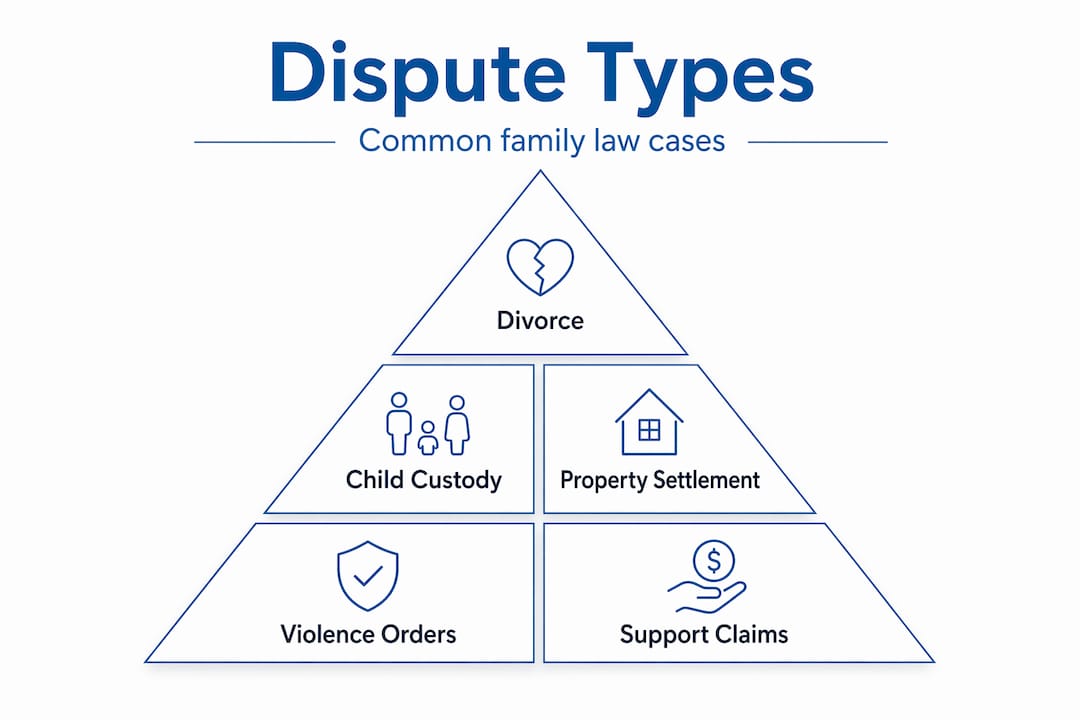
Domestic violence protection orders are a distinct but closely related area. A person experiencing family violence can apply for an Apprehended Domestic Violence Order (ADVO) in NSW. This is a civil order, not a criminal charge, though breaching one is a criminal offence. Guardianship matters, while less common, are also part of the family law picture. It is worth noting that guardianship differs from custody in that it involves court supervision without necessarily severing parental rights.
How to resolve family law disputes in Australia
The family dispute resolution process in Australia is deliberately structured to encourage resolution outside of court wherever possible. Understanding your options helps you choose the right path for your circumstances.
Family dispute resolution (FDR) and mediation. This is the starting point for most parenting disputes. A trained mediator facilitates negotiation between parties in a structured, neutral setting. Before applying to the court for parenting orders, most parties are required to attend FDR and obtain a section 60I certificate. Mediation is generally faster and less costly than litigation, and it allows the parties to shape their own outcome.
Collaborative law. Both parties and their lawyers sign an agreement to resolve the dispute without going to court. Everyone commits to open disclosure and problem-solving. This works well when both parties are willing to cooperate but still want legal representation at the table.
Negotiation. Solicitors negotiate directly on behalf of their clients to reach an agreed settlement. This is common in property disputes and can result in consent orders, which are then filed with the court to make the agreement legally binding.
Arbitration. A qualified arbitrator hears both sides and makes a binding decision. Less commonly used in Australian family law than in commercial disputes, but available for some property matters.
Court litigation. This is the last resort when all other methods have failed or where safety is a concern. Dispute resolution processes range from mediation through to full hearings, with the choice depending on the nature of the dispute and the parties’ willingness to engage. Court decisions can take months or years, and costs accumulate quickly.
Procedural requirements matter more than most people realise. Missing a mandatory disclosure step or misunderstanding a waiting period requirement can cause significant delays in finalising your matter. This is one reason why getting legal advice early pays off.
Pro Tip: If you are unsure which resolution method suits your situation, consider the level of conflict involved, whether safety is a concern, and how willing both parties are to communicate. A family law solicitor can assess your circumstances and recommend the most practical starting point.
For those looking to avoid court entirely, the team at GKE Lawyers has published a detailed resource on resolving disputes without litigation that covers NSW-specific options worth reading before you commit to any path.
Practical steps for managing family law disputes
Knowing how to resolve family disputes in theory is one thing. Applying that knowledge under emotional pressure is another. Here is what actually helps when you are in the middle of it.
Communicate with care. Research from Harvard’s Program on Negotiation confirms that collaborative language and accepting shared responsibility produces better outcomes than adversarial framing. You do not have to be friendly with your former partner. You do need to communicate in a way that does not create more conflict for the court or your children to absorb.
- Take structured time-outs when conversations escalate. Common harmful behaviours like criticism and defensiveness actively jeopardise resolution. Stepping away and returning to an issue later is a practical strategy, not avoidance.
- Keep detailed records of all significant communications, particularly in parenting disputes. Written records of missed visits, agreed arrangements, and financial transactions can become critical evidence. Resources like guides on documenting co-parent conflict explain what to save and how to organise it effectively.
- Do not delay seeking legal advice for family disputes. Many people wait too long, hoping things will resolve on their own. Early advice helps you understand your rights, avoid costly mistakes, and approach negotiations from a position of clarity.
- Prioritise long-term outcomes over short-term wins. Effective dispute resolution shifts focus from winning arguments to sustaining functional family relationships, especially where children are involved.
Pro Tip: If children are part of your dispute, consider a parallel parenting arrangement for high-conflict situations. This reduces direct contact between parents while maintaining each parent’s relationship with the child. You can find detailed guidance on parallel parenting strategies if this applies to your circumstances.
Understanding what legal advice for family disputes actually involves is also worth clarifying. A solicitor does not just represent you in court. They advise on your legal position, draft and review agreements, negotiate on your behalf, and help you comply with procedural obligations at every stage.
My perspective on family law disputes
In my experience working with clients through family law matters, the biggest mistake I see is people entering a dispute with a mindset of winning rather than resolving. That distinction sounds subtle but it changes everything. When someone focuses on winning, they make decisions that are good for the argument and damaging for the outcome, especially where children are involved.
I have seen contested property disputes drag on for two or more years because neither party was willing to accept a reasonable offer early. The legal costs in those cases frequently exceeded the value of what was actually in contention. That is not a failure of the legal system. It is a failure to step back and ask what a realistic outcome actually looks like.
What I have found genuinely works is when clients come in with a clear picture of their non-negotiables and a willingness to give ground on everything else. That combination, paired with solid legal advice, produces settlements faster and with far less damage to the family relationships that will continue after the legal matter is closed.
The families who navigate this best are not always the ones with the least conflict. They are the ones who prioritise long-term family needs over short-term grievances. That is not easy. But it is the clearest predictor of a sustainable outcome I have observed.
— Gaurav
How GKE Lawyers can help you
If you are dealing with a family law dispute in Sydney or anywhere in New South Wales, having the right legal support from the outset changes the experience significantly.

GKE Lawyers is a full-service Sydney law firm with dedicated experience in family law matters including divorce, child custody and parenting arrangements, spousal maintenance, property settlements, and domestic violence protection orders. We work with clients to assess their situation clearly, explain their options honestly, and represent their interests at every stage of the process, whether that is in mediation, negotiation, or court.
You can learn more about our family law services in Sydney or explore our detailed resource on NSW family law rights to understand how the law applies to your specific situation. Book a consultation with our team to get clear, personalised legal advice for your family dispute.
FAQ
What is a family law dispute in Australia?
A family law dispute is a legal conflict between family members arising from relationship breakdown, covering matters such as divorce, child custody, property division, financial support, and domestic violence protection under the Family Law Act 1975 (Cth).
What are the most common types of family law disputes?
The most common types include divorce and separation, child custody and parenting arrangements, property settlement, child support, spousal maintenance, and applications for domestic violence protection orders.
Do I have to go to court to resolve a family law dispute?
No. Most family law disputes in Australia are resolved through mediation, negotiation, or collaborative law before reaching court. Attendance at family dispute resolution is mandatory before applying for parenting orders in most circumstances.
How long does a family law dispute take to resolve?
Timelines vary significantly. Uncontested matters can resolve within months, while contested disputes involving court hearings can take one to three years or longer, depending on complexity and the parties’ willingness to negotiate.
When should I seek legal advice for a family dispute?
You should seek legal advice as early as possible, ideally before negotiations begin. Early advice helps you understand your rights, comply with procedural requirements, and avoid decisions that could weaken your position later in the process.