

Property law in New South Wales governs how land and buildings are owned, transferred, used, and protected under state legislation. If you are buying or selling a home, dealing with a boundary dispute, or simply trying to understand your legal rights as a property owner, knowing what is property law NSW means knowing the rules that apply to every transaction you make. Many people assume property ownership is straightforward once you hold the keys. In practice, NSW property law involves a specific body of legislation, registration requirements, and rights that can significantly affect your financial and legal position.
Table of Contents
- Key takeaways
- Property law NSW: what it means and why it matters
- How property ownership and transactions work in NSW
- Common legal issues and property disputes in NSW
- Recent legislative changes affecting property rights
- My perspective: what I have actually seen in practice
- How GKE Lawyers can help with property law in NSW
- FAQ
Key takeaways
| Point | Details |
|---|---|
| Property law covers more than ownership | NSW property law also governs transfers, disputes, easements, leases, and compulsory acquisition. |
| Torrens title is the foundation | Land registration under the Torrens system guarantees title and protects buyers against unregistered interests. |
| Conveyancing is legally significant | Contract exchange creates equitable interest, making professional legal review before signing critical. |
| Strict time limits apply in disputes | Married parties have 12 months post-divorce to commence property proceedings; de facto couples have two years. |
| Legislation is actively changing | Recent bills affecting easements and proposed human rights protections are reshaping property rights in NSW. |
Property law NSW: what it means and why it matters
Property law in NSW is the body of legal rules that defines who can own land, how ownership is recorded, what rights attach to that ownership, and what happens when those rights are disputed or transferred. It draws on both statute law and common law principles, applying specifically within the state of NSW.
The first distinction worth understanding is the difference between real property and personal property. Real property refers to land and anything permanently attached to it, including buildings and fixtures. Personal property covers moveable assets such as vehicles, furniture, and equipment. When people refer to property law in the real estate context, they almost always mean real property.
Within real property, there is a further legal distinction between legal ownership and equitable interest. Legal ownership means your name is registered on the title. Equitable interest is a beneficial interest that arises before registration, for example, when you exchange contracts on a purchase. This distinction matters because it determines your rights if something goes wrong between contract exchange and settlement.
The key legislative framework includes:
- Real Property Act 1900 (NSW): The foundational land registration legislation that establishes the title system and facilitates the transfer of land in NSW.
- Conveyancing Act 1919 (NSW): Governs contracts for the sale of land, easements, and covenants.
- Land Acquisition (Just Terms Compensation) Act 1991 (NSW): Covers the process and compensation obligations when public authorities compulsorily acquire private land.
- Environmental Planning and Assessment Act 1979 (NSW): Regulates land use, zoning, and development approvals.
- Residential Tenancies Act 2010 (NSW): Sets out the rights and responsibilities of landlords and tenants.
Understanding which legislation applies to your situation is often the first task your legal adviser will undertake. Each Act creates distinct rights and obligations, and they frequently interact with one another.
How property ownership and transactions work in NSW
The Torrens title system
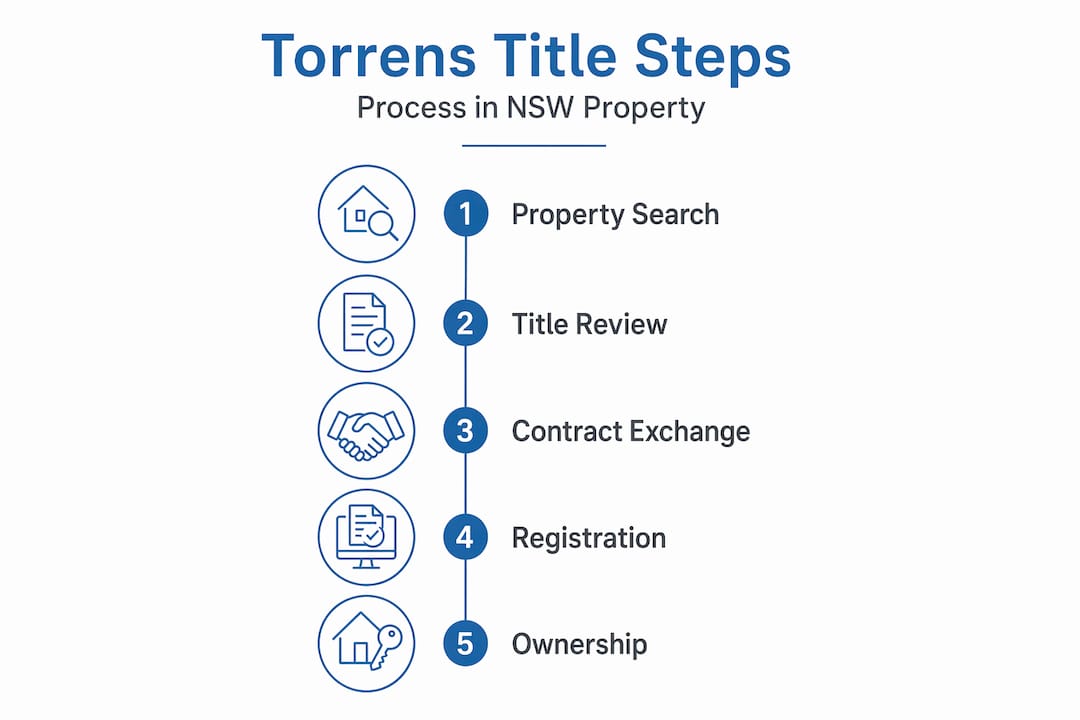
NSW operates under the Torrens title system, which means land registration guarantees ownership and protects registered proprietors against most unregistered interests. The title register, maintained by NSW Land Registry Services, is the definitive record of who owns a parcel of land. If your interest is not registered, it is vulnerable. This is a critical reason why prompt registration after settlement is not optional.

The property transaction process
Buying or selling property in NSW follows a defined legal process. Here is how it typically unfolds:
- Pre-contract checks: The vendor’s solicitor or conveyancer prepares the contract for sale, attaching title documents, zoning certificates, drainage diagrams, and Section 10.7 planning certificates. Your lawyer reviews these before you sign anything.
- Exchange of contracts: Once both parties sign and exchange contracts, a binding agreement is formed. At this point, the purchaser acquires an equitable interest in the property. The standard cooling-off period in NSW is five business days, during which the buyer may rescind and forfeit 0.25% of the purchase price.
- Pre-settlement period: Both parties satisfy conditions, arrange finance, and conduct final inspections. Stamp duty (now called transfer duty in NSW) must be assessed and paid.
- Settlement: Funds are transferred and title documents are lodged electronically via PEXA or a similar platform. Ownership passes to the purchaser upon registration.
- Post-settlement registration: The NSW Land Registry Services records the new owner, completing the Torrens title process.
Compulsory acquisition in NSW is governed by the Land Acquisition (Just Terms Compensation) Act 1991, which requires that landowners receive fair compensation when a public authority acquires their property. If acquisition occurs after you have exchanged contracts but before settlement, your equitable interest makes you entitled to participate in the compensation process. This is not widely known, and it is one reason why the timing of contract exchange carries more legal weight than most buyers realise.
The difference between freehold and leasehold title is also worth noting. Freehold ownership means you own the land outright and indefinitely. Leasehold means you hold a right to use the land for a defined term, typically under a Crown lease. Most residential properties in NSW are freehold, but leasehold arrangements exist particularly in certain strata and retirement village contexts.
Pro Tip: Always commission an independent title search before exchanging contracts. Even under the Torrens system, caveats, mortgages, and easements registered against the title can significantly affect your intended use of the property.
Common legal issues and property disputes in NSW
Property ownership does not always proceed without conflict. Knowing the types of disputes that arise and how to respond is part of understanding property rights in NSW.
Boundary and easement disputes
Boundary disputes arise when neighbours disagree about where one parcel of land ends and another begins. Easements are rights that allow one party to use another’s land for a specific purpose, such as a right of way or drainage. These disputes can be costly and time-consuming, particularly when survey evidence is ambiguous or historical agreements were never registered.
Recent legislation has added a new dimension to easement law. The Water Management Amendment Bill allows the flooding of private land for environmental water flows under the Murray-Darling Basin Plan, effectively granting government-created easements that restrict how landholders use their own property. This has sparked significant legal and political debate about the limits of state power over private land.
Lease and tenancy issues
Disputes between landlords and tenants are among the most common property-related legal matters in NSW. Issues include unpaid rent, bond disputes, unlawful entry, and end-of-lease disputes over repairs or cleaning. The NSW Civil and Administrative Tribunal (NCAT) handles most residential tenancy disputes, with a relatively accessible process for parties who have documented their communications clearly.
Family law property settlements
When a relationship breaks down, property held by either or both parties must be divided. This is governed by federal family law legislation, but it has direct implications for property rights in NSW. Key facts to know:
- Married parties have 12 months after the date of divorce to commence property or spousal maintenance proceedings. De facto couples have two years from the date of separation.
- Failing to act within these time limits requires court special leave, which is not guaranteed.
- Superannuation is treated as property for family law purposes and can be split by agreement or court order, but the trustee must be formally notified before any consent orders are made.
Understanding how to protect your rights in property settlement matters enormously when relationships end. Early legal advice prevents missed deadlines and protects the value of your interest.
| Dispute type | Governing body | Key consideration |
|---|---|---|
| Boundary or easement | NSW Supreme Court or District Court | Requires survey evidence and title review |
| Residential tenancy | NSW Civil and Administrative Tribunal | Documentary evidence of communications is critical |
| Family law property settlement | Federal Circuit and Family Court | Strict time limits apply from divorce or separation |
| Compulsory acquisition | NSW Land and Environment Court | Compensation entitlement depends on registered interest |
Pro Tip: Document every communication with neighbours, landlords, tenants, or co-owners in writing. A brief email confirming a verbal agreement can be the difference between a resolved dispute and expensive litigation.
Recent legislative changes affecting property rights
NSW property law is not static. Two significant legislative developments in 2026 are reshaping how property rights are understood and exercised in this state.
The Water Management Amendment (Easements for Inundation) Bill has been described as an unprecedented incursion into private property rights. The bill enables government-created easements that allow environmental water to flow across private land as part of the Murray-Darling Basin Plan. Landholders may receive no immediate compensation, and the legal restrictions on land use can be substantial. Property owners in affected regions need to seek specific legal advice about how registered or unregistered easements under this legislation may affect their title.
On a broader front, the proposed NSW Human Rights Act would, if enacted, include the right to own property and expressly prohibit arbitrary deprivation of property. Similar charters in Victoria and the ACT have already been used by courts to prevent unfair evictions and secure housing rights for vulnerable residents. Enshrining these protections in NSW could provide a new legal avenue for property owners and tenants to challenge government action affecting their property.
“Property rights in NSW are not absolute. They have always been shaped by legislation and public policy, and recent bills show that environmental and social obligations can and do place limits on how you use your own land.”
These developments are a reminder that understanding property law in NSW is not a one-time exercise. Legislation changes, and those changes affect what you can and cannot do with property you legally own.
My perspective: what I have actually seen in practice
I have worked across property law matters for many years, and the single most consistent pattern I see is this: people wait too long before seeking legal advice. They assume that holding the title means their position is secure. They discover after the fact that an easement registered years ago restricts their planned renovation, or that a contract clause they did not fully read prevents them from withdrawing without penalty.
The second misconception I encounter regularly is the belief that property rights in NSW are absolute. They are not. Property rights can be limited by zoning, environmental obligations, easements, and government acquisition powers. The recent easements for inundation debate makes this more visible than ever, but it has always been true.
What genuinely protects people is thorough documentation and early professional advice. A contract reviewed before signing costs a fraction of the cost of remedying a problem discovered after exchange. A family law property settlement handled within the time limit is far less expensive and stressful than applying for special leave out of time.
My advice is simple: read your title documents, understand what encumbrances are registered against your land, and speak to a solicitor before you sign anything significant. NSW property law rewards people who are informed and prepared, and it has little patience for those who assume they will sort it out later.
— Gaurav
How GKE Lawyers can help with property law in NSW

At GKE Lawyers, we work with individuals and families across Sydney and NSW on the full range of property law matters. Whether you are buying your first home, dealing with a boundary dispute, or working through a property settlement after separation, our team provides clear, practical legal advice at every step.
Our property law and conveyancing services cover contract review, title searches, settlement coordination, and post-settlement registration. For clients facing property disputes, our litigation team is experienced in resolving conflicts efficiently, whether through negotiation, tribunal, or court proceedings. If you need a property dispute resolved in Sydney, we are ready to help.
Contact GKE Lawyers to book a consultation and get advice tailored to your specific circumstances.
FAQ
What does property law cover in NSW?
Property law in NSW covers the ownership, transfer, use, and protection of real and personal property. It includes legislation governing title registration, conveyancing, easements, leases, compulsory acquisition, and property dispute resolution.
What is the Torrens title system in NSW?
The Torrens title system is the land registration framework that operates under the Real Property Act 1900 (NSW). Registration guarantees ownership and protects registered proprietors against most unregistered interests.
How long do I have to make a property claim after separation in NSW?
Married parties have 12 months from the date of divorce to commence property proceedings. De facto couples have two years from the date of separation. Missing these deadlines requires court special leave, which is not guaranteed.
What is conveyancing in NSW?
Conveyancing is the legal process of transferring property ownership from one party to another. It includes contract preparation and review, title searches, settlement coordination, and registration of the new owner with NSW Land Registry Services.
Can the government restrict what I do with my property in NSW?
Yes. Property rights in NSW can be limited by zoning laws, environmental legislation, easements, and compulsory acquisition powers. Recent legislative developments, including the Water Management Amendment Bill, demonstrate that these restrictions can extend to how and when your land may be used.