

If you are facing separation or divorce, understanding what is a property settlement may be one of the most financially significant things you do. Many people assume the law simply divides everything down the middle. It does not. In New South Wales, the division of assets between separating couples follows a structured legal process governed by federal legislation, and the outcome depends heavily on individual circumstances. This article explains how property settlement works in NSW, what the courts consider, and what you can do to protect your position.
Table of Contents
- Key takeaways
- Property settlement under NSW family law
- The four-step process courts use
- Factors affecting settlement and negotiation tips
- Timing your property settlement application
- My perspective on property settlements in NSW
- How GKE Lawyers can help with your settlement
- FAQ
Key takeaways
| Point | Details |
|---|---|
| No automatic 50/50 split | Courts assess contributions and circumstances to reach a just and equitable outcome, not an equal one. |
| Strict time limits apply | Married couples have 12 months from divorce; de facto couples have 2 years from separation to apply. |
| Superannuation counts as property | Super can be split via a formal splitting order and must be included in the asset pool. |
| Formalise any agreement | Consent orders or a Binding Financial Agreement are required to make negotiated outcomes legally enforceable. |
| Early advice protects you | Starting negotiations soon after separation often produces better outcomes and avoids costly court proceedings. |
Property settlement under NSW family law
A property settlement is the legal process by which separating or divorced couples divide their assets, liabilities, and financial resources. In NSW, this process is not governed by state law. It falls under the Family Law Act 1975, a federal statute. Section 79 applies to married couples, while section 90SM covers de facto couples, including same-sex partners who separated after 1 March 2009.
The term “financial settlement” is sometimes used interchangeably, but property settlement refers specifically to the division of the asset pool. A financial settlement can also include spousal maintenance arrangements, which are separate.
What goes into the asset pool? The court considers:
- Real property, including the family home, investment properties, and land
- Bank accounts, shares, and managed funds
- Business interests and partnership stakes
- Vehicles, furniture, and personal belongings
- Superannuation entitlements, treated as property subject to formal splitting orders
- All debts and liabilities, including mortgages, credit cards, and personal loans
- Any rights or interests that have a realisable financial value
One detail that surprises many clients: companion animals have been treated as property in Australian family law proceedings, meaning courts can determine who keeps a pet as part of the settlement process.
For a broader overview of your rights under NSW family law rights and processes, it helps to understand this framework before you begin negotiations.
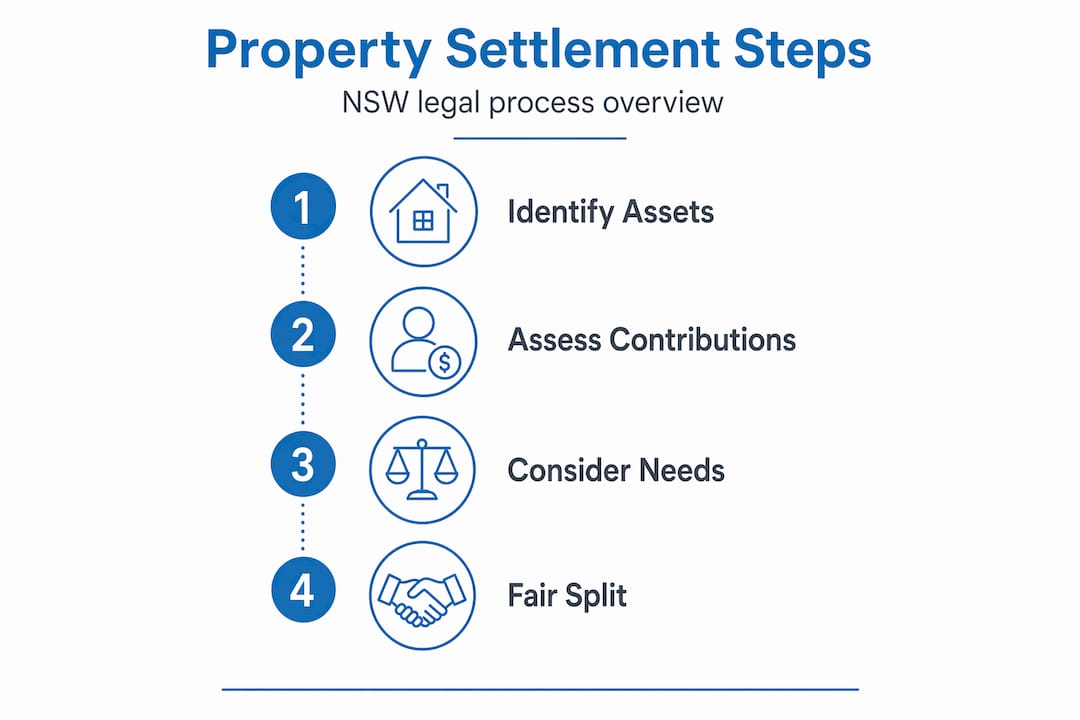
The four-step process courts use
When the parties cannot agree and the matter proceeds to court, the judge applies a structured four-step process to determine the outcome. Understanding this methodology helps you understand what evidence matters and what the court is actually weighing.
Identify and value all property and liabilities. The court establishes the total asset pool, including everything each party owns individually or jointly, and all debts. Accurate valuations are critical. Property may require a formal appraisal, businesses may need an accountant’s report, and superannuation requires specific orders through the fund trustee.
Assess contributions. The court weighs financial and non-financial contributions made by each party throughout the relationship. Financial contributions include wages, inheritances, and gifts brought into the relationship. Non-financial contributions include homemaking, parenting, renovating a property, and supporting a partner’s career or business. Courts do not treat a dollar of income as more valuable than years of unpaid domestic labour. Both carry genuine weight.
Consider future needs and circumstances. Age, health, earning capacity, the care of children, and the duration of the relationship all factor in here. A parent who takes primary care of young children post-separation may receive an adjustment in their favour, reflecting the real economic impact of that responsibility.
Determine whether the outcome is just and equitable. Even after steps one through three, the court steps back and asks whether the proposed division is fair in the circumstances. This is not a rubber stamp. An outcome that looks mathematically justified may still be rejected if it produces a result the court considers unreasonable.
Pro Tip: Document your contributions throughout the relationship with specificity. Bank statements, school pick-up records, receipts for home renovations, and tax returns are far more persuasive than general statements about what you did. Precise, itemised evidence strengthens your position at every stage.
Factors affecting settlement and negotiation tips
Understanding the factors affecting property settlement is where theory meets reality. Courts exercise considerable discretion, and assessing contributions requires nuanced judgment, not a mechanical calculation. Several practical realities shape outcomes.
Contributions: what counts and why it matters
| Type of contribution | Examples |
|---|---|
| Financial contributions | Income, savings, inheritance, pre-relationship assets |
| Non-financial contributions | Home renovations, unpaid business support, maintaining the property |
| Homemaker and parenting contributions | Primary care of children, managing the household, supporting a partner’s study |
| Post-separation contributions | Paying the mortgage or managing assets after separation |
Post-separation financial conduct, such as one party continuing to pay the mortgage or manage a business, can justify settlement adjustments but is assessed carefully. Courts do not automatically reward one party for post-separation payments without considering the full context.

Family violence and care responsibilities
Recent amendments to the Family Law Act make it explicit that family violence is a relevant factor when assessing the economic consequences of a relationship. If one party’s financial position was affected by violence, coercion, or controlling behaviour, the court can take that into account when determining a fair division.
How to formalise a settlement
Most separating couples do not go to court. They negotiate and formalise agreements through one of the following methods:
- Consent orders: Filed with the Family Court, these give a negotiated agreement the same legal force as a court order.
- Binding Financial Agreement (BFA): A private contract between the parties, signed with independent legal advice on both sides. More flexible, but requires strict compliance with formalities.
- Mediation: A structured negotiation with a neutral third party, often faster and cheaper than litigation. Family law negotiation conducted with proper legal support typically produces better outcomes with less stress than adversarial proceedings.
Pro Tip: Never rely on a verbal or informal arrangement. Without consent orders or a BFA, your agreement is not legally enforceable. One party can change their mind years later, and you will have limited recourse.
Timing your property settlement application
Time limits are not a technicality. Missing them has real consequences, and understanding the property division process means knowing exactly when the clock starts ticking.
- Married couples must apply within 12 months of the divorce order becoming final.
- De facto couples have 2 years from the date of separation to apply for a property settlement.
- If you miss these deadlines, you must apply to the court for leave to proceed out of time. This is not automatic, and the court must be satisfied there are compelling reasons to grant it.
The process generally follows this sequence when parties cannot agree privately:
- Attempt direct negotiation, ideally with legal advice from the outset
- Attend mediation or a dispute resolution process
- If unresolved, file an application in the Federal Circuit and Family Court of Australia
- Attend conciliation and directions hearings
- Proceed to trial if no agreement is reached
One of the most consequential decisions you can make is when you start. Beginning negotiations early after separation often leads to better outcomes because assets are easier to identify, memories are clearer, and both parties may be more willing to compromise before legal costs escalate.
You can read more about protecting your rights in NSW property settlement proceedings, including practical steps to take in those early weeks after separation.
My perspective on property settlements in NSW
I have worked with clients at every stage of the property settlement process, from those who come in well-organised and ready to negotiate, to those who arrive years after separation, facing a deadline they did not know existed.
The most common misconception I see is that people treat property settlement as something they can sort out later, once everything settles down emotionally. That delay almost always costs them. Assets are sold, values change, evidence disappears, and the other party becomes entrenched in a position that was preventable.
The second thing I have learned is that the four-step process sounds orderly on paper, but in practice the real work is in the contributions assessment. I have seen outcomes shift dramatically based on how well a client could document non-financial contributions. A parent who spent a decade managing a household and raising children deserves proper recognition for that. But vague statements do not achieve it. A timeline, school records, and financial records that show who was earning what and when, that is what moves the dial.
Codifying the four-step approach into legislation has improved accessibility for people representing themselves, which I think is genuinely positive. But it has not removed complexity. If anything, explicit factors like family violence and economic consequences of coercive control require more careful legal analysis, not less.
My consistent advice: get legal advice as soon as separation occurs, not when the situation feels urgent. The earlier you understand what is possible and what evidence you need to gather, the better your position will be.
— Gaurav
How GKE Lawyers can help with your settlement
Facing a property settlement is stressful enough without also having to navigate the legal process alone. GKE Lawyers is a full-service Sydney law firm with deep expertise across NSW property law and family law, and we act for clients at every stage of the settlement process, from early negotiation through to court proceedings.

Whether you need help identifying your asset pool, preparing for mediation, drafting consent orders, or pursuing a court application, our team provides clear, practical advice tailored to your situation. If a dispute has become entrenched, our property dispute resolution team works to resolve matters efficiently and protect your interests. We also assist with the full range of associated matters, including superannuation splitting orders, BFAs, and conveyancing where property is being transferred as part of a settlement.
Contact GKE Lawyers today to book a consultation and get clear advice on your position before time limits become a problem.
FAQ
What is a property settlement in NSW?
A property settlement is the legal process of dividing assets, liabilities, and superannuation between separating or divorced couples. In NSW, it is governed by the Family Law Act 1975 and does not involve an automatic 50/50 split.
How long do I have to apply for a property settlement?
Married couples have 12 months from the date their divorce order becomes final, and de facto couples have 2 years from the date of separation. Applying outside these limits requires court leave.
Does a de facto relationship qualify for property settlement in NSW?
Yes. De facto couples, including same-sex couples who separated after 1 March 2009, are entitled to apply for property settlement under section 90SM of the Family Law Act 1975.
Is superannuation included in a property settlement?
Superannuation is treated as property in Australian family law. It can be split between parties through a formal superannuation splitting order, which is directed to the fund trustee separately from other asset divisions.
Do I need to go to court for a property settlement?
Not necessarily. Many settlements are resolved through negotiation and formalised as consent orders or a Binding Financial Agreement. Court proceedings become necessary only when parties cannot reach an agreement through negotiation or mediation.