

If you have been injured in an accident that was not your fault, you may have heard that filing a claim is simple. The reality in New South Wales is more complicated. Understanding what a personal injury claim is, and how NSW-specific rules affect your eligibility and entitlements, can mean the difference between receiving fair compensation and walking away with nothing. This guide covers what qualifies for a claim, how the process works, what compensation looks like, and the critical deadlines you cannot afford to miss.
Table of Contents
- Key takeaways
- What is a personal injury claim in NSW?
- Who qualifies to file a personal injury claim?
- How to file a personal injury claim in NSW
- Types of compensation available in NSW
- Time limits, challenges, and common pitfalls
- My perspective on personal injury claims in NSW
- How GKE Lawyers can help with your claim
- FAQ
Key takeaways
| Point | Details |
|---|---|
| Definition matters in NSW | A personal injury claim is a legal right to seek compensation when another party’s negligence causes your injury. |
| Eligibility depends on fault and evidence | You must prove the injury resulted from someone else’s negligence, supported by medical records and incident documentation. |
| Time limits are strict | Most personal injury claims in NSW must be lodged within three years of the injury date. |
| Compensation types vary | You may access statutory benefits, common law damages, or scheme-based recognition payments depending on your situation. |
| Early legal advice is critical | Getting legal guidance promptly protects your rights and strengthens your claim before deadlines pass. |
What is a personal injury claim in NSW?
A personal injury claim is a formal legal process through which an injured person seeks financial compensation from the party whose negligence caused their harm. In NSW, liability and causation are both essential elements. You need to show that someone owed you a duty of care, that they breached it, and that the breach directly caused your injury.
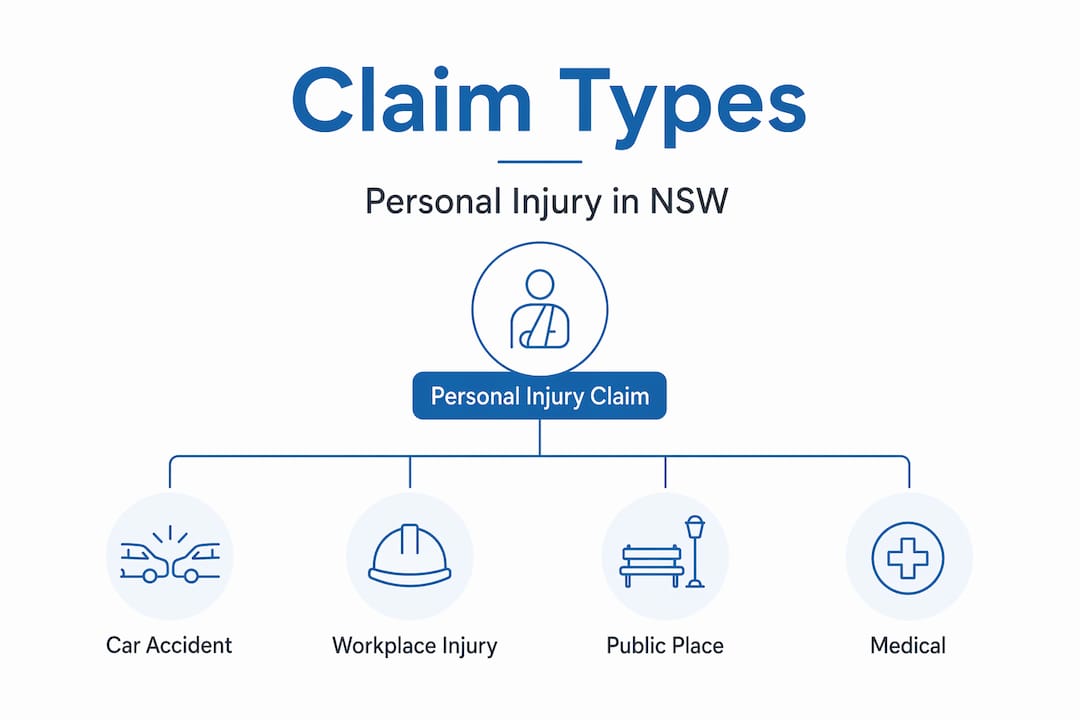
Understanding personal injury claims in NSW means recognising that the state operates under several distinct legal schemes. The scheme that applies to your situation depends heavily on where and how you were injured.
Common types of personal injury claims in NSW include:
- Motor vehicle accidents covered under the Compulsory Third Party (CTP) insurance scheme
- Workplace injuries handled through the workers compensation system administered by icare
- Public liability claims where injury occurs on someone else’s property or in a public space
- Medical negligence claims arising from substandard professional health care
- Victims of crime claims processed through the NSW Victims Support Scheme
Each category carries its own rules, timeframes, and compensation structures. A workplace injury claim operates very differently from a CTP motor accident claim, even if both involve serious physical harm. NSW personal injury entitlements vary depending on when the accident occurred and which scheme applies, which is why understanding the correct category matters before you take any formal step.
Who qualifies to file a personal injury claim?
Not every injury automatically gives rise to a legal claim. To qualify, your injury must meet specific criteria tied to fault, evidence, and timing.
- Another party was at fault. You must demonstrate that your injury resulted from the negligence or wrongful act of another person, business, or organisation. A fall caused by your own inattention on a clearly marked surface, for example, is unlikely to meet this threshold.
- You have documented the injury and its cause. Medical records, incident reports, witness statements, and photographs all serve as evidence. Early and thorough medical documentation significantly affects both eligibility and the value of any common law damages claim.
- You lodge the claim within the time limit. The standard limitation period for personal injury claims in NSW is three years from the date of injury. Missing this deadline generally forfeits your right to claim, though narrow exceptions exist for minors or cases where the injury was not immediately apparent.
- Your injury meets any applicable threshold. For CTP claims, accessing non-economic loss compensation requires meeting a defined injury severity threshold. Not all injuries qualify for the full range of compensation available.
- You are lodging with the correct body or insurer. CTP claims go to the at-fault driver’s insurer or the Nominal Defendant. Workplace claims go through icare. Public liability claims are typically directed at the responsible party’s insurer.
Eligibility also differs across schemes. Rights and entitlements vary depending on when your accident happened and which legislative framework governs it. A 2015 motor accident claim operates under different rules than a 2022 one because NSW updated its CTP legislation in 2017.
Pro Tip: See a doctor immediately after any accident, even if your symptoms feel minor. Delayed medical treatment is frequently used by insurers to argue that your injuries are not as serious as claimed, or that they were caused by something other than the accident.
How to file a personal injury claim in NSW
The personal injury claim process in NSW follows a broadly consistent path, regardless of which scheme applies. Here is a step-by-step overview.
- Seek immediate medical attention. Your health is the priority. Medical records created close to the date of injury also form the foundation of your claim. Do not wait to see a doctor.
- Preserve evidence. Photograph the scene, collect witness contact details, and keep records of every expense related to your injury, including transport to medical appointments, medications, and lost wages.
- Report the incident. Notify the relevant authority. For motor accidents, report to the police and your insurer within 28 days. For workplace injuries, notify your employer in writing as soon as possible. For public liability incidents, report to the property owner or business.
- Identify the correct insurer or claims body. For motor vehicle accidents, contact the at-fault driver’s CTP insurer. Motor accident CTP claims in NSW must be lodged within three years, with statutory benefits claims ideally made within 28 days of the accident to avoid complications.
- Lodge your claim formally. Complete the relevant claim form and submit it with supporting documentation. For CTP claims, this is done through the State Insurance Regulatory Authority (SIRA) portal or directly with the insurer.
- Engage with the assessment process. Insurers assess the claim, may request independent medical examinations, and will determine your entitlements to statutory benefits.
- Negotiate settlement or proceed to common law. If your injury is serious and you meet the relevant threshold, you may pursue common law damages through negotiation or, if necessary, court proceedings. Filing a personal injury lawsuit is generally a last resort when settlement discussions cannot resolve the matter fairly.
- Obtain legal advice early. A solicitor experienced in NSW personal injury law can identify which scheme applies, protect you from insurer tactics, and manage deadlines on your behalf.
Pro Tip: Do not provide a recorded statement to an insurer before speaking with a solicitor. Adjusters are trained to ask questions in ways that can undermine your claim. A brief, factual written account provided with legal guidance is far safer.
Types of compensation available in NSW
The compensation you can access depends on the nature of your claim and which scheme applies. The table below outlines the main categories.
| Compensation type | What it covers | Typical availability |
|---|---|---|
| Statutory personal injury benefits | Weekly income support and medical expenses | CTP and workers compensation claimants |
| Common law damages (lump sum) | Pain and suffering, non-economic loss | Claimants meeting injury thresholds in CTP or public liability |
| Economic loss damages | Lost earnings, reduced future earning capacity, rehabilitation | Serious injury claimants across multiple schemes |
| Recognition payments | Acknowledgment payment for crime victims | NSW Victims Support Scheme recipients |
| Out-of-pocket expenses | Medical costs, pharmaceuticals, travel for treatment | Most personal injury schemes |
CTP claims include statutory benefits such as weekly payments and medical coverage, alongside potential common law damages for eligible claimants. The Victims Support Scheme provides recognition payments and financial assistance to victims of crime-related injuries, with payment amounts tied to the severity of the offence.
Several factors influence how much a claim is ultimately worth: the severity and permanency of the injury, the degree of the other party’s fault, your pre-injury income, the strength of your medical evidence, and whether your injury meets any applicable threshold test.

Time limits, challenges, and common pitfalls
Time limits in NSW personal injury law are firm, and missing them is one of the most common reasons valid claims fail. Key deadlines to know:
- CTP motor accident claims must be lodged within three years of the accident date
- For common law damages in CTP claims, the three-year window applies to initiating proceedings, not just lodging the initial benefits claim
- Workers compensation claims should be notified to the employer as soon as practicable, with formal claims lodged within six months in most circumstances
- Victims Support Scheme applications have separate deadlines depending on the type of support sought
Beyond deadlines, missing documentation or inadequate evidence are the most frequent causes of reduced or failed claims. Other common challenges include:
- Difficulty proving causation when injuries develop over time or were pre-existing
- Disputes with insurers over the severity or permanency of an injury
- Insurers requesting independent medical examinations that produce conflicting assessments
- Gaps in treatment history that create doubt about ongoing symptoms
- Failure to report the accident to the correct authority within the required timeframe
Being proactive from day one addresses most of these risks. The claimants who fare best are those who document thoroughly, engage a solicitor early, and treat every deadline as non-negotiable.
My perspective on personal injury claims in NSW
I have worked with many clients who arrive at a consultation months after an accident, believing their situation is straightforward and well-documented. What I find, more often than not, is that they have gaps in their medical records, they have spoken to an insurer without advice, and they are unclear about which scheme applies to them.
The most common misconception I see is that personal injury claims reward patience. People wait to see how their injuries develop before taking action, which is understandable. But in NSW, waiting has legal consequences. Lump sum damages are subject to injury thresholds and strict timeframes, so the decision to delay often costs claimants far more than they realise.
What I tell every client is this: seek legal advice before you speak with any insurer, and treat your medical appointments as legal documents in progress. The outcome of your claim is often shaped in the first few weeks after an injury, not at the negotiating table months later. Get the foundations right.
— Gaurav
How GKE Lawyers can help with your claim
If you are considering a personal injury claim in NSW, the team at GKE Lawyers is ready to guide you through every stage of the process with clear, practical advice.

Our personal injury lawyers in Sydney have deep experience across CTP, public liability, and common law claims throughout NSW. We help clients understand which scheme applies to them, gather the right evidence, meet critical deadlines, and negotiate with insurers from a position of knowledge. For those involved in road accidents, our motor vehicle claim specialists provide dedicated support from the initial claim lodgement through to resolution. Contact GKE Lawyers today for a consultation and protect your right to fair compensation before time runs out.
FAQ
What is a personal injury claim in NSW?
A personal injury claim in NSW is a legal process where an injured person seeks compensation from the party whose negligence caused the harm. It covers physical and psychological injuries arising from motor accidents, workplace incidents, public liability situations, and crime-related harm.
What qualifies for a personal injury claim in NSW?
To qualify, you must have suffered an injury caused by another party’s negligence or fault, supported by medical evidence and incident documentation. The claim must also be lodged within the applicable limitation period, typically three years from the date of injury.
How long does a personal injury claim take in NSW?
Timelines vary widely depending on injury severity, which scheme applies, and whether the matter settles or proceeds to court. Straightforward statutory benefits claims may resolve within months, while complex common law damages claims can take one to three years or more.
How much is a personal injury claim worth in NSW?
Compensation depends on injury severity, the claimant’s pre-injury income, medical costs, and whether the injury meets any applicable threshold for non-economic loss. Amounts range from modest statutory benefit payments to significant lump sum damages for serious injuries.
Do I need a lawyer to file a personal injury claim?
You are not legally required to use a solicitor, but given the complexity of NSW schemes, strict deadlines, and insurer negotiations, legal representation materially improves most claimants’ outcomes. A solicitor helps identify the correct scheme, build evidence, and avoid procedural errors that can reduce or void a claim.