

Separating from a spouse is one of the most stressful events a person can face. Yet when it comes to the legal side, many people in Sydney are unsure where to even begin. Understanding what is a divorce application, how it differs from separation, and what the process actually requires can make an enormous difference. This article walks you through the divorce application process in NSW, covering eligibility, paperwork requirements, the steps to apply for divorce, and what to expect after you file. Whether you are considering a sole or joint application, this guide gives you a clear picture from start to finish.
Table of Contents
- Key takeaways
- What is a divorce application and who can apply?
- The divorce application process, step by step
- What to include in your divorce application paperwork
- Sole vs joint applications: which suits your situation?
- What happens after you file
- What most people miss about the divorce process
- How GKE Lawyers can support your application
- FAQ
Key takeaways
| Point | Details |
|---|---|
| Separation period required | You must be separated for at least 12 months before you can file a divorce application in Australia. |
| Online filing via portal | Applications are lodged through the Commonwealth Courts Portal, which manages documents and court dates. |
| Two application types | You can file as a sole applicant or jointly with your spouse, each carrying different procedural requirements. |
| Correct paperwork matters | The Divorce Civil Bill and supporting Statements of Truth are central documents that must be accurately completed. |
| Legal advice is worthwhile | A divorce application can affect property, parenting, and financial matters beyond simply ending the marriage. |
What is a divorce application and who can apply?
A divorce application is a formal legal request made to the Federal Circuit and Family Court of Australia to dissolve a marriage. In NSW, as across the rest of Australia, the sole legal ground for divorce is the irretrievable breakdown of marriage, which is demonstrated by living separately from your spouse for at least 12 months with no reasonable likelihood of reconciliation.
The application is not a negotiation about assets, children, or finances. Those matters are handled through separate family law proceedings. A divorce application deals only with the legal question of whether the marriage should end.
There are two types of applicants:
- Sole applicant. One spouse files the application without the other’s agreement. The other spouse becomes the respondent and receives a copy of the filed documents.
- Joint applicants. Both parties sign and file together, which generally makes the process less adversarial and may reduce complexity.
To be eligible, at least one party must be an Australian citizen, regard Australia as their permanent home, or be ordinarily resident in Australia and have lived here for at least 12 months before filing. Short-term visitors cannot access Australian divorce proceedings.
Pro Tip: If you and your spouse separated under the same roof, you will need to provide additional evidence of the separation, such as statutory declarations from a third party who can confirm your living arrangements changed.
You do not need your spouse’s consent to apply as a sole applicant. The court does not require you to prove fault, assign blame, or show that one party caused the breakdown. The 12-month separation period is the only threshold you must meet.
The divorce application process, step by step
Understanding the full sequence of the divorce application process removes much of the uncertainty people feel at the start. Here is how it works in NSW:
Confirm eligibility. Confirm you have been separated for at least 12 months and that you or your spouse meet the residency or citizenship requirements described above.
Create an account on the Commonwealth Courts Portal. Applications are filed online through this portal. You will need to create an account and complete the required forms digitally.
Complete the Divorce Civil Bill. This is the primary application document. It records the details of your marriage, your separation date, and any children of the marriage.
Prepare supporting documents. You will need your marriage certificate (and a translated copy if it is not in English), and where relevant, a statement regarding the care and welfare of children under 18.
Pay the filing fee. A court filing fee applies. Reduced fees are available if you hold a valid healthcare or concession card.
Receive a court date. The court will assign a hearing date after accepting your application. For joint applications, attendance is generally not required. For sole applications involving children under 18, at least one party must attend.
Serve documents on the respondent. Serving divorce documents on the other party is compulsory after the court accepts your application. This cannot be done by you personally. A third party must serve the documents and complete a proof of service.
The respondent replies. The respondent can consent, do nothing, or contest the application. Non-response does not automatically prevent the divorce, but a contested application may require additional directions from the court and extend timeframes.
Court hearing. A judge reviews the application and any responses. In straightforward cases, this is brief. The divorce order is issued to both parties following the hearing.
Final divorce order. The divorce becomes absolute one month and one day after the order is made, unless the court sets a different date.
Pro Tip: Keep a clear written record of your separation date and any evidence that supports it. This protects you if the respondent disputes the timeline.
What to include in your divorce application paperwork
The accuracy of your paperwork directly affects how quickly your application moves through the court. Missing or incorrectly completed documents are the most common cause of delays. Here is what you will need to prepare:
- Divorce Civil Bill. The main application document that outlines the details of the marriage and the legal basis for the divorce application. It must be completed carefully and truthfully.
- Marriage certificate. The original or a certified copy. If it is in a language other than English, an accredited translation must accompany it.
- Statement of Truth regarding children. Required if there are children of the marriage under 18. This document addresses living arrangements, parenting orders, and welfare considerations.
- Affidavit of eftective service. Completed by the person who served documents on the respondent, confirming service was carried out correctly.
- Proof of name change documents. If either party has changed their name, supporting identification may be requested.
The table below summarises the key documents and when each is required:
| Document | When required |
|---|---|
| Divorce Civil Bill | All applications |
| Original marriage certificate (translated if needed) | All applications |
| Statement of Truth regarding children | Where children under 18 are involved |
| Affidavit of effective service | Sole applications after service is completed |
| Respondent’s acknowledgement of service | Where respondent signs confirmation of receipt |
Common mistakes include entering the wrong separation date, submitting an uncertified marriage certificate copy, or failing to include children’s welfare details when required. Each of these errors can result in the court returning your application for correction, adding weeks to the process.
Sole vs joint applications: which suits your situation?
The choice between a sole and joint application is worth considering carefully. Both achieve the same legal outcome, but the process differs in important ways.
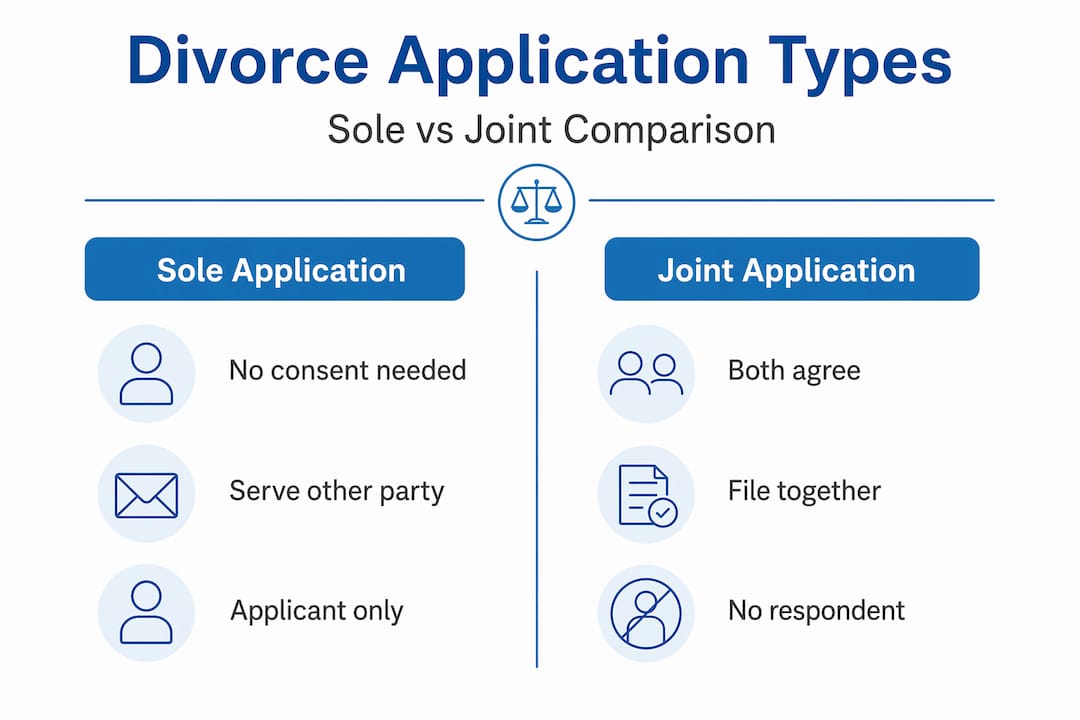
A sole application is appropriate when one spouse wants to proceed without the other’s co-operation, or when there is no communication between the parties. The applicant carries full responsibility for filing, serving documents, and attending court (where required). The respondent must be notified, but their agreement is not needed.
A joint application requires agreement from both parties to file together. Neither party is labelled applicant or respondent. Both sign the application, and in most cases, neither party needs to attend the court hearing. This can reduce stress and simplify the administrative burden.
| Factor | Sole application | Joint application |
|---|---|---|
| Other party’s consent needed to file | No | Yes |
| Court attendance required | Sometimes | Generally not required |
| Service of documents required | Yes | No |
| Labels assigned | Applicant and respondent | Both are co-applicants |
| Potential for conflict | Higher | Lower |
If you and your spouse are on reasonable terms and both want to resolve matters without unnecessary conflict, a joint application is often the more practical path. If there is hostility or a complete breakdown in communication, a sole application allows the process to move forward regardless.
What happens after you file
Filing the application is just the beginning. Here is what to expect once your documents have been submitted and accepted:
- Service on the respondent. For sole applications, you must arrange for a third party to personally serve the documents on the respondent within a set timeframe. Failure to serve correctly can delay or void the application.
- Respondent’s reply period. The respondent has 28 days (or 42 days if they are overseas) to file a response. Their options are to consent, not respond, or contest.
- Court hearing preparation. Review the hearing date carefully. If you are required to attend, prepare any relevant documents and confirm your identification. Most uncontested hearings are brief.
- Receiving the final order. After the judge grants the divorce, the order takes effect one month and one day later. You will receive a copy of the divorce order, which serves as official legal confirmation that the marriage has ended.
- Broader family law matters. Divorce does not automatically resolve property settlements, parenting arrangements, or spousal maintenance. These require separate applications or agreements. The broader implications of a divorce are covered in detail in family law in NSW.
Seeking legal advice at this stage is worth the investment. A divorce can have real financial and parenting consequences that are easy to overlook when focused solely on the application itself.
What most people miss about the divorce process
I have worked through many divorce matters, and the same pattern appears consistently. People focus intensely on the application form itself and assume that once it is filed, the difficult work is done. In reality, the application is the administrative beginning, not the end.
What I have seen catch people off guard is the service requirement. Many clients do not realise they cannot personally hand documents to their spouse. Arranging a third party, getting the affidavit completed correctly, and meeting the service deadline adds steps that feel unexpected at an already stressful time.
The other thing I have found is that the 12-month separation period surprises people in how strictly it is applied. The date must be accurate and, if disputed, defensible with evidence. Vague recollections of when things “fell apart” are not enough if the timeline is challenged.
My strongest advice is this: do not treat the divorce application process as something to handle entirely alone. The online portal makes it feel approachable, but the procedural and legal details matter. An error in paperwork or a missed service deadline can delay what is already a difficult process by weeks.
— Gaurav
How GKE Lawyers can support your application
Navigating a divorce application while managing the emotional weight of separation is genuinely hard. At GKE Lawyers, our Sydney family lawyers provide clear, practical support across every stage of the divorce application process, from preparing accurate paperwork to advising on court requirements and post-divorce arrangements.

Our team understands that divorce rarely exists in isolation. Property settlement, parenting plans, and financial agreements often need to be addressed at the same time. Whether you are filing as a sole applicant or jointly, our experienced divorce lawyers in Sydney can guide you through the process with confidence. Contact GKE Lawyers to book a consultation and get advice that is specific to your circumstances.
FAQ
What is a divorce application in Australia?
A divorce application is a formal court request to legally end a marriage under the Family Law Act 1975. The only ground for divorce in Australia is the irretrievable breakdown of the marriage, shown by 12 months of separation.
How do I file for divorce in NSW?
You file through the Commonwealth Courts Portal, completing the Divorce Civil Bill and any required supporting documents such as your marriage certificate and, where applicable, a statement regarding children’s welfare.
What documents do I need for a divorce application?
The core divorce paperwork requirements include the Divorce Civil Bill, your original or certified marriage certificate, and a Statement of Truth regarding children if any children under 18 are involved in the marriage.
Can I apply for divorce without my spouse’s agreement?
Yes. You can file a sole divorce application without your spouse’s consent. You must still serve them with the documents after the court accepts your application, but their agreement is not required to proceed.
How long does the divorce application process take?
After filing, the court assigns a hearing date, which typically falls several months later. Once the divorce order is granted, it takes effect one month and one day after the hearing, meaning the full process commonly takes four to six months from the date of filing.