
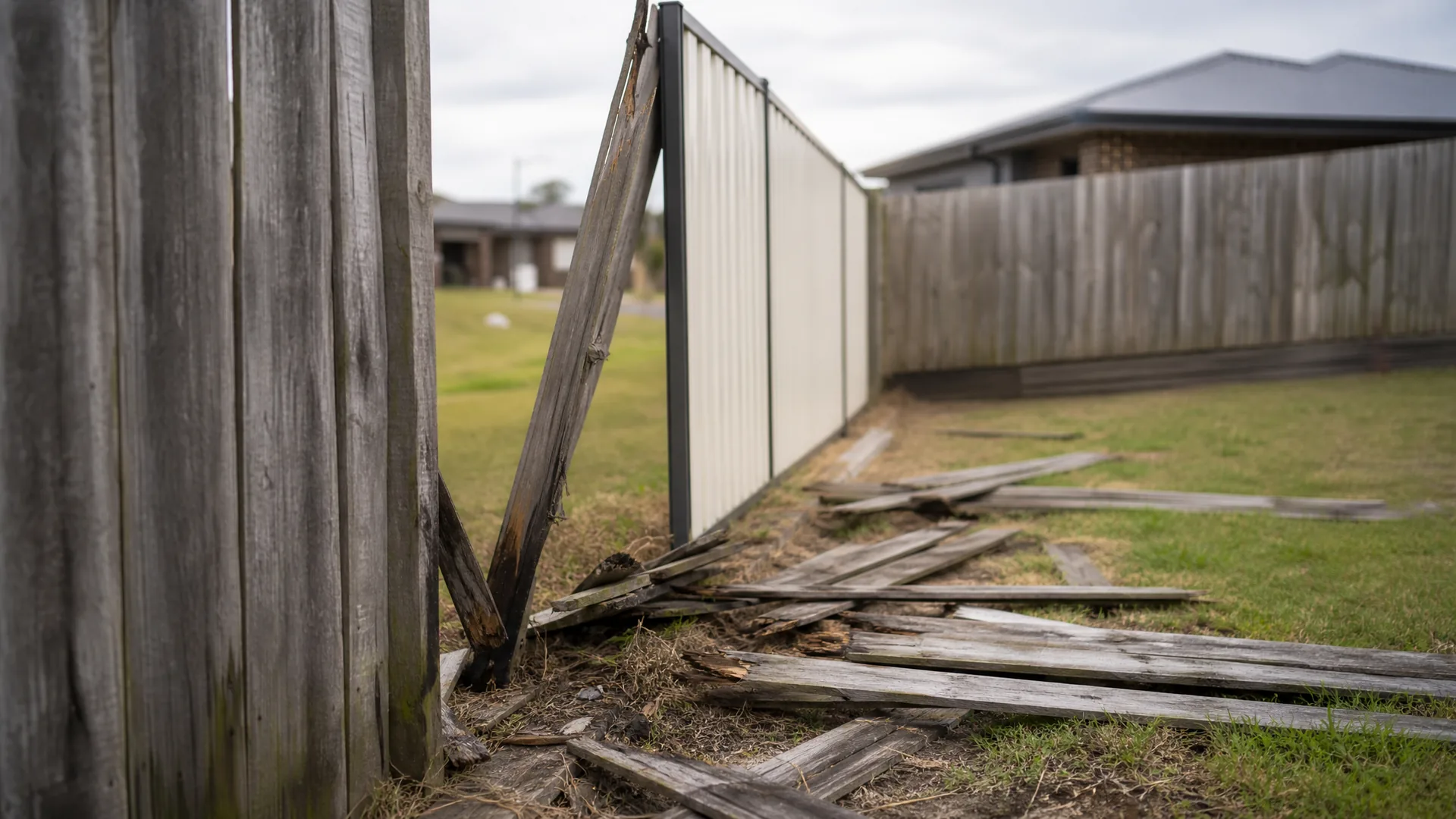
A neighbourhood fence dispute in NSW can feel like it comes out of nowhere, a storm brings down a paling, a neighbour wants Colorbond, or a boundary line gets questioned and suddenly nobody’s talking. NSW has a clear legal framework for exactly these situations. Knowing the rules before you send that first text message can save you months of stress and real money.
What the Dividing Fences Act NSW Actually Says
The Dividing Fences Act 1991 (NSW) has governed neighbour fencing obligations for over three decades. It sets equal cost-sharing as the default rule for adjoining landowners across the state. Understanding what falls inside, and outside, that framework matters before you do anything else.
The Act covers fences that divide two parcels of land. It does not cover retaining walls, boundary walls of buildings, or swimming pool fences built solely for one owner’s benefit. If your dispute is about a retaining wall rather than a true dividing fence, you’re in different legal territory.
What counts as a ‘sufficient’ dividing fence
The Act requires each neighbour to contribute to a fence that is “sufficient” for the needs of the land. What “sufficient” means depends on context, the locality, the land’s use, and any fencing already in place. A basic timber paling fence is typically sufficient for a suburban residential block. Something more elaborate may be appropriate on rural properties where livestock are involved.
You don’t have an automatic right to demand a premium fence at your neighbour’s expense. The Act sets the floor, not the ceiling.
Who is an ‘adjoining owner’ under the Act
An “adjoining owner” is the person who owns the land next to yours. That includes landlords, not tenants, when it comes to fencing obligations. If you’re renting and your fence is damaged, the responsibility sits with your landlord. If you’re a landlord dealing with a fence issue, this is your obligation to manage. Questions about tenant and landlord disputes in NSW often intersect with fencing responsibilities, so it’s worth being clear on who has standing to act.
Crown land and some local council land have modified obligations under the Act. If your fence adjoins a reserve or public land, the standard rules may not apply in full.
Splitting the Cost: Neighbour Fence Costs NSW Explained
The default rule is simple: adjoining owners share the cost of a sufficient dividing fence equally. That means 50/50 for materials, labour, and any reasonable preparation work like clearing vegetation along the boundary line.
Most neighbour fence cost disputes in NSW don’t arise because the rule is complicated. They arise because neighbours can’t agree on what “sufficient” looks like in their particular case.
When one neighbour wants a more expensive fence
This is one of the most common scenarios we see at GKE Lawyers. One owner wants a Colorbond fence; the other is happy with a basic timber paling. The Act handles this directly under section 10: the owner requesting the upgrade pays the difference above the sufficient fence standard. So if a paling fence costs $3,000 and a Colorbond fence costs $5,000, your neighbour contributes $1,500 (their half of the sufficient fence) and you cover the remaining $3,500.
That split needs to be agreed, or ordered, before work starts. Don’t assume your neighbour will just cop the extra cost.
Exceptions to the equal cost-sharing rule
Equal cost-sharing is the default, but it’s not absolute. A court or tribunal can shift the proportions where:
- One owner caused the damage requiring repair
- One owner’s land use (like keeping livestock) creates greater need for a particular fence
- A specific agreement between owners already exists
Existing contracts, subdivision covenants, and easements can also override the Act’s default rules. If you’re buying property in NSW and there’s a fence dispute in progress, check what obligations may transfer to you on settlement.
How to Start a Fence Dispute Resolution in NSW: The Notice Process
Fence dispute resolution in NSW almost always begins with a formal fencing notice. Skipping this step is one of the most common mistakes homeowners make, and at GKE Lawyers, we regularly advise clients who have done exactly that, only to find their position at NCAT is weakened and resolution is delayed by months.
A valid fencing notice must include:
- Your details, name and address
- The neighbour’s details, name and address
- The boundary line, a description of where the fence is to be built or repaired
- The type of fence proposed and the materials to be used
- The estimated cost and how you propose to split it
- A quote or estimate from a fencing contractor where possible
The notice must be served personally or by post. Email is not a recognised method of service under the Act, so don’t rely on it.
Your neighbour then has 30 days to respond. They can agree, propose a counter-notice with different terms, or do nothing. If they don’t respond within 30 days, or they refuse outright, you have the right to apply to NCAT or the Local Court for an order. You cannot simply proceed with the work and send them a bill. That approach almost never ends well and removes your legal leverage entirely.
Mediation Before Court: Your Best First Move
Before you file anything with a tribunal or court, consider mediation. It’s faster, cheaper, and, for most fence disputes, more likely to produce a workable outcome than litigation.
The reason is straightforward: you and your neighbour will still be neighbours after this is over. A tribunal order might resolve the legal question, but it won’t fix the relationship. Mediation gives both parties a chance to reach a deal they’ve actually agreed to, rather than one imposed on them.
Alternatives to going to court in NSW are almost always the right first step in a fencing dispute.
Using Community Justice Centres for fence disputes
Community Justice Centres in NSW offer free, voluntary mediation for neighbourhood disputes, including fence disagreements. The service is government-funded, impartial, and available across the state. Many disputes reach a resolution at this stage without any formal legal proceedings.
Both parties need to agree to participate. If your neighbour refuses mediation entirely, that doesn’t stop you from proceeding, it just means the next step is a formal application to NCAT or the Local Court. But attempting mediation first, and being able to demonstrate that to a tribunal, reflects well on your conduct and can influence how costs are handled.
When to Take a Property Boundary Dispute NSW to NCAT or Court
If mediation fails, or your neighbour simply won’t engage, formal proceedings become necessary. A property boundary dispute in NSW involving fencing obligations will typically go to one of two places: NCAT or the Local Court.
What NCAT can and cannot order
NCAT’s Consumer and Commercial Division handles most fencing disputes. It can order:
- That fencing work be carried out
- How costs are to be apportioned between neighbours
- A specific type of fence to be built
What NCAT cannot do is resolve an underlying title or boundary dispute. If the actual location of the boundary line is genuinely contested, meaning there’s a real disagreement about where your land ends and your neighbour’s begins, that requires the Land and Environment Court or the Supreme Court. Those proceedings are more expensive and more complex. Getting a surveyor’s report early can help clarify whether the boundary itself is the real issue.
When the Local Court is the right forum
The Local Court handles fencing matters where the amount in dispute exceeds NCAT’s general jurisdiction, or where the matter involves a debt claim, for example, where one owner has already paid for work and is seeking to recover the neighbour’s share. Local Court proceedings are more formal and legal representation becomes more important.
If your dispute has crossed into harassment, defamation, or other serious conduct, that’s a separate issue, and you may want to understand when neighbour disputes turn into something more serious before deciding on your approach.
Fence Liability NSW: Urgent Repairs, Dangerous Fences, and Shared Risk
Fence liability questions in NSW often come up after unexpected events, a storm brings down a section of fence, a tree falls across the boundary, or a fence becomes genuinely dangerous to people or animals.
The Act allows an owner to carry out urgent repairs without the usual notice process where the fence is dangerous or needs immediate attention. If you do carry out urgent repairs without notice, you must notify your neighbour as soon as practicable after the work is done and provide an account of the costs. You can then seek to recover half the reasonable cost.
When a storm or falling tree damages a dividing fence, neither neighbour is automatically at fault, and the cost is still shared equally in most cases. However, if a tree from your neighbour’s property caused the damage and they had been warned about it, their liability may be greater. Document everything: photograph the damage before repairs begin, keep all quotes and invoices, and note the date and circumstances.
Where a fence poses a safety risk, say, it’s leaning dangerously toward a footpath or is adjacent to a property where children are present, don’t wait for the notice process to resolve. Act on the safety issue first, notify your neighbour in writing immediately, and deal with the cost-sharing question afterwards. Concerns about animal injury liability on your property can also come into play where fencing gaps create a risk of animals straying or entering.
If you’ve reached an impasse with your neighbour, or you’re not sure whether your fencing notice is valid before you send it, getting clear advice early makes a real difference. At GKE Lawyers, we offer plain-English, fixed-fee consultations so you know exactly where you stand before the dispute escalates to NCAT or court. Get in touch today.