

If you believe a healthcare provider’s failure caused you harm, understanding your rights is the first step toward pursuing justice. This medical negligence claim NSW guide walks you through eligibility, the claims process, compensation types, and practical tips specific to New South Wales. Many residents feel overwhelmed by where to begin, uncertain about time limits, and unsure what evidence is needed. The process does not have to be confusing. With the right preparation and legal support, you can take a clear, confident path toward the outcome you deserve.
Table of Contents
- Key takeaways
- Eligibility for a medical negligence claim in NSW
- How to file a medical negligence claim in NSW
- Types of compensation available in NSW
- Avoiding common mistakes in your claim
- My perspective on pursuing medical negligence claims
- How GKE Lawyers can support your claim
- FAQ
Key takeaways
| Point | Details |
|---|---|
| Three-year time limit applies | You generally have three years from when you became aware of your injury to file a claim in NSW. |
| Evidence is everything | Medical records, expert reports, and treatment histories are the foundation of a successful claim. |
| Compensation covers multiple losses | You may claim for lost income, medical expenses, pain and suffering, and future care costs. |
| Most claims settle out of court | Many medical negligence matters resolve through negotiation before reaching a formal trial. |
| Legal support matters | Working with an experienced personal injury lawyer significantly improves your claim outcome. |
Eligibility for a medical negligence claim in NSW
Before you can pursue a claim, you need to understand whether your situation meets the legal threshold for medical negligence in New South Wales. Not every negative medical outcome qualifies. The law requires you to demonstrate that a healthcare provider owed you a duty of care, that they breached that duty by falling below an accepted standard of practice, and that the breach directly caused your harm.
Who can file a claim?
Most people harmed during medical treatment in NSW can potentially file a claim. This includes patients treated by doctors, surgeons, nurses, dentists, pharmacists, and hospitals. In some circumstances, a family member may file on behalf of a deceased person or a child. The key requirement is that you suffered measurable harm as a direct result of substandard care.
Time limits you must know
Time is one of the most critical factors in any medical negligence matter. Under the Limitation Act 1969 (NSW), most claims must be commenced within three years of when you became aware of the injury. This is not necessarily the date of the medical treatment itself. If you only discovered the harm months or years later, the clock typically starts from that point of awareness. Courts do have discretion to extend time limits in limited circumstances, but relying on that is risky.
What documents do you need?
Comprehensive documentation strengthens your claim from the outset. You should gather:
- Complete medical records from all treating practitioners
- Hospital discharge summaries and treatment notes
- Specialist reports and referral letters
- Photographs of injuries where applicable
- Personal diary entries documenting symptoms, appointments, and impacts on daily life
- Receipts for out-of-pocket medical expenses
Independent expert medical opinions are particularly powerful. Courts in NSW give significant weight to evidence from qualified specialists who can confirm that the care you received fell below an accepted professional standard.
Pro Tip: Request your complete medical records early. Hospitals and practitioners are legally required to provide them, but processing can take several weeks. Starting this process promptly avoids unnecessary delays down the track.

How to file a medical negligence claim in NSW
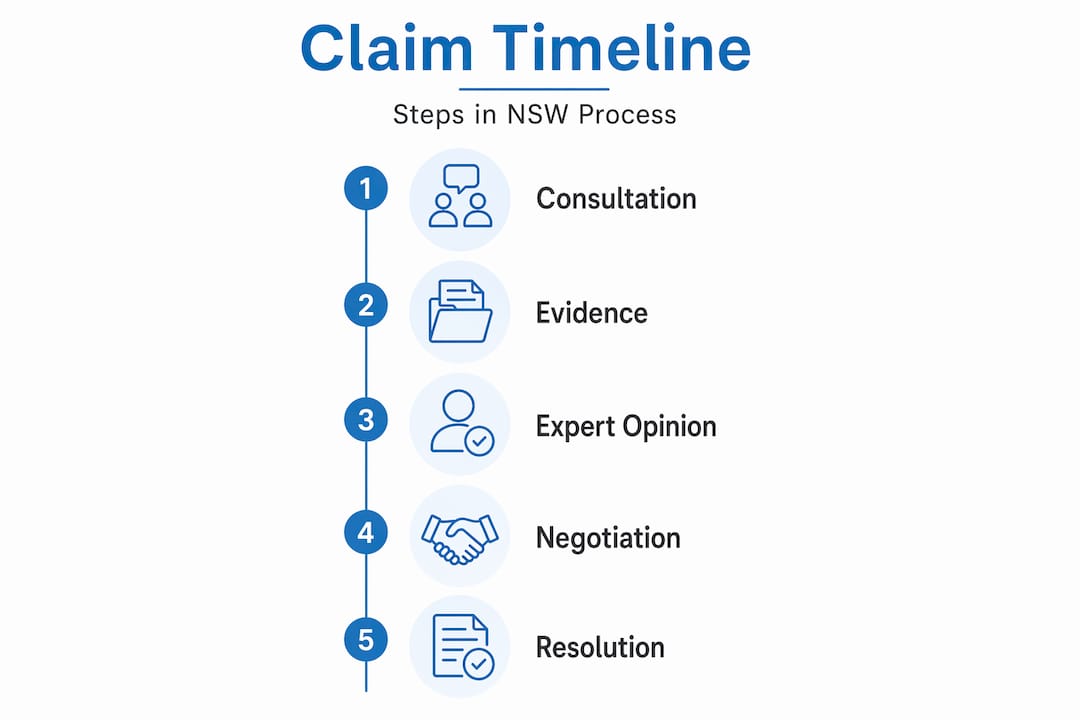
Once you have confirmed your eligibility, the claims process follows a structured sequence. Understanding each stage helps you stay prepared and reduces stress throughout what can be a lengthy process.
Initial legal consultation. Contact a personal injury lawyer experienced in medical negligence. They will assess the merits of your case, identify the relevant defendant, and advise on your realistic prospects. Many solicitors offer an initial consultation at no cost.
Evidence gathering and expert review. Your lawyer will obtain your medical records and engage independent medical experts to review the treatment you received. Expert medical opinions are central to establishing that the standard of care was breached. This stage can take several months depending on the complexity of your case.
Pre-litigation steps. In NSW, there are mandatory pre-litigation requirements under the Civil Liability Act 2002 for personal injury claims. You and the defendant are expected to exchange relevant information before proceedings are formally commenced. This often includes a letter of claim, supporting evidence, and a response from the defendant.
Filing in court. If the matter does not resolve pre-litigation, your lawyer will file proceedings in the appropriate NSW court. The court selected depends on the quantum of the claim. The District Court handles mid-range claims, while larger, more complex matters proceed to the Supreme Court.
Negotiation and mediation. Most matters do not proceed all the way to trial. Legal negotiations often resolve claims outside court, saving time and cost for both parties. Mediation is frequently used to facilitate a settlement agreement with the assistance of a neutral third party.
Trial, if necessary. If negotiations fail, the matter proceeds to a hearing where a judge determines liability and compensation. Trials are time-consuming and costly, but sometimes they are the only path to a fair outcome.
Typical timeframes for each stage
| Stage | Approximate timeframe |
|---|---|
| Initial consultation and case assessment | 1 to 4 weeks |
| Evidence gathering and expert reports | 3 to 9 months |
| Pre-litigation exchange | 1 to 3 months |
| Negotiation and mediation | 1 to 6 months |
| Trial (if required) | 6 to 18 months additional |
Pro Tip: Keep a running document of every medical appointment, symptom change, and financial cost from the moment you suspect negligence. Early attention to worsening symptoms can directly affect both the outcome of your treatment and the strength of your legal claim.
Types of compensation available in NSW
Understanding what you can recover financially helps you set realistic expectations and make informed decisions. Damages in medical negligence claims fall into two broad categories: economic loss and non-economic loss.
Economic damages cover the financial costs directly caused by the negligence. These include:
- Past and future medical expenses, including specialist treatment, rehabilitation, and medications
- Lost income and reduced earning capacity if the injury has affected your ability to work
- Future care costs if you require ongoing assistance with daily activities
Non-economic damages compensate for the personal impact of the injury. Under the Civil Liability Act 2002 (NSW), there is a statutory threshold and cap that applies to non-economic loss claims. Pain and suffering, loss of enjoyment of life, and psychological harm all fall into this category. Your compensation amount under this head depends on the severity of your impairment compared to the most extreme case, which is assessed as a percentage.
Factors that affect your compensation amount
Several factors can reduce the compensation you receive. Contributory negligence applies where you are found to have partially contributed to your own harm, such as failing to follow medical advice. Pre-existing conditions are also assessed carefully. Insurers and defendants will argue that some of your current condition stems from issues that existed before the negligent treatment.
Private health insurance and Medicare may have already covered some of your treatment costs. In those cases, Medicare and your insurer may have a right to recover those payments from your compensation. Your lawyer will account for these obligations during negotiations so you understand your net position.
Patients who experience a delayed diagnosis may face more invasive treatment as a result, which can directly increase the damages awarded. The more serious the downstream consequences of the negligence, the broader the range of losses you may claim.
Avoiding common mistakes in your claim
Even strong claims can be undermined by avoidable errors. Knowing what goes wrong for other claimants helps you stay on the right path.
Many claimants fail because they miss the limitation period or submit insufficient supporting evidence. These are not minor procedural issues. They can end an otherwise valid claim entirely.
Other common mistakes include:
- Waiting too long to seek legal advice, reducing the time available to build a strong case
- Failing to keep organised records of medical appointments, symptoms, and costs
- Accepting an early settlement offer without fully understanding the long-term costs of your injury
- Attempting to manage the claim without legal support, particularly when dealing with experienced insurers or hospital legal teams
- Underestimating the complexity of proving causation, which requires clear links between the breach and the specific harm suffered
Choosing the right legal support makes a real difference. Legal specialists provide clarity on eligibility, help gather evidence, and negotiate with insurers or defendants in a way that maximises your outcome. Look for a firm with direct experience in medical negligence, not just general personal injury. Ask how many similar matters they have handled and what their process looks like for your specific situation.
Pro Tip: Do not provide recorded statements to insurers or hospital representatives without speaking to your lawyer first. What you say in those early conversations can be used to limit your compensation later.
My perspective on pursuing medical negligence claims
In my experience working with clients who have been harmed through substandard medical care, the biggest obstacle is rarely the legal process itself. It is the delay. People often spend months, sometimes years, questioning whether what happened to them was really negligence or just an unfortunate outcome. That self-doubt costs them time they cannot recover.
What I have found is that acting early, even just to get an honest assessment from a lawyer, changes the trajectory of a claim. The NSW medical claim process is procedural and requires careful preparation, but the foundation of every successful claim is evidence gathered while memories are fresh and records are complete.
I also think the emotional dimension is underappreciated. Pursuing a claim is not just about financial recovery. For most people, it is about accountability. Understanding what went wrong and why. That purpose gives clients the resilience to see a matter through, especially when negotiations take longer than expected. My advice is always the same: document everything, act before the limitation period closes, and work with someone who genuinely specialises in this area of law.
— Gaurav
How GKE Lawyers can support your claim

If you are considering a medical negligence claim in NSW, GKE Lawyers is here to help. Our team includes experienced personal injury lawyers who understand the specific requirements of medical negligence matters in New South Wales. We assist clients at every stage of the process, from the initial case assessment through to negotiation and, where necessary, litigation. We can also help you understand your rights under NSW’s civil liability framework and advise you on documentation, time limits, and realistic compensation outcomes. Contact GKE Lawyers today to arrange a consultation and get clear, direct advice on your situation.
FAQ
How long do I have to make a medical negligence claim in NSW?
You generally have three years from the date you became aware of the injury to commence a claim under the Limitation Act 1969 (NSW). Acting promptly protects your rights and preserves the quality of your evidence.
What is the difference between economic and non-economic damages?
Economic damages cover measurable financial losses such as medical costs and lost income, while non-economic damages compensate for pain, suffering, and loss of enjoyment of life. Both may be available in a medical negligence claim, subject to statutory thresholds in NSW.
Do most medical negligence claims go to court?
No. Many claims in NSW resolve through negotiation or mediation before reaching a formal trial. However, if the parties cannot agree on liability or compensation, a court hearing may be required to determine the outcome.
What evidence do I need to support my claim?
You will need medical records, hospital discharge summaries, specialist reports, and an independent expert opinion confirming that the standard of care was breached. Personal records documenting symptoms and expenses also strengthen your case considerably.
Can a pre-existing condition affect my compensation?
Yes. If you had a pre-existing condition, defendants and insurers will argue that part of your current harm is attributable to that condition rather than the negligence. Your lawyer will work to distinguish the injury caused by the negligent treatment from any pre-existing health issues.