

If you are considering buying property in NSW, understanding what is a leasehold property NSW context requires matters far more than most buyers realise. Leasehold, known formally as a leasehold interest or leasehold estate, is a legal arrangement where you hold a time-limited right to occupy and use property while ownership of the land remains with another party. It operates very differently from the freehold title most NSW buyers are familiar with, and the distinctions carry real financial and legal consequences. This guide covers what leasehold means, how it is legally structured in NSW, and what you need to know before committing.
Table of Contents
- Key takeaways
- What is a leasehold property in NSW?
- Legal framework for leasehold interests in NSW
- Leasehold vs freehold: a direct comparison
- Practical implications for leasehold buyers
- My perspective on leasehold decisions in NSW
- How GKE Lawyers can assist with your leasehold transaction
- FAQ
Key takeaways
| Point | Details |
|---|---|
| Leasehold is time-limited | You hold a right to occupy, not own the land; the lease typically runs between 20 and 99 years. |
| Registration protects your rights | Leases over three years must be registered under the Real Property Act 1900 to be enforceable against third parties. |
| Freehold and leasehold differ fundamentally | Freehold gives indefinite land ownership; leasehold is a temporary, conditional interest with ongoing obligations. |
| Ongoing costs apply | Ground rent and site fees are standard in leasehold arrangements, affecting long-term affordability. |
| Legal due diligence is non-negotiable | Title documentation and lease registration status must be checked before any leasehold purchase. |
What is a leasehold property in NSW?
At its core, a leasehold property is one where the occupier holds a legal interest in the property for a defined period, but does not own the underlying land. The leasehold property definition describes it as a time-limited right to occupy and use property, with land ownership remaining with the freeholder or Crown. In NSW, lease periods commonly range from 20 to 99 years, with ongoing obligations such as ground rent attached.
The lease agreement itself is the foundation of your rights. It specifies what you can and cannot do with the property, whether you can make alterations, how the site is to be used, and what fees apply. Treating the lease document as part of the asset you are acquiring is the right approach, because your entitlements are only as strong as what that agreement contains.
Key features of leasehold properties in NSW include:
- Time-limited tenure. Your right to occupy expires at the end of the lease term unless renewed or extended.
- Land ownership stays with another party. The freeholder or Crown retains title; you hold a registered interest, not ownership.
- Ground rent or site fees. Ongoing payments are common and can affect your financial planning significantly.
- Use restrictions. The lease typically limits alterations, sub-leasing, and the purposes for which you can use the property.
- Registered interest under the Torrens system. Your legal protections depend on the lease being properly registered with NSW Land Registry Services.
Pro Tip: Never assume a property is freehold based on appearance alone. Leasehold status is confirmed through title documentation, not a physical inspection of the site.
The difference between leasehold and freehold is not subtle. Freehold ownership is indefinite and gives you full control over both the land and any buildings on it, subject to planning laws. Most NSW residential properties are held as freehold under the Torrens title system. Leasehold, by contrast, is conditional, time-bound, and subject to the terms set by whoever owns the land.
Legal framework for leasehold interests in NSW
Understanding how leasehold works in NSW legally is not optional for buyers. The rights you hold, and how well they are protected, depend on compliance with specific statutory requirements.

The governing legislation is the Real Property Act 1900 (NSW). Under section 53, leases exceeding three years must be registered to pass a legal interest enforceable against third parties. This requirement is non-negotiable. A lease that is not properly registered may still be valid between the parties who signed it, but it will not bind a subsequent purchaser of the land.
Here is what the registration process involves in NSW:
- Lodging the lease at NSW Land Registry Services. The lease must be in the approved form prescribed by the Registrar-General.
- Creating a leasehold estate folio. Once registered, the lease is recorded in its own folio under the Torrens system, giving it the same protections that apply to freehold title.
- Confirming the registration status before settlement. A title search will reveal whether the lease has been registered and under what terms.
- Checking encumbrances and conditions. Other interests affecting the leasehold, such as mortgages or caveats, will appear on the title and must be reviewed carefully.
“Legal enforceability of lease rights in NSW depends on registration and adherence to statutory requirements. Registration protects the lessee’s rights against third parties, a crucial factor in conveyancing.” — Registrar General’s Guidelines
If you are buying a property in Sydney or elsewhere in NSW and the title is leasehold, confirming registration status before exchange of contracts is one of the most protective steps you can take. Buyers who skip this step can find themselves holding an unregistered interest with limited recourse.
Leasehold vs freehold: a direct comparison
The leasehold vs freehold NSW property distinction is where many buyers experience genuine confusion. Both confer a legal right to use property, but the nature, duration, and security of those rights differ substantially.
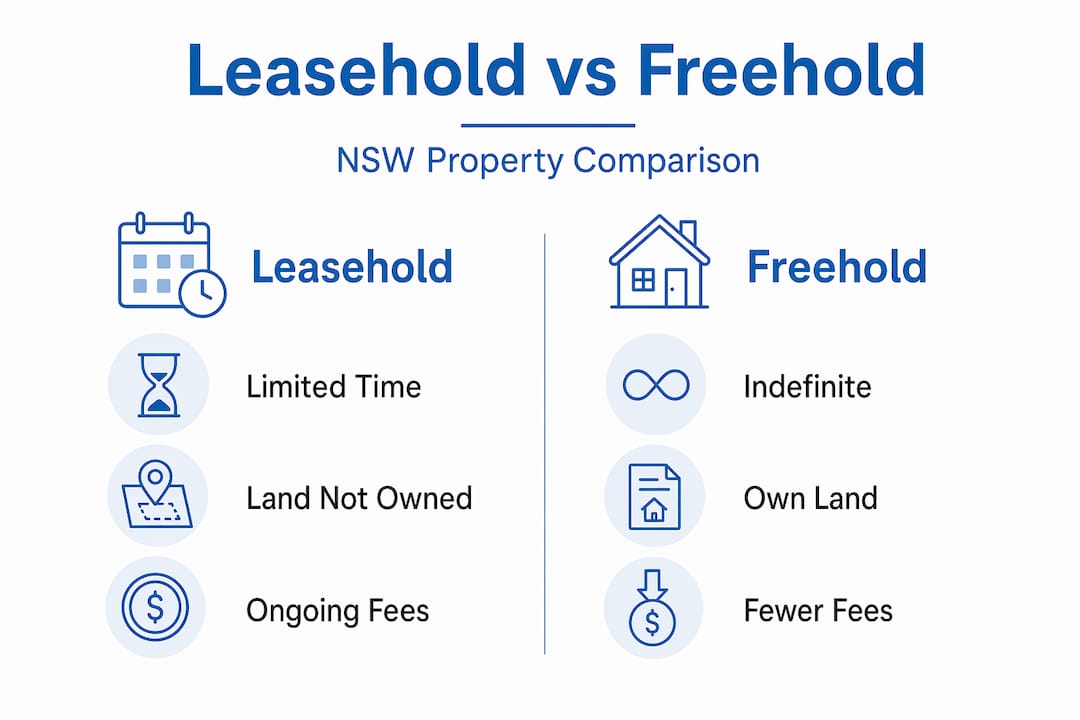
| Feature | Leasehold | Freehold |
|---|---|---|
| Ownership of land | Remains with freeholder or Crown | Vested in the buyer on settlement |
| Duration | Fixed term, typically 20 to 99 years | Indefinite |
| Ongoing costs | Ground rent, site fees, service charges | Council rates, strata levies if applicable |
| Control over property | Subject to lease conditions and restrictions | Full control, subject to planning laws |
| Resale considerations | Value affected by remaining lease term | Not subject to lease term expiry |
| Common examples in NSW | Land lease communities, Crown land leases | Standard residential and commercial title |
One common misconception is that buying into a land lease community is equivalent to buying a freehold home. It is not. In those communities, you own the dwelling but lease the land it sits on from the community operator. That distinction changes your rights in ways that are not always obvious at first glance.
Crown land leases present a related scenario. Buying a Crown land lease means acquiring the improvements on the land, not the land itself. The Crown retains title under the Crown Land Management Act 2016, and your lease grants permission to exclusively occupy the land for a set purpose and term. When that term expires, your rights revert to the Crown unless the lease is renewed.
Pro Tip: If you are comparing a leasehold property against a freehold alternative at a similar price, factor in the cost of ongoing ground rent, the number of years remaining on the lease, and any restrictions on modification or resale. These costs and limitations affect the real long-term value of what you are acquiring.
Practical implications for leasehold buyers
Buying leasehold in NSW is not inherently a poor decision, but it requires clear-eyed assessment of the financial and practical realities involved.
Financial obligations. Ground rent and site fees are standard in leasehold arrangements, particularly in land lease communities. These fees can change over time and need to be factored into your long-term budget. For some buyers considering ongoing costs like land tax, leasehold arrangements may affect how obligations are calculated and attributed.
Restrictions on use and modification. Most leases include clauses that limit what you can do with the property. Structural renovations, sub-leasing, and even cosmetic changes may require the landholder’s consent. Breaching these conditions can have serious consequences, including termination of the lease.
Lease expiry risk. A leasehold’s finite tenure means your rights revert to the landowner when the lease ends unless you successfully negotiate a renewal. As the expiry date approaches, the property’s market value typically declines, which affects both your ability to sell and your capacity to use the property as security for finance.
Before purchasing, conduct thorough due diligence:
- Obtain a full title search and confirm the lease is registered with NSW Land Registry Services.
- Review the lease terms carefully, including any rent review clauses, permitted use conditions, and renewal options.
- Check leasehold interests in title documentation to confirm status and any encumbrances.
- Seek independent legal advice before exchanging contracts, particularly if the lease term is shorter than 40 years.
- Understand your rights under any applicable legislation, such as the Residential (Land Lease) Communities Act 2013 for land lease community residents.
Legal checks before buying commercial property follow similar principles to residential leasehold due diligence, and the same rigour should apply regardless of property type.
My perspective on leasehold decisions in NSW
In my experience advising NSW clients on property transactions, leasehold arrangements are consistently the area where buyers are least prepared. People walk into a land lease community purchase assuming that because they own the dwelling, they have the same security as a freehold owner. They do not, and the gap between those two positions can be significant when it comes to financing, selling, or dealing with a dispute.
What I have seen repeatedly is that buyers focus heavily on the purchase price and the physical condition of the property, while underweighting the lease terms. A 30-year lease on a residential property may look appealing today, but a property with 15 years remaining is harder to sell, harder to finance, and harder to negotiate a renewal on from a position of strength.
The registration question is also one most buyers miss entirely. I have reviewed transactions where the lease had never been formally registered, leaving the purchaser with a contractual right but no guarantee of protection against a third-party claim on the land. Under NSW’s Torrens system, unregistered interests are vulnerable. That is not a technicality. That is a real risk with real consequences.
My position is straightforward. Leasehold property can work well for the right buyer in the right circumstances. But it demands more scrutiny, not less, than a freehold purchase. Get legal advice early, read the lease document thoroughly, and do not rely on representations from the vendor or their agent about what the lease allows.
— Gaurav
How GKE Lawyers can assist with your leasehold transaction
Leasehold property transactions in NSW involve layered legal obligations that go well beyond a standard conveyancing matter. At GKE Lawyers, our property law and conveyancing team works with buyers, investors, and residents to review lease terms, verify registration status, identify risks, and protect your interests before and after settlement. Whether you are purchasing in a land lease community, acquiring a Crown land lease, or dealing with a leasehold dispute, we provide the legal clarity you need to move forward with confidence. For specialist conveyancing advice tailored to leasehold property in NSW, contact GKE Lawyers today to book a consultation.
FAQ
What does leasehold property mean in NSW?
A leasehold property in NSW is one where you hold a time-limited legal interest to occupy and use the property, while ownership of the land remains with the freeholder or Crown. Lease terms typically range from 20 to 99 years.
Does a leasehold property need to be registered in NSW?
Yes. Under section 53 of the Real Property Act 1900, any lease exceeding three years must be registered with NSW Land Registry Services to be legally enforceable against third parties.
What is the main difference between leasehold and freehold in NSW?
Freehold gives you indefinite ownership of the land and property. Leasehold gives you a right to occupy for a fixed term only, with ongoing obligations and restrictions set out in the lease agreement.
Can I buy a home in a land lease community in NSW?
Yes. In a residential land lease community, you purchase the dwelling but lease the land from the community operator and pay ongoing site fees. Your rights are governed by the Residential (Land Lease) Communities Act 2013.
How do I check if a property in NSW is leasehold?
You can confirm tenure type by conducting a title search through NSW Land Registry Services. Physical inspection alone is not a reliable indicator. A property solicitor can review the title documentation and advise you on the nature of the interest.