

When a relationship breaks down, many Australians assume that a written agreement between two parties is legally binding. It is not. Understanding what is a consent order in family law is one of the most practically important things you can do to protect your rights. A consent order is a court-approved written agreement that carries the same legal force as an order made after a full court hearing. This article explains what consent orders cover, how the application process works, recent procedural changes, and what to watch out for before you file.
Table of Contents
- Key takeaways
- What is a consent order in family law?
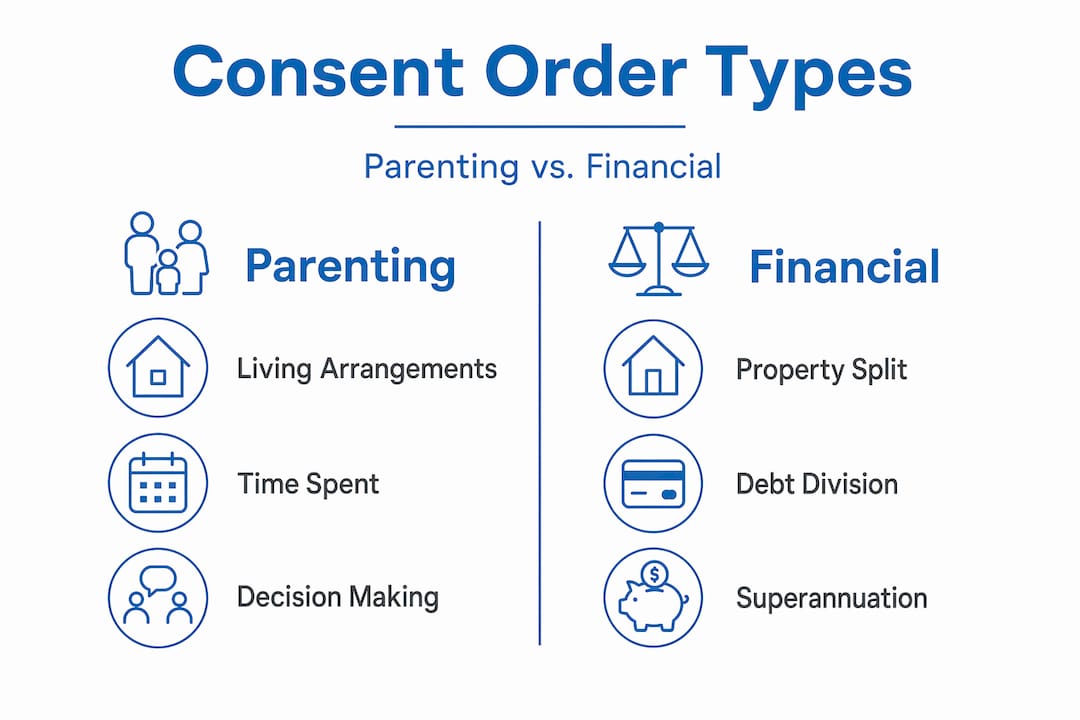
- Types of consent orders: parenting and financial
- How to apply for consent orders
- Common pitfalls to avoid
- Preparing your application and what comes next
- My perspective on consent orders and why precision matters
- How GKE Lawyers can assist with your consent orders
- FAQ
Key takeaways
| Point | Details |
|---|---|
| Consent orders are court-approved | An agreement only becomes legally enforceable once the court formally approves it as an order. |
| Two types of orders exist | Consent orders cover either parenting arrangements or property and financial matters, but not child support. |
| Court standards must be met | The court checks that parenting orders serve the children’s best interests and financial orders are just and equitable. |
| New filing rules apply from 2025 | Applications must now include both a signed PDF and an unsigned Word document of proposed orders. |
| Non-compliance has legal consequences | A party who breaches a consent order can face enforcement action through the family courts. |
What is a consent order in family law?
A consent order is a written agreement between parties to a family law dispute that is submitted to and approved by a court. Once approved, it has the same effect as any other court order made after a contested hearing. That distinction matters enormously. An informal agreement, regardless of how carefully it is drafted or sincerely it is intended, is not enforceable in the same way.
The formal term used in Australian family law practice is “consent order,” and you will see it referred to throughout the Federal Circuit and Family Court of Australia’s (FCFCOA) procedures and forms. The definition of consent order in this context means the court is not simply rubber-stamping what two people have agreed. It actively reviews the proposed terms to confirm they meet the legal standards that apply to each type of order.
For parenting arrangements, the court assesses whether orders are in the best interests of the children. For property and financial matters, the standard is whether the orders are just and equitable. The court will not approve an agreement that fails either test, even if both parties are in complete agreement.
There are a few practical points worth understanding about scope:
- Consent orders can address parenting arrangements, property division, spousal maintenance, and superannuation splitting
- They cannot include child support or ongoing child expenses, which are handled through the child support system
- They apply to both married couples and de facto partners in most Australian states and territories, including NSW
Pro Tip: Do not confuse a parenting plan with a parenting consent order. A parenting plan is a written agreement between parents that is not filed with or approved by the court. It has no court-enforced legal standing, meaning if one party stops following it, your options are limited.
Types of consent orders: parenting and financial
The two broad categories of consent orders serve quite different purposes, and it helps to understand what each one can and cannot include.
Parenting consent orders
These orders formalise the arrangements for children after separation. The parenting content can include who the children live with, how much time they spend with each parent, how parental responsibility is shared, and details about contact with other significant people such as grandparents.

The level of detail in a parenting order matters. Vague terms like “reasonable time” create room for disagreement later. A well-drafted parenting order will specify school holiday arrangements, handover logistics, communication protocols, and how disputes about the order will be managed.
Courts place particular emphasis on the child’s welfare when reviewing these orders. Research into co-parenting dynamics shows that conflict between parents directly affects children’s wellbeing, which is exactly why the court scrutinises parenting orders rather than approving them automatically.
Property and financial consent orders
These orders deal with how assets and liabilities are divided after separation. The table below outlines what each type typically covers.
| Type of order | What it can include |
|---|---|
| Property division | Transfer of real estate, motor vehicles, shares, bank accounts, and other assets |
| Spousal maintenance | Regular payments from one party to support the other after separation |
| Superannuation splitting | Splitting of superannuation entitlements between parties |
| Debt allocation | How mortgages, credit cards, and other liabilities are divided |
One area that confuses many families is child support. It cannot be included in a consent order. Even if both parties agree to a specific child support amount, that arrangement must go through the child support system or be formalised through a separate binding child support agreement. Attempting to include it in a consent order will result in those provisions being rejected.
For advice specific to property matters in NSW, the guidance on NSW property settlement rights explains how to protect your entitlements through the consent order process.
How to apply for consent orders
Applying for consent orders in Australia involves submitting an application to the Federal Circuit and Family Court. The process is not simply sending in a written agreement. There are specific procedural requirements, and getting them right avoids delays.
Here is a step-by-step overview of how the process works:
- Reach agreement with the other party. Both parties must agree on the proposed terms before an application is lodged. The court does not mediate disagreements during the consent order process.
- Draft the proposed orders. The proposed orders must be written in precise legal language. This is where professional drafting assistance makes a significant difference.
- Complete the application forms. You will need to fill out the Application for Consent Orders along with the relevant financial or parenting statements, depending on the type of order sought.
- Lodge the documents with the court. As of 31 October 2025, applications must include both a signed PDF version and an unsigned Word document of the proposed orders. This is a hard requirement, and applications that do not comply will be rejected or delayed.
- Wait for court review. A registrar reviews the application without a hearing in most cases. If more information is needed, the court will issue a requisition requesting clarification or additional documents.
- Receive the sealed orders. Once approved, the court seals the orders and sends them to the parties. The orders are then legally binding.
Processing times typically run between four and five weeks from the date of lodgement, though this can extend to six to eight weeks if a requisition is issued. Responding to requisitions quickly is one of the most effective ways to prevent delays.
Pro Tip: The 2025 document requirements introduced new items specifically for parenting orders by consent. If you are filing parenting orders, review the updated FCFCOA guidelines carefully before lodging, or ask a family lawyer to confirm your documents comply.
Common pitfalls to avoid
Many applicants approach the consent order process with misunderstandings that cause avoidable problems. Understanding these pitfalls before you apply saves time and money.
- Assuming agreement equals enforceability. The single most common mistake is believing that because both parties have signed a document, it is automatically a legally enforceable order. Court approval is not a formality. The court actively assesses suitability, and applications that do not meet the required standards will be rejected.
- Including child support provisions. As noted above, child support and child expenses cannot be part of a consent order. Many families discover this only after drafting detailed financial terms, requiring a complete redraft.
- Vague or ambiguous drafting. Precise drafting is not a nicety. It is what makes the order enforceable. If the terms are unclear, enforcement becomes complicated and potentially ineffective.
- Incomplete applications. Missing a required document, failing to include the correct version of the proposed orders, or lodging a statement outside the 90-day timeframe will all trigger a requisition or rejection.
- Underestimating the consequences of non-compliance. Once consent orders are made, breaching them is a serious matter. The other party can apply to the court for enforcement orders, contravention orders, or in severe cases, seek penalties.
A consent order is not the end of a process. It is the legal framework that governs arrangements going forward. Treating it as anything less than a binding court order is a mistake with real consequences.
Information about family law disputes in NSW can also help you understand the broader context in which consent orders arise and how they relate to contested proceedings.
Preparing your application and what comes next
Before you lodge an application, a few practical steps will put you in a stronger position.
- Reach clear, specific agreement on every term with the other party before drafting anything. Disagreements that surface mid-drafting cause significant delays.
- Confirm that all proposed terms fall within the scope of consent orders. Identify anything that needs to be handled separately, such as child support.
- Have the documents reviewed for legal compliance, particularly to confirm that the drafting meets the precision standard courts expect.
- Check that signatures are correct, that you have both required document versions (signed PDF and unsigned Word document), and that all statements are lodged within the required 90-day period.
- After the orders are made, store sealed copies securely. Both parties should retain a copy. If circumstances change significantly over time, such as a relocation or change in a child’s schooling needs, you can apply to vary the orders.
Enforcement follows a clear path if one party does not comply. The affected party can apply to the court for a contravention order, and the court has a range of responses available depending on the seriousness of the breach. Understanding your rights and obligations under the NSW family law framework helps you act quickly and correctly if a problem arises.
My perspective on consent orders and why precision matters
I’ve worked with clients on family law consent order applications long enough to notice a clear pattern. The applications that run smoothly are almost always the ones where someone invested proper time upfront in getting the drafting right. The ones that cause months of frustration are usually the ones where parties assumed the hard part was reaching agreement, not writing it down correctly.
In my experience, the most underestimated part of the consent order process is document precision. I’ve seen applications where terms like “the parties will share school pick-up” appeared in parenting orders. That kind of language is not enforceable. Enforcing an order requires clarity about who does what, when, and under what conditions.
The 2025 procedural changes to document filing requirements reflect a court system that is becoming more systematic about compliance. That is a good development for parties who want certainty. But it also raises the bar for self-represented applicants, because a technically non-compliant application will not be waved through.
What I find encouraging is that clients who come in with a clear understanding of what they want to achieve, and who are willing to engage properly with the process, almost always get a good outcome. The court is not an adversary in the consent order process. It is a mechanism for turning agreement into legal certainty. Approaching it with that mindset, and with proper preparation, makes all the difference.
— Gaurav
How GKE Lawyers can assist with your consent orders

Consent order applications involve procedural requirements that are easy to get wrong without legal guidance, and errors cause delays that add stress to an already difficult period. GKE Lawyers’ family law team in Sydney works with clients across NSW on consent order applications covering both parenting arrangements and property and financial matters. We review proposed terms for legal precision, prepare documents to meet current court requirements, and guide you through each step of the process. If you are ready to formalise your family law arrangements with confidence, contact GKE Lawyers for a consultation.
FAQ
What is the difference between a consent order and a parenting plan?
A parenting plan is a written agreement between parents that is not approved by any court and carries no formal enforcement mechanism. A consent order is approved by the court and is legally binding, meaning breaches can be enforced through court proceedings.
Can consent orders include child support payments?
No. Child support cannot be included in a consent order. Child support arrangements must be made through the Services Australia child support system or through a separate binding child support agreement.
How long does it take to get consent orders approved?
Processing typically takes four to five weeks, but this can extend to six to eight weeks if the court issues a requisition requesting additional information or clarification.
What happens if someone breaches a consent order?
A breach of a consent order is a serious legal matter. The affected party can apply to the court for contravention orders, and the court can impose a range of consequences depending on how serious the breach is.
Do both parties need to agree before applying for consent orders?
Yes. Consent orders require genuine agreement between both parties. If you cannot reach agreement, the appropriate path is to file a contested application, where the court will hear evidence and decide the outcome.